
Islas Galapagos from Puerto Ayora’s shore
Published on 09/04/2026 at 21:44 | Editorial responsibility: Rafael Müller, Editor-in-Chief AD HOC NEWS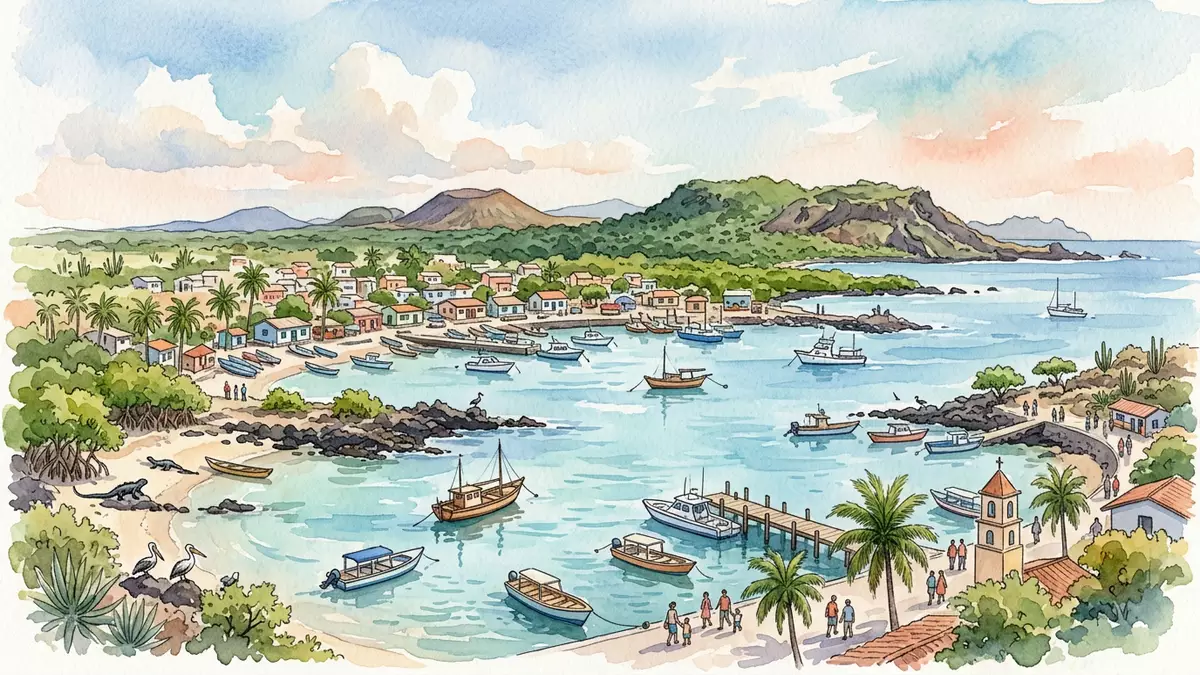
Islas Galapagos is a volcanic Pacific archipelago off mainland Ecuador, and around Puerto Ayora its landscapes, wildlife and harbour life come together in a compact, memorable way. Santa Cruz Island, home to Puerto Ayora, combines black lava coasts, highland forests and human settlement in a setting that has helped make the wider archipelago a recognised World Heritage site in the late twentieth century.
Puerto Ayora: harbour town at Academy Bay
Puerto Ayora lies on the southern coast of Santa Cruz Island beside Academy Bay, a natural harbour where volcanic shoreline meets sheltered Pacific water. The town is the largest settlement in Islas Galapagos and serves as the main hub for movement around the islands, with small ports and piers along the bay supporting inter-island traffic and local fishing boats. Streets in Puerto Ayora run inland from the waterfront into modest residential districts, with Avenida Charles Darwin following the curve of the shore and linking the harbour area to institutions such as the Charles Darwin Research Station. Low-rise buildings line the main streets, and the town’s position between sea and the higher interior of Santa Cruz makes it a starting point for excursions to coastal sites and the island’s central highlands.
Academy Bay itself is framed by dark volcanic rocks and small beaches where marine iguanas, sea birds and occasional sea lions share space with moored yachts and working vessels. The location of Puerto Ayora within the Galápagos National Park zone means that while the town has shops and services, much of the land around it is under conservation rules that protect native species and restrict expansion into surrounding habitats. Santa Cruz Island carries the administrative centre of the Galápagos National Park in Puerto Ayora, reinforcing the town’s role in managing conservation and visitor access across Islas Galapagos.Galápagos National Park administration
Volcanic islands and protected status
Islas Galapagos rises from a submarine platform on the junction of the Nazca and Cocos tectonic plates, forming an archipelago of larger islands such as Isabela, Santa Cruz and San Cristóbal alongside many smaller islands and rocky outcrops. The islands are largely the summits of volcanoes that emerged from the ocean floor over millions of years, creating rugged terrain with lava flows, craters and coastal cliffs in both inhabited and uninhabited areas. The equator crosses part of the archipelago, and the surrounding marine reserve stretches around the land within a circumferential zone defined by fixed coordinates, reflecting the importance of the surrounding waters as much as the islands themselves.marine reserve around the Galápagos Islands
The wider archipelago holds formal international designations that underscore its conservation significance. In 1978 the Galápagos Islands were inscribed on the UNESCO World Heritage List under natural criteria that recognise exceptional geological and ecological features, and later the Archipiélago de Colón was designated a Biosphere Reserve under the UNESCO Man and the Biosphere Programme in 1984. A Ramsar Site recognition for key wetlands followed at the start of the twenty-first century.Archipiélago de Colón–Galápagos Biosphere Reserve These designations frame the daily reality in Puerto Ayora and elsewhere in Islas Galapagos, where conservation measures shape access to habitats and guide scientific work.
Wildlife and science around Santa Cruz Island
Islas Galapagos is known for high levels of endemism across its wildlife, including reptiles, birds, mammals and marine species that evolved in isolation from mainland South America. On and around Santa Cruz Island, giant tortoises, marine iguanas and various finches share space with human settlement, and protected areas lie within reach of Puerto Ayora by road and trail. The mix of cold and warm ocean currents around the archipelago supports a broad variety of marine life, while terrestrial zones range from arid coastal scrub to more humid highland vegetation on islands such as Santa Cruz, creating distinct habitats over relatively short distances.rich marine ecosystems in the Galápagos archipelago
On the edge of Puerto Ayora, the Charles Darwin Research Station operates as a biological research centre dedicated to studying and conserving the ecosystems of Islas Galapagos. The station, established in 1964, stands on the shore of Academy Bay and works alongside the Galápagos National Park Service, undertaking projects such as giant tortoise breeding and long-term monitoring of species and habitats.Charles Darwin Research Station Trails and interpretive areas within the station grounds give visitors a structured view of ongoing scientific work and of conservation challenges linked to invasive species, climate variability and human activity.
Visiting Islas Galapagos: what travellers from Western Europe should know
- Islas Galapagos lies in the eastern Pacific Ocean around 1,000 km (621 mi) west of mainland Ecuador, and Puerto Ayora sits on the southern shore of Santa Cruz Island within the archipelago.
- Puerto Ayora’s waterfront and nearby sites involve walking over uneven volcanic rock and compacted earth paths, with some routes including modest gradients between the harbour and the island’s interior.
- Other named settlements and natural areas on Santa Cruz Island are reached by road from Puerto Ayora, with the island’s main paved route running between the northern Itabaca Channel and the town on Academy Bay.
- The official language in Islas Galapagos is Spanish and the currency is the US dollar.
- Entry requirements depend on your nationality; UK travellers can check the FCDO travel advice at gov.uk/foreign-travel-advice, Irish travellers the Department of Foreign Affairs at ireland.ie.
Searching for Islas Galapagos on social platforms
These links open searches for Islas Galapagos on each platform.
Frequently asked questions about Islas Galapagos
Where are Islas Galapagos and Puerto Ayora located?
Islas Galapagos lies in the eastern Pacific Ocean west of mainland Ecuador, with Puerto Ayora on the southern coast of Santa Cruz Island beside Academy Bay.
What can travellers expect when visiting Islas Galapagos from Puerto Ayora?
A visit combines a small harbour town, nearby volcanic shores and access to protected habitats on Santa Cruz Island, along with contact points with conservation and scientific work.
What makes Islas Galapagos distinctive compared with other island groups?
The archipelago’s volcanic origin, equatorial setting, high levels of endemic species and formal recognition as a World Heritage site give it a character unlike many other island chains.


