
Isla Contoy, where dunes meet mangroves and sea
Published on 09/24/2026 at 03:26 | Editorial responsibility: Rafael Müller, Editor-in-Chief AD HOC NEWS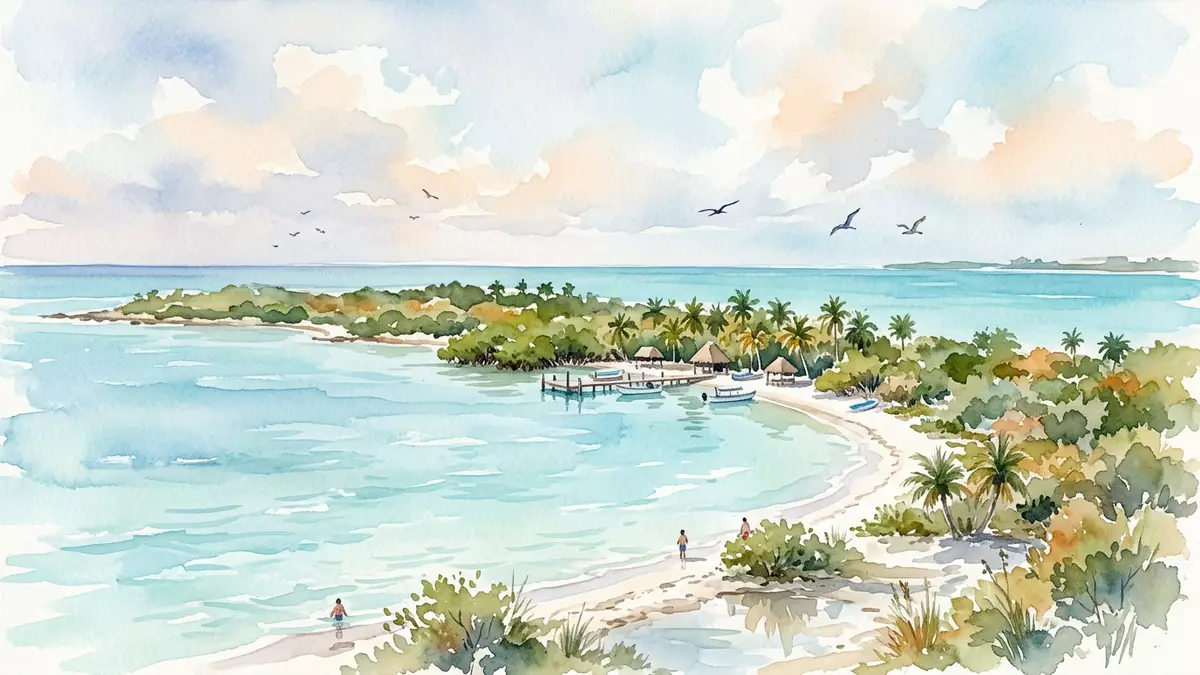
Isla Contoy is a slender barrier island at the meeting point of the Caribbean Sea and the Gulf of Mexico, north of the Yucatán Peninsula. Low dunes, mangrove wetlands and seabird colonies form a landscape where land and surrounding water belong to the same protected national park.
Isla Contoy’s narrow island landscape
Isla Contoy lies in Quintana Roo, off the peninsula’s north-eastern coast. The island extends for about 8.5 kilometres, while its land area covers approximately 230 hectares. Beyond the shore, the protected marine zone reaches across roughly 4,900 hectares of surrounding water.
The island’s physical form is simple but varied. Beaches and low dunes run beside lagoons, mangrove stands and shallow coastal water. The vegetation changes across short stretches of ground, creating a sequence of open sand, dense greenery and wetland edges. The protected area is formally listed as a Ramsar wetland of international importance, with a designated area of 5,126 hectares. Ramsar wetland details
From nature reserve to national park
Mexican protection for Isla Contoy began in 1961, when the island became a nature reserve. In February 1998, its status changed to Parque Nacional Isla Contoy, bringing the island and its marine surroundings under national-park protection.
The designation covers more than scenery. Mangroves, dunes, coastal vegetation, reef habitats and open water form one ecological area. The park’s boundaries include both terrestrial and marine environments, giving the island a cultural identity closely tied to conservation. The national park status is recorded in the name Parque Nacional Isla Contoy. national park history
The island of birds
Birdlife is central to Isla Contoy’s character. The island is known in Spanish as la isla de los pájaros, and its mangroves, dunes and coastal margins provide nesting and feeding areas for seabirds and other wetland species.
Frigatebirds, pelicans, cormorants and herons belong to the island’s visible natural world, while surrounding waters support fish, seagrass and coral habitats. Sea turtles are also associated with the island’s protected beaches. Archaeological traces indicate that Maya communities used island resources between 300 and 200 BC, although Isla Contoy has no permanent population because it lacks freshwater bodies. the island of birds
Visiting Isla Contoy: what travellers from Western Europe should know
- Isla Contoy lies north of Isla Mujeres and is reached by boat from the northern coast of Quintana Roo. Routes commonly depart from Cancún and Isla Mujeres.
- The island combines sandy beaches, low dunes, mangroves and lagoons. Walking takes place across exposed coastal terrain and designated paths.
- The surrounding marine zone is part of the protected area, alongside the island itself. Coral, seagrass and open Caribbean water belong to the park’s landscape.
- The official language is Spanish and the currency is the Mexican peso.
- Entry requirements depend on your nationality; UK travellers can check the FCDO travel advice at gov.uk/foreign-travel-advice, Irish travellers the Department of Foreign Affairs at ireland.ie.
Searching for Isla Contoy on social platforms
These links open searches for Isla Contoy on each platform.
Frequently asked questions about Isla Contoy
Where is Isla Contoy?
Isla Contoy is in Quintana Roo, Mexico, at the meeting point of the Caribbean Sea and the Gulf of Mexico. It lies north of Isla Mujeres, off the north-eastern tip of the Yucatán Peninsula.
What can visitors expect on Isla Contoy?
The island presents beaches, dunes, lagoons, mangroves and protected coastal habitats. Boat access and walking routes form part of a visit centred on the landscape and its birdlife.
What makes Isla Contoy distinctive?
Its national-park boundary includes both an elongated island and a large surrounding marine zone. The combination of seabird habitat, mangroves, dunes, reefs and lagoons gives the place its distinctive character.


