
iSimangaliso Wetland Park’s long estuary and wild coast
Published on 09/10/2026 at 19:47 | Editorial responsibility: Rafael Müller, Editor-in-Chief AD HOC NEWS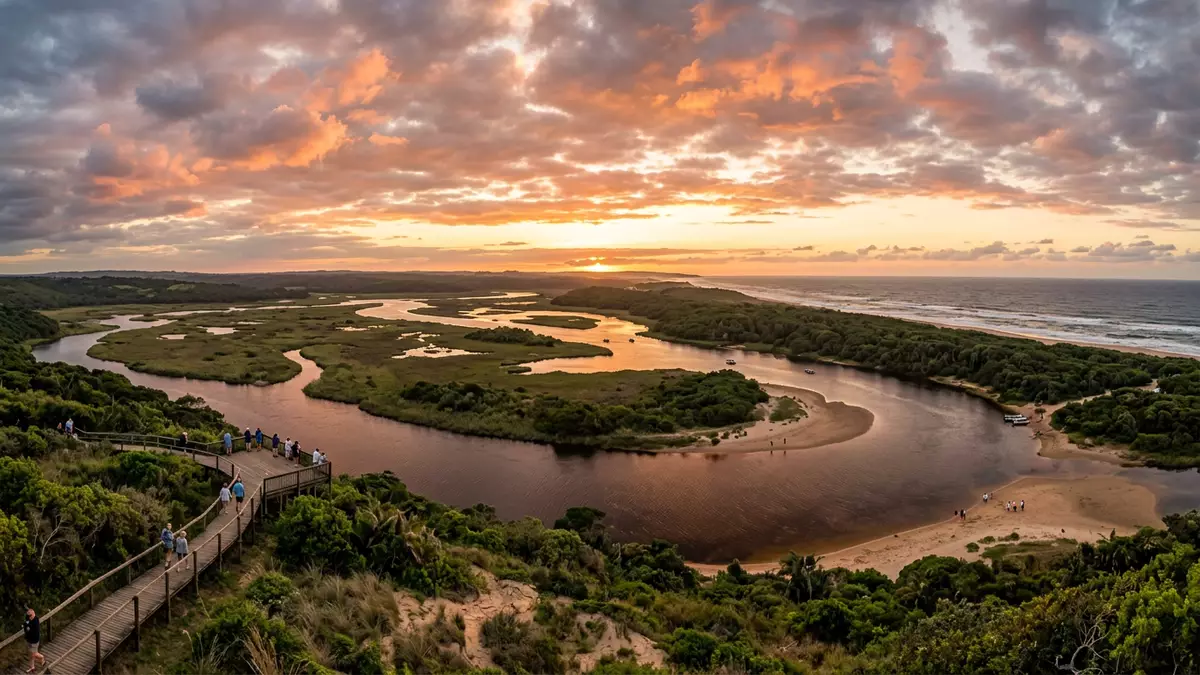
On the Indian Ocean coast of KwaZulu-Natal in South Africa, iSimangaliso Wetland Park stretches along the shore near St. Lucia as a long protected landscape where a broad estuarine lake system runs behind coastal dunes and beaches. Recognised as a UNESCO World Heritage Site since 1999, it brings together wetlands, lakes, ocean waters and dry savannah in a single continuous reserve shaped around the St. Lucia system in the north-eastern corner of the country.
Lake St Lucia and Africa’s largest estuarine system
The core feature of iSimangaliso Wetland Park is the St. Lucia system, an extensive estuarine lake complex that forms Africa’s largest estuarine system within a conservation area on the Indian Ocean coast of KwaZulu-Natal.Africa's largest estuarine system The lake lies landward of the coastal dunes and is connected to the sea through an estuary mouth whose shifting states between more saline and fresher phases have long been part of its character.shifting mouth and estuarine character
Within the park’s boundaries lie three major lake systems and extensive wetlands, all set within a low coastal plain that has been recognised as a Ramsar Wetland of International Importance and backed by conservation measures for well over a century.three major lake systems and Ramsar designation The St. Lucia lake and estuary have a documented protection history dating back to the nineteenth century, when the system began to be safeguarded as a distinctive coastal wetland and estuarine environment.protection of the estuary since 1895
Coast, dunes and a meeting of ecosystems
iSimangaliso Wetland Park occupies coastal lowlands that run for about 220 km (137 mi) parallel to the Indian Ocean, forming an elongated strip with a narrow belt of protected marine waters offshore.coastal lowlands that run for about 220 km Within this footprint, the landscape brings together sandy beaches, coastal dunes, lake margins and inland savannah, creating a mosaic where several distinct ecosystems lie side by side inside a single conservation boundary.ocean, dunes, lake and savannah
The park has been described as one of the outstanding coastal wetland sites of Africa, with landforms produced by fluvial, marine and aeolian processes that range from coral reefs and long sandy beaches to reedbeds and papyrus wetlands.outstanding coastal wetland site Within the protected area, ancient coastal dunes rise above the lakes and wetlands, forming a long barrier that separates the inland waters from the Indian Ocean and creating a marked visual contrast between low-lying reed-fringed shores and higher ridges closer to the sea.ancient dunes and eight interlocking ecosystems
World Heritage status and biodiversity
iSimangaliso Wetland Park was inscribed on the UNESCO World Heritage List in 1999 under natural criteria that highlight its scenic coastal wetlands, ongoing ecological and biological processes and biodiversity.inscribed on the World Heritage List in 1999 The inscription recognises a protected area of 239,566 ha where marine, coastal, wetland, estuarine and terrestrial environments remain largely unmodified within their designated zones.area 239,566 ha
Within this space, iSimangaliso Wetland Park supports a wide range of plant and animal life, including swamp forests, grasslands and coastal forest as well as wetland habitats that host hundreds of bird species.swamp forests and bird diversity The park’s name is derived from isiZulu and refers to something wondrous, reflecting the variety of habitats protected in northern KwaZulu-Natal from lake and wetland to savannah and coral reef.isiZulu name for something wondrous
Visiting iSimangaliso Wetland Park: what travellers from Western Europe should know
- iSimangaliso Wetland Park lies along the Indian Ocean coast of KwaZulu-Natal in north-eastern South Africa, with the small town of St. Lucia at the southern end of the estuarine lake system; road approaches use routes inland from Durban towards St. Lucia before reaching park gates.
- The terrain includes low-lying wetlands, lake margins and coastal dunes, with sections of sandy tracks and boardwalks and some areas where access routes cross uneven ground that can involve short walks on sand or soil.
- Within South Africa, the official language relevant to the park’s management and signage is primarily English alongside isiZulu in the province, and the national currency is the South African rand.
- Entry requirements depend on your nationality; UK travellers can check the FCDO travel advice at gov.uk/foreign-travel-advice, Irish travellers the Department of Foreign Affairs at ireland.ie.
Searching for iSimangaliso Wetland Park on social platforms
These links open searches for iSimangaliso Wetland Park on each platform.Frequently asked questions about iSimangaliso Wetland Park
Where is iSimangaliso Wetland Park?
iSimangaliso Wetland Park lies on the Indian Ocean coast of KwaZulu-Natal in north-eastern South Africa, extending along the shoreline near St. Lucia and northwards towards the border with Mozambique.
What can visitors expect on a visit?
A visit centres on long stretches of coastal landscape, estuarine lake shores and wetlands, with views over dunes, savannah and water where protected habitats and wildlife are part of a large conservation area.
What makes iSimangaliso Wetland Park distinctive?
The park combines Africa’s largest estuarine lake system with coastal dunes, ocean waters and inland savannah inside a single World Heritage-listed reserve, bringing several ecosystems together along more than 200 km of shore.


