
Intramuros, the stone-walled heart of old Manila
Published on 08/31/2026 at 16:52 | Editorial responsibility: Rafael Müller, Editor-in-Chief AD HOC NEWS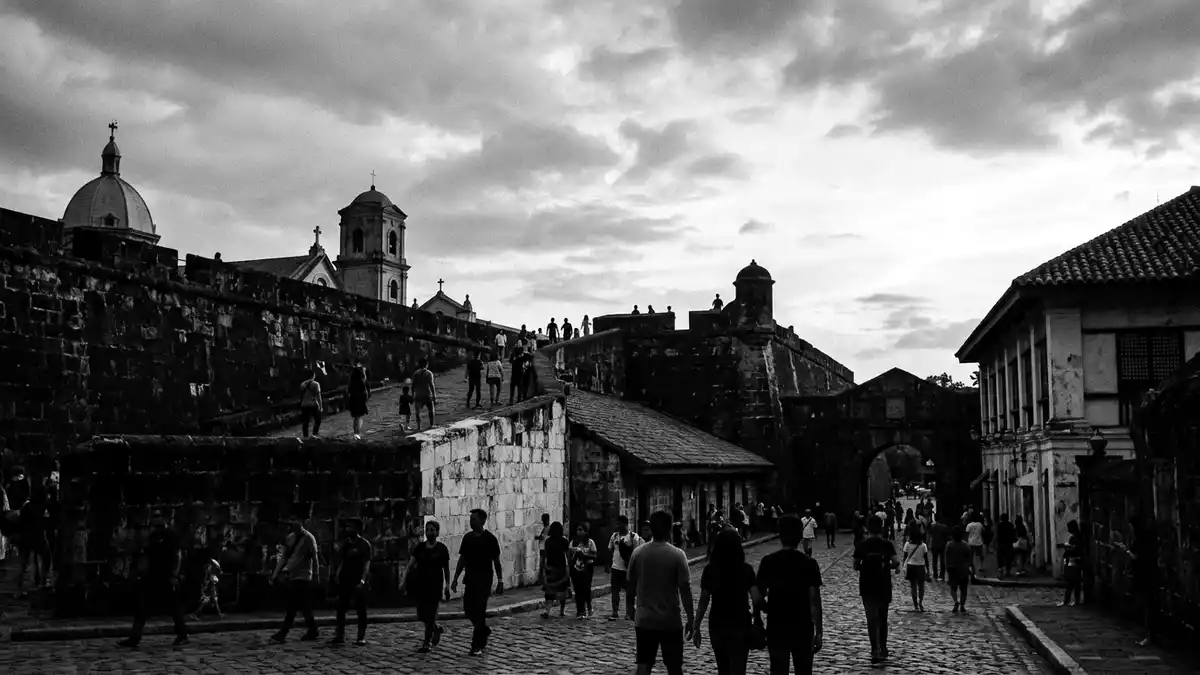
Intramuros is the historic walled city at the mouth of the Pasig River in Manila, a compact stone-built district laid out under Spanish rule in the late sixteenth century.historic walled city Its name comes from Latin and Spanish for “within the walls”, and those fortifications still define the urban grid that once contained the colonial capital of the Philippines.within the walls
Stone ramparts and the shape of a colonial stronghold
Intramuros occupies about 0.67 square kilometres (0.26 sq mi) on the south bank of the Pasig River, enclosed by fortifications that once marked the entire city of Manila.0.67 square kilometres The walls form an irregular pentagon in plan, following the line of the river and the land between the water and Manila Bay.irregular pentagon Built in stone and masonry, the ramparts reach substantial thickness and carry bastions, batteries and platforms that recall a fortified European city adapted to tropical terrain.
Inside the enclosure, the district is divided into a rectilinear grid of streets, laid out in the sixteenth century as the ordered urban plan for the Spanish colonial capital.Spanish colonial capital The gridiron pattern, with streets intersecting at right angles, reflects the planning principles used by Spanish conquistadors in their American and Asian territories.gridiron plan Within the circuit of walls lie blocks of civic, religious and residential buildings that together form a compact urban landscape framed by stone ramparts and moats.
From Legazpi’s capital to twentieth-century ruin and restoration
Intramuros was founded shortly after 1571 by Miguel López de Legazpi, the first Spanish Governor-General of the Philippines, as the seat of Spanish power in the archipelago.Miguel López de Legazpi For more than three centuries, spanning the seventeenth and eighteenth centuries in particular, it functioned as the political, military and religious centre of Spanish colonial rule in the Far East.capital of the Spanish colonial empire Governors-general, archbishops and colonial administrators all worked and lived within the walls, while institutions of empire occupied prominent plots along the main streets and plazas.
Intramuros’ fortifications and buildings have endured sieges, occupations and heavy bombardment, including destruction during the Second World War, after which many structures were reduced to ruins.fortifications bore witness In the mid-twentieth century the district was recognised as a historic monument under Philippine law, and a dedicated Intramuros Administration was later established to oversee conservation and adaptive reuse of the surviving walls, bastions and streetscapes.Intramuros Administration Walking through the area today, the layers of construction, damage and restoration are visible in rebuilt churches, reconstructed sections of wall and open grounds where dense colonial housing once stood.
Churches, Fort Santiago and stone houses inside the walls
Within Intramuros stand several of Manila’s most important religious and civic buildings, including Manila Cathedral and San Agustin Church, both associated with the Spanish colonial era.Manila Cathedral and San Agustin San Agustin, a stone church with a monastery complex, is one of the oldest surviving churches in the Philippines and forms part of the Baroque Churches of the Philippines group inscribed on the World Heritage List.Baroque Churches of the Philippines Manila Cathedral, rebuilt several times, occupies a prominent position on one of the main plazas and serves as the seat of the Archdiocese of Manila.
At the north-western end of Intramuros lies Fort Santiago, a stone fortress that formed part of the defensive system controlling access from the river and bay.Fort Santiago The fort housed the residence of the governor-general during the Spanish period and later became associated with national history as the place of imprisonment for José Rizal, whose final footsteps are marked in the stone leading towards the execution site.Rizal Museum Around the fortress and the main streets stand restored examples of bahay na bato houses, with stone lower levels and timber upper storeys, which evoke the architecture of colonial elites who once lived “inside the walls”.
Visiting Intramuros: what travellers from Western Europe should know
- Intramuros lies on the south side of the Pasig River in central Manila, close to Manila Bay, and is reached by city streets that run along and across the old moat line.
- Much of the district is level and paved, but the ramparts, bastions and parts of Fort Santiago are accessed by stairways and elevated walks that involve climbing stone steps.
- The official language is Filipino and English is widely used; the currency is the Philippine peso.
- Entry requirements depend on your nationality; UK travellers can check the FCDO travel advice at gov.uk/foreign-travel-advice, Irish travellers the Department of Foreign Affairs at ireland.ie.
Searching for Intramuros on social platforms
These links open searches for Intramuros on each platform.Frequently asked questions about Intramuros
Where is Intramuros and what kind of place is it?
Intramuros is a historic walled district in central Manila, on the south bank of the Pasig River near Manila Bay, forming the old colonial core of the city.
What can a visitor expect when walking inside the walls?
Visitors encounter stone ramparts, bastions, plazas, colonial churches, restored houses and museums, arranged on a grid of streets within a compact urban enclosure.
What makes Intramuros distinctive among historic districts?
Intramuros combines a complete circuit of stone fortifications with a planned colonial street grid, major religious and civic buildings and a setting beside river and bay.


