
Intramuros, Manila’s stone-walled colonial heart
Published on 08/28/2026 at 11:32 | Editorial responsibility: Rafael Müller, Editor-in-Chief AD HOC NEWS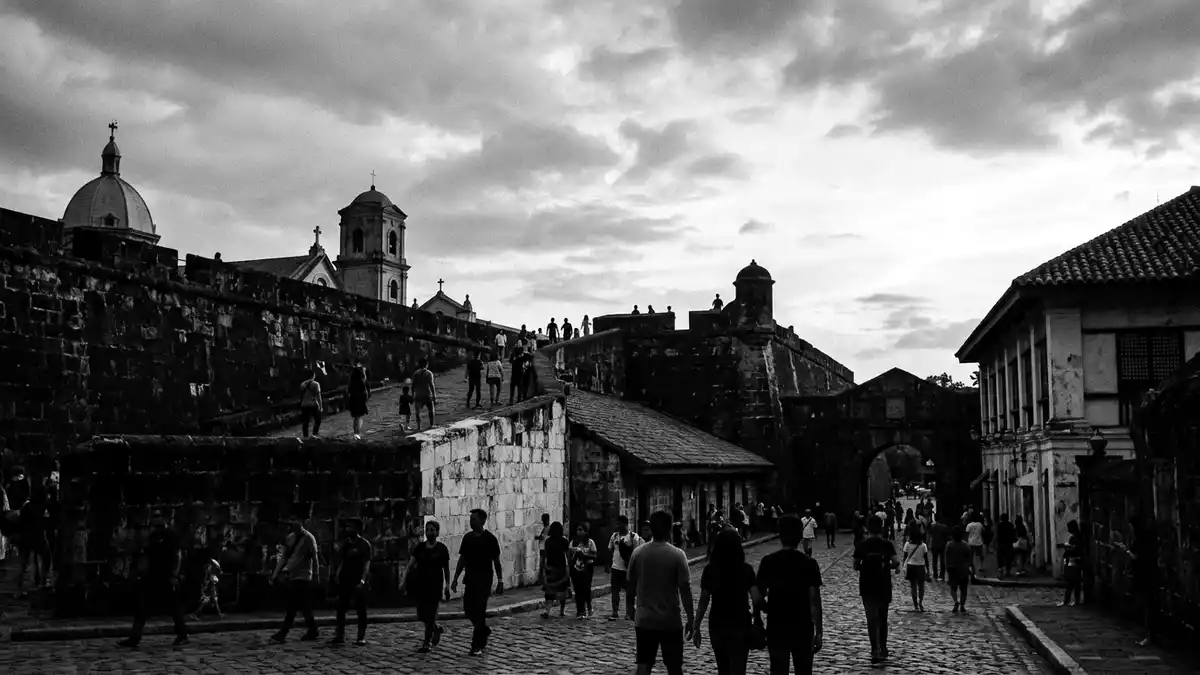
Intramuros is Manila’s historic walled district, a compact stone-bound enclave where Spanish colonial churches, fortifications and civic buildings once concentrated power in the Philippines. Founded in 1571 by Spanish conquistador Miguel López de Legazpi at the mouth of the Pasig River, it became the fortified core of Manila and the seat of colonial government for more than three centuries.
A city within walls of stone
The name Intramuros comes from Latin and Spanish roots that mean “inside the walls”, and the phrase describes the district’s defining feature: a continuous circuit of massive masonry ramparts enclosing an urban grid. Within this boundary, seventeenth- and eighteenth-century streets form a rectilinear pattern, laid out as a Spanish colonial grid around plazas, churches and official residences.historic walled city
The fortifications run for several kilometres around Intramuros, forming bastions, curtain walls and moats that once defended the colonial capital against both maritime attack from Manila Bay and incursions from the wider Luzon hinterland. Built up progressively from the late sixteenth century onwards, these walls enclosed an area of around 0.67 square kilometres, defined in later legislation as roughly 67 hectares of historic centre.0.67 square kilometre area
Colonial capital and baroque landmarks
Intramuros served as the political, religious and military heart of Spanish rule in the archipelago. Within its walls stood the Governor-General’s palace, administrative offices and the residences of colonial elites, alongside monasteries and churches belonging to different religious orders. The Manila Cathedral rose here as the seat of the archdiocese, joined by San Agustin Church, a stone baroque building recognised internationally as part of a World Heritage listing for Philippine baroque churches.Manila Cathedral and San Agustin Church
Fort Santiago anchors the north-western sector of Intramuros, a citadel whose stonework faces the Pasig River and the approach from Manila Bay. Inside the district, streets lined with bahay na bato houses – hybrid dwellings with stone lower levels and lighter upper structures – once expressed the hierarchy between Spanish residents and communities outside the walls. Churches here followed European baroque models, adapted to local materials and tropical conditions to form a distinctive Philippine–Spanish architectural language.Fort Santiago and colonial-era sights
Destruction, preservation and living heritage
Intramuros endured earthquakes, sieges and occupations across its history, but its most extensive damage came in 1945 during the Battle of Manila in the Second World War. Urban combat between Japanese forces and Allied troops devastated the district; much of its historic building fabric was reduced to rubble, leaving fragments of walls, gates and churches amid ruins and open ground.Battle of Manila destruction
In the decades after the war, reconstruction and conservation initiatives re-established parts of the walled city, combining preserved fragments with rebuilt structures and new infill. The Intramuros Administration, created in 1979 as a dedicated government body, oversees preservation and development, while a tentative listing at UNESCO recognises the colonial urban plan and fortifications as heritage of international value.Colonial urban plan and fortifications
Intramuros in Manila’s urban landscape
Intramuros occupies a strategic position between Manila Bay and the Pasig River, on the south bank of the estuary where Spanish planners fixed their capital. From the walls, views take in the river, neighbouring districts and surviving bastions, while within the perimeter the grid of streets connects plazas, courtyards and institutional buildings in a walkable scale.
The walled city sits within Metro Manila as a distinct historic core, its stone ramparts separating it from later districts of the modern metropolis. Landmarks such as Manila Cathedral, Fort Santiago and San Agustin draw visitors alongside civic institutions including the University of the City of Manila, all within the footprint of the former colonial capital.urban district within Metropolitan Manila
Visiting Intramuros: what travellers from Western Europe should know
- Intramuros lies on the south bank of the Pasig River in central Manila, between Manila Bay and the river mouth, and is reachable by road transport from other city districts.
- The walled district is enclosed by substantial stone ramparts and bastions, and exploring on foot involves walking along level streets and across plazas, with steps at gates and fortifications.
- The official language in Manila is Filipino (with English widely used) and the currency is the Philippine peso.
- Entry requirements depend on your nationality; UK travellers can check the FCDO travel advice at gov.uk/foreign-travel-advice, Irish travellers the Department of Foreign Affairs at ireland.ie.
Searching for Intramuros on social platforms
These links open searches for Intramuros on each platform.Frequently asked questions about Intramuros
Where is Intramuros located?
Intramuros is in central Manila in the Philippines, on the south bank of the Pasig River close to Manila Bay.
What can visitors expect inside the walls?
Visitors encounter stone fortifications, churches such as Manila Cathedral and San Agustin, plazas, museums and streets laid out on a Spanish colonial grid.
What makes Intramuros distinctive among Manila’s districts?
Intramuros is distinguished by its continuous stone walls, its role as the former Spanish colonial capital and its concentration of historic religious and civic landmarks.


