

Inle Lake’s floating villages and leg?rowers of Shan State
Published on 08/27/2026 at 08:29 | Editorial responsibility: Rafael Müller, Editor-in-Chief AD HOC NEWS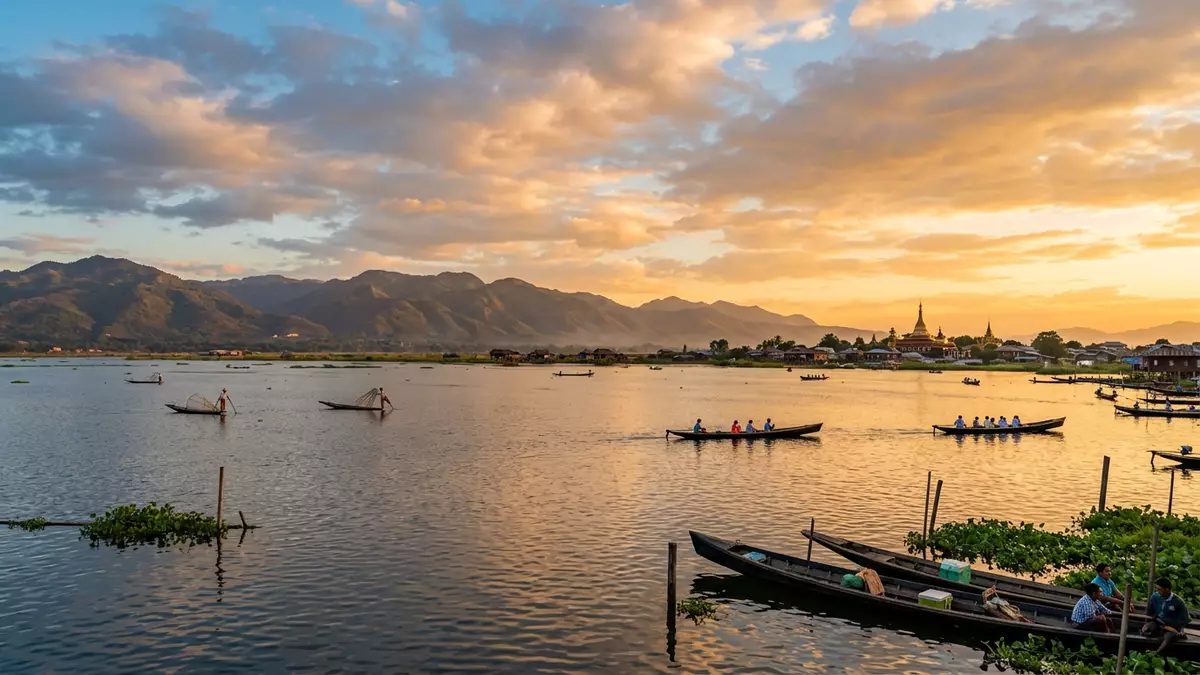
Inle Lake in Myanmar’s Shan State is a highland freshwater lake where whole neighbourhoods stand on wooden stilts above the water and boats serve as everyday transport. Set within Nyaungshwe Township and framed by the Shan Hills, it has become closely associated with the Intha people, whose settlements and floating fields form a continuous waterborne landscape.
Life built directly on the water
Inle Lake lies in western Shan State and fills part of a long north–south valley, with water, marsh and village areas interwoven rather than clearly separated.freshwater lake located in the Nyaungshwe Township of Shan State The lake surface sits at an elevation of around 900 m (2,953 ft) above sea level, giving it a cooler highland character than Myanmar’s lowland plains.a beautiful highland lake, 900 meters above sea level
The communities around the lake are primarily Intha, alongside Shan, Pa-O, Danu, Taungyo, Kayah, Danaw and Bamar groups, each with their own language and dress.population consists predominantly of Intha, with a mix of other Shan, Taungyo, Pa-O, Danu, Kayah, Danaw and Bamar ethnicities Many families live in timber houses raised on piles driven into the lakebed, with walkways of planks and narrow channels linking clusters of dwellings. Buddhist monasteries such as Nga Phe Chaung also stand on stilts above the water, reinforcing the sense that daily life, religious practice and travel all take place within the same aquatic space.Nga Phe Chaung monastery was built on stilts of Inle Lake
Floating gardens and the leg?rowers of the lake
One of the defining features of Inle Lake is its system of floating gardens, where crops grow on rafts formed of vegetation and lake sediments rather than on solid ground.the lake is known for its floating gardens and “leg rowers” Intha farmers bind layers of water plants and mud into elongated islands, anchor them with bamboo poles and plant vegetables, flowers and other produce into the buoyant soil. These cultivated strips form parallel bands across shallow sections of the lake, with narrow boat channels cut between them.
Intha boatmen and fishers are recognised for a distinctive rowing technique in which they stand towards the stern, wrap one leg around the oar and use a circular movement to propel their narrow wooden boats.stilt villages of the Intha “Sons of the Lake” This style keeps the hands free for nets or baskets and offers a high vantage point over the water. Together with the gardens, it has become a visual shorthand for the lake’s culture, visible from early morning when boats move through the cultivated channels and past house frontages.
Pagodas, hill villages and protected wetland
Beyond the central lake surface, channels lead towards villages such as Indein on the western side, where pagoda clusters rise above the surrounding fields.Indein is a small village West of Inle Lake, known for its market and two groups of ancient pagodas Just behind Indein village, the Nyaung Ohak group consists of partly overgrown stupas with carved guardian figures and decorative reliefs.Nyaung Ohak, a set of picturesquely overgrown stupas A covered stairway climbs from there to Shwe Inn Thein Paya, where hundreds of slender stupas in brick and stucco stand close together along the ridge.
Inle Lake has been recognised as a wetland of international importance under the Ramsar Convention, reflecting both its ecological value and the depth of human settlement around its margins.Ramsar site: Inle The Ramsar site description notes the lake’s elongated form and the concentration of Inntha households within Nyaungshwe Township. On the water and surrounding land, residents make livelihoods in agriculture, weaving, fishing, metalwork and horticulture, tying the religious sites, villages and cultivated lake surface into one continuous cultural landscape.
Visiting Inle Lake: what travellers from Western Europe should know
- Inle Lake lies in Shan State in eastern Myanmar, with Nyaungshwe town a common base slightly north of the lake reached by road from Taunggyi.
- Many areas are accessible only by boat, and moving between stilt villages or pagoda sites usually involves boarding narrow wooden craft with low sides.
- The lake surface sits at around 900 m (2,953 ft), so approaches often involve modest gradients and steps between jetties, banks and monastery platforms.
- Myanmar’s official language is Burmese and the currency is the Myanmar kyat.
- Entry requirements depend on your nationality; UK travellers can check the FCDO travel advice at gov.uk/foreign-travel-advice, Irish travellers the Department of Foreign Affairs at ireland.ie.
Searching for Inle Lake on social platforms
These links open searches for Inle Lake on each platform.Frequently asked questions about Inle Lake
Where is Inle Lake located in Myanmar?
Inle Lake is in Shan State in eastern Myanmar, within Nyaungshwe Township, and occupies part of a highland valley south of Nyaungshwe town.
What can visitors expect to see on the lake?
Visitors encounter stilt houses, Buddhist monasteries, floating gardens cultivated by Intha farmers and boats rowed with a distinctive leg?rower technique.
What makes Inle Lake distinctive among Myanmar’s destinations?
The combination of elevated freshwater lake, dense waterborne settlements, leg?rowers and nearby pagoda complexes such as Nyaung Ohak and Shwe Inn Thein creates a distinctive cultural landscape.


