
Inle Lake: life on the water in Myanmar’s Shan hills
Published on 09/08/2026 at 11:22 | Editorial responsibility: Rafael Müller, Editor-in-Chief AD HOC NEWS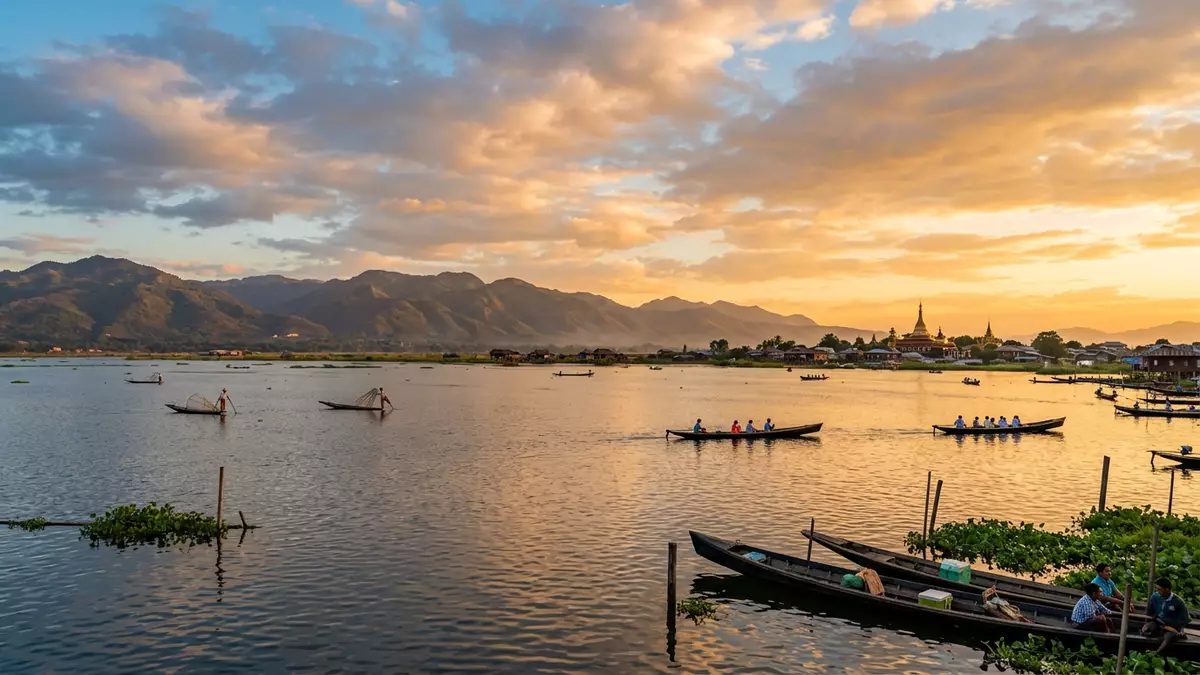
Inle Lake is a highland freshwater lake in Nyaungshwe Township in southern Shan State, Myanmar, where much of daily life takes place directly on the water. It lies in the Shan Hills at an elevation of around 880 m (2,900 ft), forming a long valley basin framed by ridges and surrounded by wetlands recognised for their biodiversity and conservation importance.a freshwater lake in Nyaungshwe Myanmar’s government and international bodies have recorded Inle Lake and its basin as a protected wetland sanctuary and biosphere reserve in the early twenty-first century, under frameworks such as UNESCO’s Man and the Biosphere Programme.Myanmar’s first UNESCO Biosphere Reserve
A lake shaped by villages, canals and floating gardens
Inle Lake stretches along a north–south valley in Shan State, its open water surface measuring on the order of 22 km in length and about half that in width.length and open-water area The basin sits at about 2,880 ft above sea level and is ringed by gentle hills that drop towards the water, so the horizon from a boat is a continuous line of blue-grey slopes and reeds rather than city buildings. The shoreline is irregular, cut by canals and small inlets, and much of what seems at first glance to be “shore” turns out to be lake-based settlement and cultivation.
Across large parts of Inle Lake, villagers have built floating gardens from layers of lake vegetation and mud, anchored with bamboo poles to keep them in place.floating villages and on-water gardens These cultivated strips sit slightly above the water surface, forming long parallel bands with narrow channels for boats between them. Houses in the villages rise on wooden stilts out of the water, linked by narrow walkways and jetties, so there is a continuous transition from open lake to settlement without solid ground in between. From Nyaungshwe’s canal, boats move along the water highways between these gardens and stilt-house quarters before reaching the broader open reaches of the lake.
Communities, leg-rowing fishermen and religious sites
Inle Lake is home to the Intha and other communities whose livelihoods are organised around the water, from fishing and market trading to handicrafts and lake-edge agriculture.well known destination in Nyaungshwe Township Fishermen use distinctive flat-bottomed wooden boats, standing on one leg at the stern and wrapping the other leg around the oar to row, a technique that leaves their hands free and has become closely associated with the lake’s visual identity.their unique way of rowing Markets rotate between lakeside and on-water settlements, and villages host weaving workshops, silversmiths and boatyards, so a journey along the canals passes directly beside the workspaces where local crafts are practised.
Religious sites add further structure to the landscape of water and villages. Pagodas and monasteries are located on promontories and lake islands, with jetties and steps linking the main prayer halls to the boat landings. Some monasteries in the wider basin are known for their timber architecture and position above the wetlands, while closer to Nyaungshwe, stupas rise on small hills that overlook the lake and the surrounding Shan plateau. Pilgrimage and seasonal ceremonies take place around these sites, with processions moving by boat along the canals and across the lake to reach the principal shrines.
Conservation designations and the Inlay Lake Wetland Sanctuary
Beyond its cultural landscape, Inle Lake has been recognised for its ecological importance. The surrounding basin, including the lake and its watershed, has been set aside as the Inlay Lake Wetland Sanctuary, a protected area covering more than 500 km² over Nyaungshwe, Pinlaung and Pekon Townships in Shan State.Inlay Lake Wetland Sanctuary Within this sanctuary, elevations range from about 830 m to 1,270 m (2,720 to 4,170 ft), taking in the open-water surface of Inle Lake, its reedbeds, surrounding agricultural land and the foothills that drain into the basin.
Inle Lake has accumulated several formal conservation labels. It became an ASEAN Heritage Park and an Important Bird and Biodiversity Area in the early 2000s, a UNESCO Biosphere Reserve in 2015 and a Ramsar Wetland of International Importance in 2018.ASEAN Heritage Park and Ramsar Site Conservation documents describe habitats for at least 267 bird species, including wetland birds, and more than forty freshwater fish species, some of them endemic to the lake’s waters.recorded bird and fish species For travellers, these designations underline that Inle Lake is not only a cultural destination but also part of a wider protected wetland landscape with recognised international status.
Visiting Inle Lake: what travellers from Western Europe should know
- Inle Lake lies in Nyaungshwe Township in southern Shan State, eastern Myanmar, with Nyaungshwe town serving as the main access point along a canal that connects directly to the lake’s northern end.
- Approaching the lake by boat from Nyaungshwe involves standing and seated travel in narrow wooden vessels, with frequent steps at jetties and uneven surfaces on stilt-house walkways and village landings.
- The wider basin around Inle Lake forms part of the Inlay Lake Wetland Sanctuary in Shan State in Myanmar, so water, marshland and low hills dominate the immediate surroundings rather than dense urban development.
- The official language is Burmese and the currency is the Myanmar kyat.
- Entry requirements depend on your nationality; UK travellers can check the FCDO travel advice at gov.uk/foreign-travel-advice, Irish travellers the Department of Foreign Affairs at ireland.ie.
Searching for Inle Lake on social platforms
These links open searches for Inle Lake on each platform.
Frequently asked questions about Inle Lake
Where is Inle Lake located?
Inle Lake is in Nyaungshwe Township in Taunggyi District, southern Shan State, in eastern Myanmar, forming a long basin within the Shan Hills.
What can travellers expect when visiting Inle Lake?
Travellers encounter a freshwater lake where transport, markets, floating gardens and stilt-house villages are organised directly on the water, with boat travel central to movement.
What makes Inle Lake distinctive compared with other lakes?
Inle Lake combines on-water settlement and leg-rowing fishermen with formal recognition as a biosphere reserve and wetland sanctuary, linking cultural life and recorded ecological diversity.


