
Hwange National Park’s vast Kalahari sands and wildlife pans
Published on 09/14/2026 at 13:33 | Editorial responsibility: Rafael Müller, Editor-in-Chief AD HOC NEWS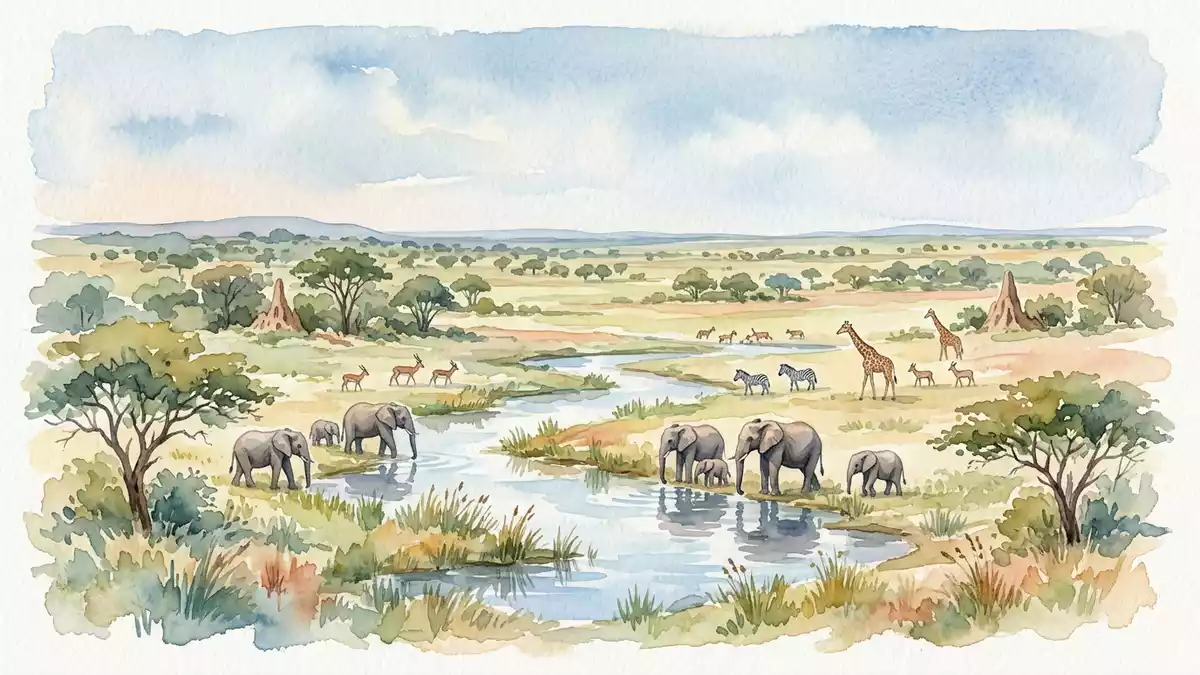
Hwange National Park in north-western Zimbabwe is a vast protected landscape where Kalahari sand plains, scattered woodlands and man-made pans together shape one of southern Africa’s largest wildlife reserves. Established as Wankie Game Reserve in 1928 and later recognised in the mid-twentieth century as a national park, Hwange has grown into a major conservation area with hundreds of mammal and bird species and a network of artificial waterholes across its wide, dry terrain.
A park built on Kalahari sands and scarce natural water
Hwange National Park lies in the north-west corner of Zimbabwe, near the frontier with Botswana, in an area long associated with the edge of the Kalahari Desert sand system.Hwange National Park covers 14,600 km2 of mostly sandy soils, low ridges and shallow depressions known as pans. The ground is dominated by ancient Kalahari sands that were laid down in a wetter age when swamps and forests in the north formed the Hwange coalfields and great rivers crossed what is now dry woodland.the Hwange coalfields
Those sandy soils hold little natural surface water in the long dry season, which was a key reason the colonial administration judged the land unsuitable for agriculture and set it aside for wildlife conservation in 1928 as Wankie Game Reserve.Established in 1928 as a game reserve The reserve was named after a local Nhanzwa chief, Hwange Rosumbani, whose name was later adapted to its present spelling, and it drew on a much older history of the area as royal hunting ground for Ndebele rulers such as Mzilikazi and Lobengula. Over time, the park’s managers sank boreholes, enlarged natural pans and constructed dams to provide year-round water at scattered points across the sandy landscape, turning those pans into focal points for wildlife movement.
From Wankie Game Reserve to Zimbabwe’s largest national park
The origins of Hwange National Park as a protected area trace back to its proclamation as Wankie Game Reserve in 1928, when the Rhodesian government gazetted the land primarily for wildlife conservation.Wankie Game Reserve was declared a reserve in 1928 In September that year a young warden, Edward Hartley “Ted” Davison, aged around 22 and previously employed in tsetse fly control, accepted the first wardenship of the new reserve, working with a small initial budget and minimal infrastructure.First warden Ted Davison took the post in September 1928 Over more than three decades Davison oversaw the development of Hwange’s artificial water systems, road network and viewing platforms, laying down much of the framework on which the modern park still rests.
The game reserve gradually shifted to full national park status in the mid-twentieth century. Different sources record varying dates for this change, including 1950 and 1961, but they agree that Wankie’s upgrade to a national park occurred after the inclusion of neighbouring areas such as Robins Game Sanctuary.Robins Game Sanctuary was incorporated when Hwange became a National Park The park was later renamed Hwange National Park in the early 1980s, aligning its official title with the local chief’s name. Today Hwange is recognised as Zimbabwe’s largest national park, extending over roughly 14,651 km² (5,657 mi²) of protected land.14,651 km² in size
Kalahari woodlands, pans and rich wildlife communities
Hwange’s Kalahari-derived soils support a mosaic of vegetation types that change across the park’s breadth. Broad stretches of semi-arid woodland with species such as mopane and teak are interspersed with open grasslands, scrub and seasonal pans that fill with water in wetter months and are maintained by boreholes in dry periods.encompasses the edge of the Kalahari sand system These pans, many fitted with viewing platforms dating back to Davison’s tenure, give travellers structured vantage points from which to watch animals congregate at water, a distinctive feature of Hwange compared with parks that rely solely on rivers.
Wildlife in Hwange National Park is notably diverse, with about 100 species of mammals and hundreds of bird species recorded.home to nearly 100 species of mammals and over 400 bird species The park is particularly associated with its large population of African elephants, with estimates reaching tens of thousands of individuals, and it supports substantial numbers of buffalo, giraffe, blue wildebeest and sable antelope.Hwange holds a large Elephant population and numerous Buffalo, Giraffe, Blue Wildebeest and Sable Hwange also holds Zimbabwe’s most significant population of African wild dog, alongside predators such as lion and leopard, and birdlife that includes species like southern ground hornbill, martial eagle and Kori bustard. The absence of perennial rivers inside much of the park means that wildlife movements are closely linked to the spacing of its artificial and seasonal water sources across the sandy terrain.
Visiting Hwange National Park: what travellers from Western Europe should know
- Hwange National Park lies in north-western Zimbabwe, south-east of Victoria Falls and close to the border with Botswana; road access connects the park with Hwange town and other regional centres.
- The terrain combines flat Kalahari sand plains, low ridges and numerous pans; game-viewing areas are reached on unpaved tracks, and many viewpoints stand beside waterholes.
- English is an official language in Zimbabwe and the currency is the Zimbabwean dollar.
- Entry requirements depend on your nationality; UK travellers can check the FCDO travel advice at gov.uk/foreign-travel-advice, Irish travellers the Department of Foreign Affairs at ireland.ie.
Searching for Hwange National Park on social platforms
These links open searches for Hwange National Park on each platform.
Frequently asked questions about Hwange National Park
Where is Hwange National Park located?
Hwange National Park is in north-western Zimbabwe near the border with Botswana, south-east of Victoria Falls and connected by road to Hwange town.
What can travellers expect on a visit to Hwange?
Travellers encounter extensive Kalahari sand plains, woodland and grassland, with game drives focused on pans and borehole-fed waterholes where elephants, antelope and other mammals gather.
What makes Hwange National Park distinctive among African parks?
Hwange stands out for its combination of Kalahari sand terrain, a large elephant population, substantial African wild dog numbers and a long-established system of artificial waterholes across the park.


