
Huangshan’s sculpted granite peaks above seas of cloud
Published on 09/14/2026 at 15:14 | Editorial responsibility: Rafael Müller, Editor-in-Chief AD HOC NEWS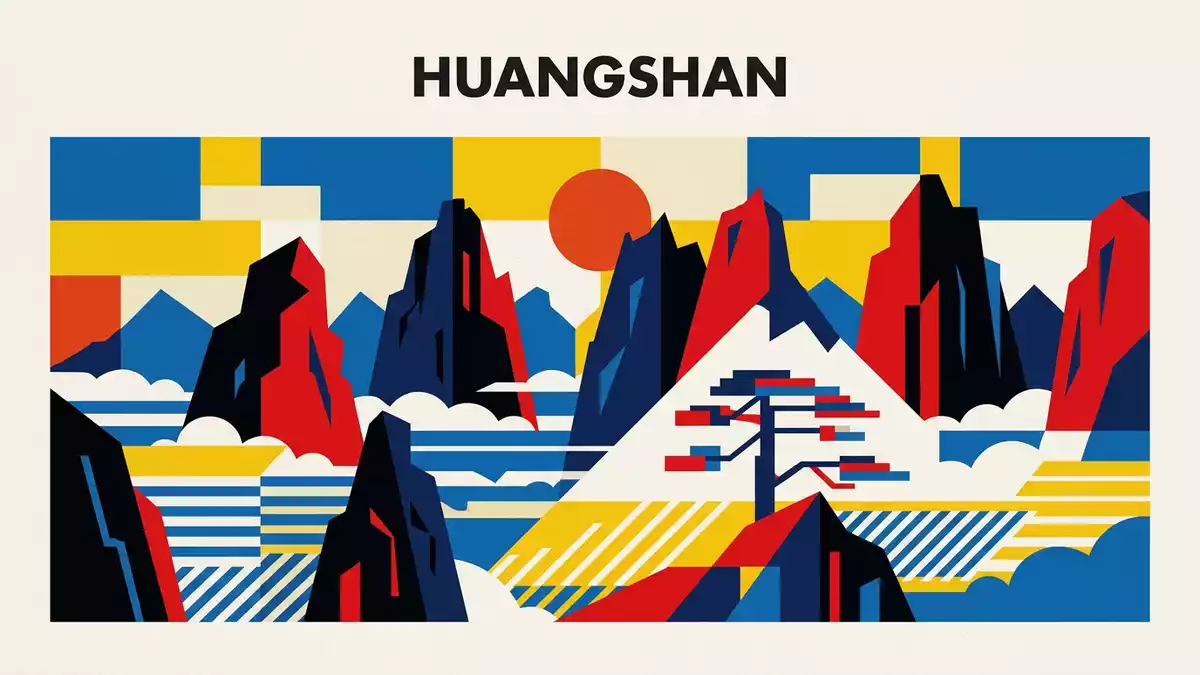
Huangshan in eastern China is a mountain range where jagged granite peaks rise above drifting seas of cloud, with ancient pine trees clinging to the rock faces. Set in Anhui Province and named “Yellow Mountain” by imperial decree in 747, it is both a dramatic landscape and a long-standing inspiration for Chinese painters and poets.named Huangshan in 747
Granite summits and Huangshan’s four famed wonders
Huangshan is not a single summit but a compact mountain range in southern Anhui, with numerous granite peaks that rise beyond 1,000 m (3,281 ft). The highest of these, Lotus Peak, reaches about 1,864 m (6,115 ft), with other prominent tops including Bright Summit and Celestial Capital Peak.Lotus Peak at 1,864 m Trails and stone stairways thread through steep gullies and along ridges, linking view platforms and small clusters of buildings that serve visitors in the scenic area.
The landscape is widely associated with four classic “wonders”: expressive pine trees, oddly shaped rocks, seas of cloud and hot springs. The pines twist out of cracks in the granite, some with forms that have earned evocative names, while rock outcrops form spires and overhangs that catch low-angle light. In humid weather, cloud layers settle between the peaks so that summits appear as islands above a white expanse, a scene that has become emblematic of Huangshan in traditional “mountain and water” painting.four wonders of Huangshan
A landscape written into Chinese art and heritage
Mount Huangshan has been celebrated in Chinese literature and painting since at least the Ming period, feeding into the “shan shui” tradition that pairs mountains with water as the core of landscape art.Shanshui mountain and water style Poets and painters travelled here to sketch the peaks and forests, and their work helped fix Huangshan as a reference point for an idealised mountain world. The range has also been linked in legend to the Yellow Emperor, Huang Di, whose name is associated with the mountain’s later imperial designation.named for the Yellow Emperor
In formal terms Huangshan is recognised for both cultural and natural significance. It was inscribed on the UNESCO World Heritage List in 1990 for its outstanding scenery and contribution to Chinese art, and later recognised as a Global Geopark and Biosphere Reserve.World Heritage inscription in 1990 The protected core area extends over more than 16,000 ha, with a larger buffer zone around it, and lies within a humid subtropical climate zone that supports rich forest ecosystems and many endemic plant species.biosphere reserve details
Peaks, pines and the structure of the scenic area
The Huangshan Scenic Area is organised around groups of peaks and valleys, with named zones such as the North Sea, Jade Screen and West Sea Grand Canyon. Within these, paths climb to ridge-top viewpoints, descend into narrow gorges and pass clusters of weathered pavilions and guesthouses built in traditional styles.main scenic zones Some sections use long staircases cut directly into the rock, while others follow more gradual contours through forest. At lower elevations, near the main entrances, buildings stand beside streams and the hot springs that form part of the classic Huangshan image.
The wider mountain system is often described as having dozens of named peaks above 1,000 m (3,281 ft), with Lotus Peak, Bright Summit and Heavenly Capital Peak among the best known.72 famous peaks Granite dominates the geology, giving the cliffs their pale colour and sheer faces. Vegetation varies with altitude, from mixed forest at lower levels to scattered pines and shrubs near the summits, while the combination of rock, trees and cloud creates changing views through the day as light moves and mist lifts or settles.
Visiting Huangshan: what travellers from Western Europe should know
- Huangshan lies in southern Anhui Province in eastern China, with the main scenic area north of Huangshan City and reached from transport hubs around the city.
- Paths within the scenic area include steep staircases, long uphill stretches and sections along exposed ridges, so a visit involves sustained walking on stone steps.
- The mountain climate can bring cloud, rain and rapid changes in visibility, and higher paths and view platforms stand at elevations well above 1,000 m (3,281 ft).
- The official language is Chinese and the currency is the renminbi (yuan).
- Entry requirements depend on your nationality; UK travellers can check the FCDO travel advice at gov.uk/foreign-travel-advice, Irish travellers the Department of Foreign Affairs at ireland.ie.
Searching for Huangshan on social platforms
These links open searches for Huangshan on each platform.
Frequently asked questions about Huangshan
Where is Huangshan and what kind of place is it?
Huangshan is a granite mountain range in Anhui Province in eastern China, with a protected scenic area north of Huangshan City and numerous peaks above 1,000 m (3,281 ft).
What should travellers expect on a visit to Huangshan?
Travellers encounter steep stone stairways, forested slopes and ridge-top viewpoints, along with characteristic twisted pines, sculpted rock formations, cloud layers and areas around natural hot springs at lower elevations.
What makes Huangshan distinctive among Chinese mountains?
Huangshan combines tall granite peaks, ancient pine trees and frequent seas of cloud with a long-standing role in Chinese painting and poetry, and formal recognition as a UNESCO World Heritage Site and Biosphere Reserve.


