

Huangshan’s granite peaks above a shifting sea of clouds
Published on 08/22/2026 at 08:47 | Editorial responsibility: Rafael Müller, Editor-in-Chief AD HOC NEWS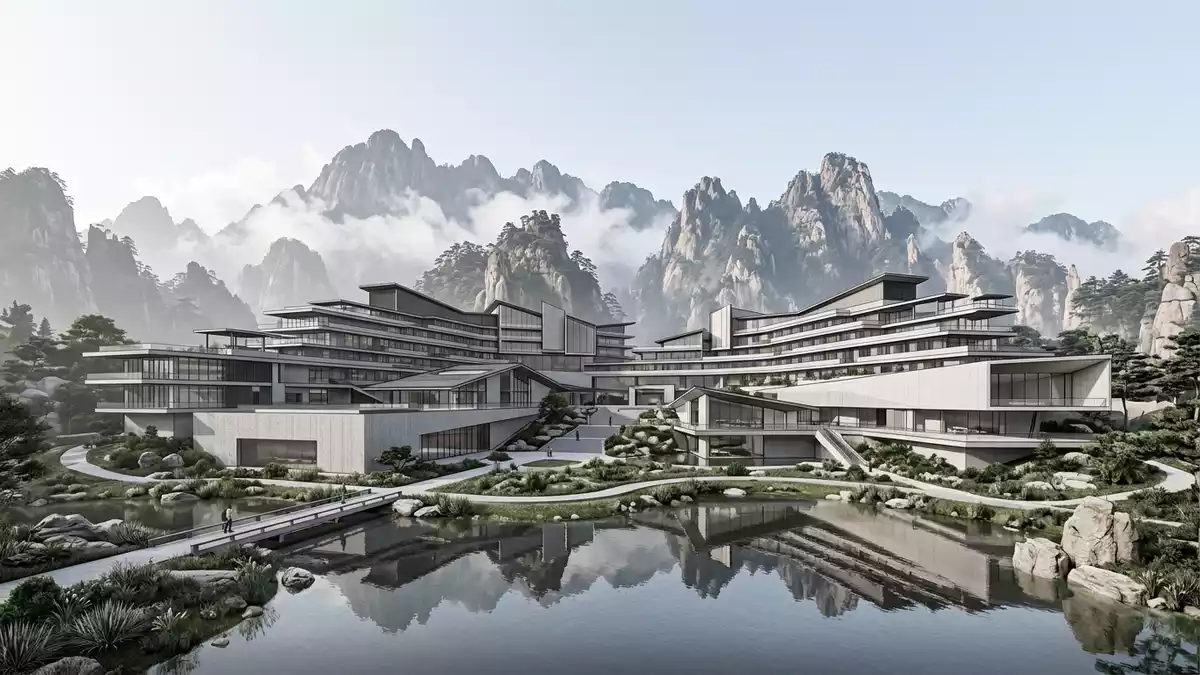
Huangshan in eastern China is a mountain range where bare granite peaks rise steeply above forested slopes and drifting banks of cloud. The landscape has carried strong cultural weight since at least the Tang dynasty, when poets and painters turned these cliffs and pines into a recurring subject. In 1990 Mount Huangshan was inscribed as a UNESCO World Cultural and Natural Heritage Site, recognising both its scenery and its ecological value.
Granite summits and the classic “sea of clouds”
Huangshan forms part of the mountainous interior of Anhui province, south of the Yangtze basin and east of China’s central ranges. It is a compact group of peaks where hard granite has weathered into towers, buttresses and slabs, standing above valleys cut into the same rock. Within the protected area the elevation reaches around 1,864 m (6,115 ft), with the highest point known as Lotus Peak on many maps.The granite landscape is a central reason for Huangshan’s designation as a UNESCO Global Geopark.
The image that visitors know best is the “sea of clouds”, when layers of mist and vapour hang in the valleys and low hollows while the peaks stand clear above them. On such days the rock towers appear as islands in changing white surfaces, with individual pines and small clusters of trees emerging from the edges. This combination of steep granite, cloud layers and isolated vegetation has been described as characteristic of Huangshan since early landscape painting in the Shanshui tradition, where mountains and water together form the main motif.Huangshan’s reputation as “the loveliest mountain of China” grew directly from these views.
Pines, cliffs and hot springs
On the upper slopes and near the summits, Huangshan’s vegetation includes pine trees that cling to ledges, grow out of cracks and sit alone on projecting ridges. Many of these trees have gained descriptive names and have been painted repeatedly, their angled trunks and flat canopies standing against bare rock. The rugged ground also supports a range of forest communities and locally endemic plants, giving the mountain its status as a nature reserve under China’s protected area system. The forest coverage within the wider Mount Huangshan protected area reaches a high proportion of its surface, supported by the humid subtropical monsoon climate of this part of Anhui.The UNESCO listing for Mount Huangshan highlights both scenic and botanical richness.
At lower elevations, away from the peaks and cliffs, Huangshan is also known for its hot springs. These emerge near the base of the massif and have been used as bathing places for many years, forming a strong contrast with the cooler, wind-exposed ledges higher up. Water from these springs flows through pools and channels set among rock and vegetation, and their presence contributes to Huangshan’s identity as a landscape containing both hard granite and flowing water. The combination of vertical stone, ancient trees, moving mist and thermal springs has made the mountain a favoured subject in Chinese poetry, painting and more recent photography.Descriptions of Huangshan National Park commonly mention this mix of cliffs, pines and hot springs.
World Heritage mountain shaped by art and conservation
Mount Huangshan was among the first group of sites in China to be added to the UNESCO World Heritage List.The inscription in 1990 recognised both the visual qualities of its landscape and its importance as habitat for rare and threatened species. The formal World Heritage criteria applied to Huangshan include aesthetic values and biodiversity, reflecting a long-standing link between its slopes and Chinese cultural production. Paintings from the Ming period show stylised versions of its peaks and pines, while later ink works and printed images continue the approach. Modern visitors encounter this legacy in galleries across China, where Huangshan appears as a repeated motif.
Beyond World Heritage status, Huangshan has also been designated as a UNESCO Global Geopark, further emphasising its geological significance.The geopark designation focuses on the granite landforms and the way they record Mesozoic tectonic and magmatic activity. The mountain group lies within a broader biosphere reserve under UNESCO’s Man and the Biosphere Programme, connecting conservation of forests and wildlife with research on human presence in this rugged terrain.Mount Huangshan’s biosphere reserve status situates the peaks within a network of protected landscapes across south-east China.
Visiting Huangshan: what travellers from Western Europe should know
- Huangshan lies in Anhui province in eastern China, with the main access point in Huangshan City. The area is reached by regional rail and road links from large coastal cities.
- The upper parts of the mountain are reached on foot along stepped paths and stone stairways, with significant ascent and descent and sections exposed to wind and weather.
- The terrain includes steep rock faces, narrow ridges and cliff-side walkways with railings, so visitors spend long periods on stone surfaces at varying elevations.
- The official language is Chinese and the currency is the Chinese yuan.
- Entry requirements depend on your nationality; UK travellers can check the FCDO travel advice at gov.uk/foreign-travel-advice, Irish travellers the Department of Foreign Affairs at ireland.ie.
Searching for Huangshan on social platforms
These links open searches for Huangshan on each platform.
Frequently asked questions about Huangshan
Where is Huangshan and what kind of place is it?
Huangshan is a granite mountain range in Anhui province in eastern China, forming a protected scenic and ecological area above Huangshan City.
What should travellers expect on a visit to Huangshan?
Travellers encounter steep stone paths, stairways, cliff-side viewpoints and changing cloud layers around the peaks, with forested slopes and hot springs at lower levels.
What makes Huangshan distinctive among China’s mountains?
Huangshan is distinctive for its combination of jagged granite peaks, ledge-growing pines, cloud seas and thermal springs, together with its recognised World Heritage and geopark status.


