

Huangshan and the granite peaks of Anhui
Published on 08/18/2026 at 14:02 | Editorial responsibility: Rafael Müller, Editor-in-Chief AD HOC NEWS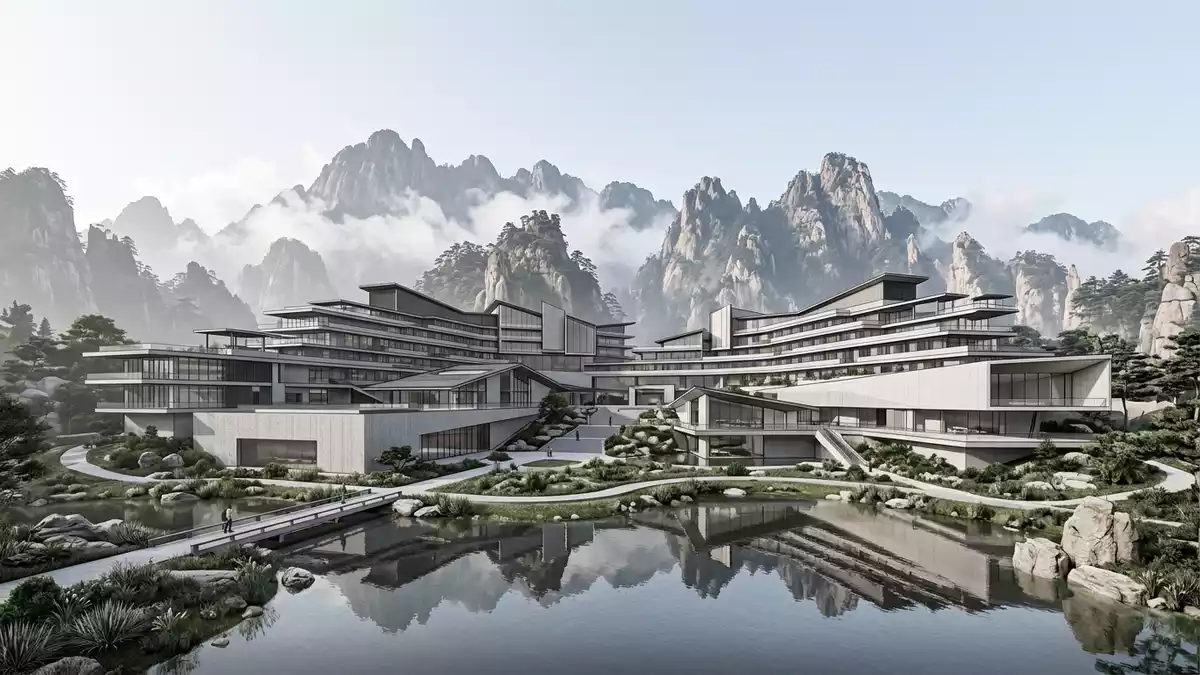
Huangshan is a granite mountain landscape in Anhui, China, with peaks, joints and weathered rock forming its most visible character. It is also known in English as Mount Huangshan, a name tied to a UNESCO World Heritage site inscribed in 1990UNESCO World Heritage site.
Granite peaks in southern Anhui
The mountain rises in southern Anhui and belongs to the hilly region of the Nanling Range. Its highest summit reaches 1,864 m (6,115 ft), and the wider protected area covers 16,060 ha1,864 m16,060 ha.
Huangshan is formed mainly of granite, and its terrain includes steep faces, exposed joints and weathered surfaces. The place is also recorded as a biosphere reserve and a geopark, with the World Heritage inscription dating from 1990 and the geopark designation from 2015biosphere reservegeopark designation.
A landscape shaped by rock and weathering
The mountain’s rock history reaches deep into the Mesozoic, and its present surface shows repeated uplift, faulting and erosion. A geological study describes Huangshan as an 1,864-m granite massif, with the granite formed during the Early Cretaceous and later reshaped by uplift and erosiongranite massif.
That history is visible in the mountain itself: exfoliated rock, spheroid weathering and an intricate pattern of cracks and joints. The result is a place where the form of the mountain is inseparable from the grain of the granitegranite landscapefaults and joints.
Huangshan in Chinese art and memory
Huangshan has long occupied a place in Chinese painting, poetry and literary culture. UNESCO’s documentation links the mountain with the tradition of shanshui, the mountain-and-water style that helped define Chinese landscape artChinese landscape art.
The mountain is often associated with the phrase “the loveliest mountain of China”, a description that reflects its dramatic outlines, granite peaks and sea-of-cloud imagery. Its botanical value also matters: the UNESCO record notes endemic plant species and a humid subtropical monsoon climate in Anhui Provinceendemic plant specieshumid subtropical monsoon climate.
Visiting Huangshan: what travellers from Western Europe should know
- The mountain lies in Anhui Province in eastern China. Huangshan City gives access to the wider area, and the site is part of a protected landscape of mountains and forest.
- The terrain is steep in many places, with granite faces, exposed joints and a highest point of 1,864 m (6,115 ft). The landscape rewards attention to contours and rock forms rather than to any single viewpoint.
- The site includes a biosphere reserve and a UNESCO Global Geopark. Huangshan also has a long association with Chinese painting and literature, which remains part of its identity.
- The official language is Chinese and the currency is the Chinese yuan. The mountain sits in a province with a humid subtropical monsoon climate.
Searching for Huangshan on social platforms
These links open searches for Huangshan on each platform.
Frequently asked questions about Huangshan
Where is Huangshan?
Huangshan is in southern Anhui Province in eastern China. The mountain is part of a larger protected landscape that includes granite peaks and forested slopes.
What does a visit involve?
The main experience is landscape rather than architecture: granite peaks, steep relief and long views across the mountain mass. The site is associated with the scenic and cultural traditions of Chinese landscape painting.
What makes Huangshan distinctive?
Its granite geology, high summit and long cultural reputation set it apart as a mountain landscape with both natural and artistic significance. The World Heritage inscription in 1990 formalised that standing.


