
Huacachina: a desert lagoon ringed by towering dunes
Published on 09/16/2026 at 11:27 | Editorial responsibility: Rafael Müller, Editor-in-Chief AD HOC NEWS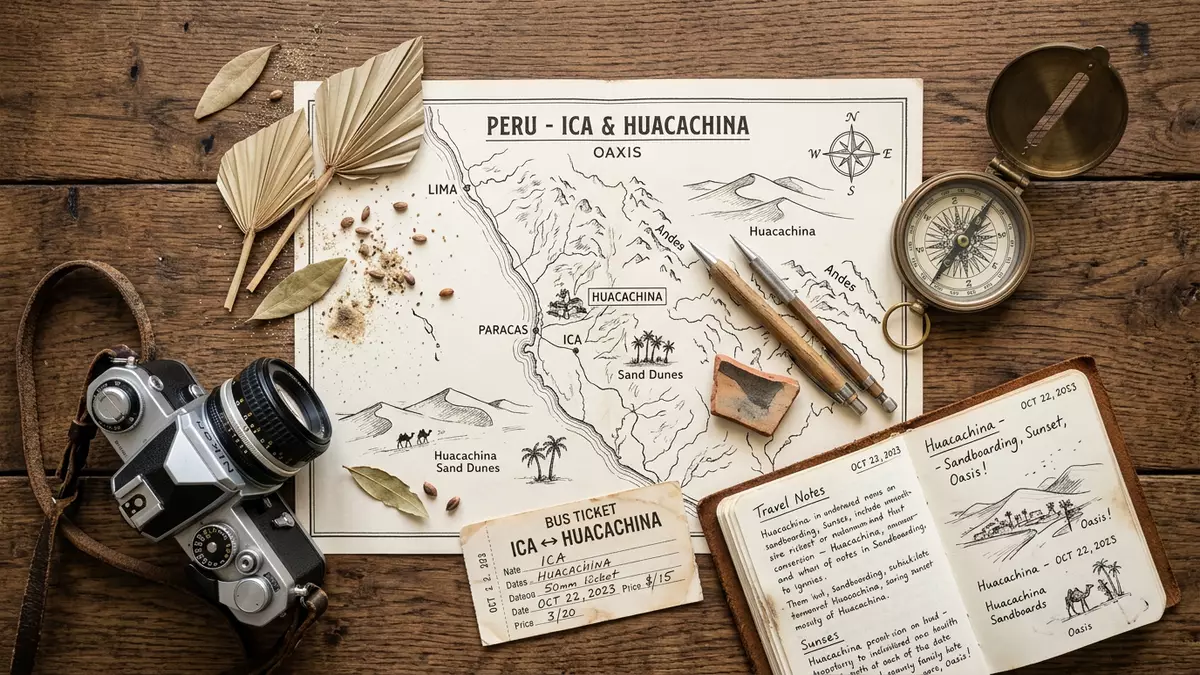
In the desert outside Ica in southern Peru, Huacachina appears as a tight ring of buildings around a green lagoon, hemmed in on every side by steep sand dunes. The village sits in the coastal desert belt that runs south from Lima, and its basin of water and palms has long drawn visitors seeking a desert landscape that combines sand, vegetation and settlement in a single view.
A natural lagoon turned desert village
Huacachina is a small village built directly around a desert lagoon, a pocket of water held in the sand of the Ica desert and enclosed by dunes that rise several hundred feet above the surrounding terrain.a village built in a small oasis The lagoon forms part of the wider Ica desert, one of the hyper-arid regions along Peru’s Pacific coast, where rainfall is scarce and the wider landscape is dominated by bare sand and rock rather than vegetation.a lagoon lined with vegetation in the driest desert
Groundwater from aquifers beneath the desert feeds the basin, giving rise to the body of water known as Laguna Huacachina and supporting a strip of palms and shrubs along its shore.water from underground aquifers reaches the surface The combination of permanent water, vegetation and sand created conditions for a settlement, and Huacachina developed around the lagoon as a resort village during the early and mid twentieth century, when visitors from coastal Peru travelled inland for desert air and the reputed qualities of the waters.a leisure and healing waters getaway in the early–mid 1900s
Sand dunes as everyday surroundings
The most striking element of Huacachina’s setting is the sheer size of the dunes that frame the lagoon and village, their faces rising several hundred feet and forming slopes that are climbed, descended and crossed as part of daily life.sand dunes beyond the oasis rise several hundred feet In places these dunes reach heights around 500 m (1,600 ft), making them among the highest dune forms accessible to visitors in Peru and South America and giving Huacachina a distinctive vertical scale despite the small footprint of the settlement.dunes rising up to 500 metres above the desert floor
Buildings in the village follow the curve of the lagoon’s edge, forming a nearly continuous band of low-rise structures around the water. Between this ring and the rising dunes lies a narrow margin of planted ground and paths, so that almost every route through Huacachina involves a view either across water to facades and arcades or up sand slopes to the crest lines that ring the village.emerald lagoon surrounded by towering dunes and arcades The dunes themselves host tracks worn by repeated foot traffic and by vehicles designed for sand terrain, and the angle between village streets and the dune faces gives Huacachina its characteristic enclosed feeling.
Legends, “healing waters” and maintenance of the lagoon
Stories have grown around Laguna Huacachina, intertwining local legend and the place’s development as a resort. One well known tale tells of a young woman who is transformed into a mermaid-like figure in the lagoon, her story used for decades to add narrative colour to the basin of water and to explain its presence in the desert in mythical terms.the legend of a woman changed into a mermaid in the lagoon In the first half of the twentieth century, Huacachina gained a reputation as a place whose waters were associated with medicinal or “healing” properties, reinforcing its status as a spa-style destination.
Hydrological studies in the Ica valley describe Huacachina as a naturally formed lagoon whose levels have been affected by aquifer extraction, with the basin now maintained by measures that stabilise its water supply.a natural lagoon now artificially maintained Groundwater use in the wider valley increased markedly through the twentieth century, and records trace a gradual decline in lagoon depth from the 1940s, followed by steeper drops in the 1970s which left the basin close to drying. In response, authorities introduced pumping to sustain the lagoon as a visible body of water within the desert, a move that reflects its importance both as a local ecological feature and as the core of Huacachina’s identity as a desert oasis village.
Visiting Huacachina: what travellers from Western Europe should know
- Huacachina lies a short distance west of Ica in southern coastal Peru, reached by road from Ica and set inland from the Pacific shoreline.
- The village sits at low altitude in the Ica desert, but is surrounded by dunes with steep sandy gradients; approaches to viewpoints involve climbing loose sand rather than formed steps.
- Huacachina is in Peru, where the official language is Spanish and the currency is the Peruvian sol.
- Entry requirements depend on your nationality; UK travellers can check the FCDO travel advice at gov.uk/foreign-travel-advice, Irish travellers the Department of Foreign Affairs at ireland.ie.
Searching for Huacachina on social platforms
These links open searches for Huacachina on each platform.
Frequently asked questions about Huacachina
Where is Huacachina and what surrounds it?
Huacachina is near Ica in southern coastal Peru, set in the Ica desert and surrounded by large dunes that enclose a small lagoon and village.
What should visitors expect on a visit to Huacachina?
Visitors find a compact settlement wrapped around a green lagoon, with sandy slopes rising on all sides and paths and tracks leading up the dunes to desert viewpoints.
What makes Huacachina distinctive among desert landscapes?
The combination of a permanent lagoon, a ring of vegetation and buildings, and dunes reaching several hundred feet gives Huacachina a rare enclosed oasis character in the wider desert.


