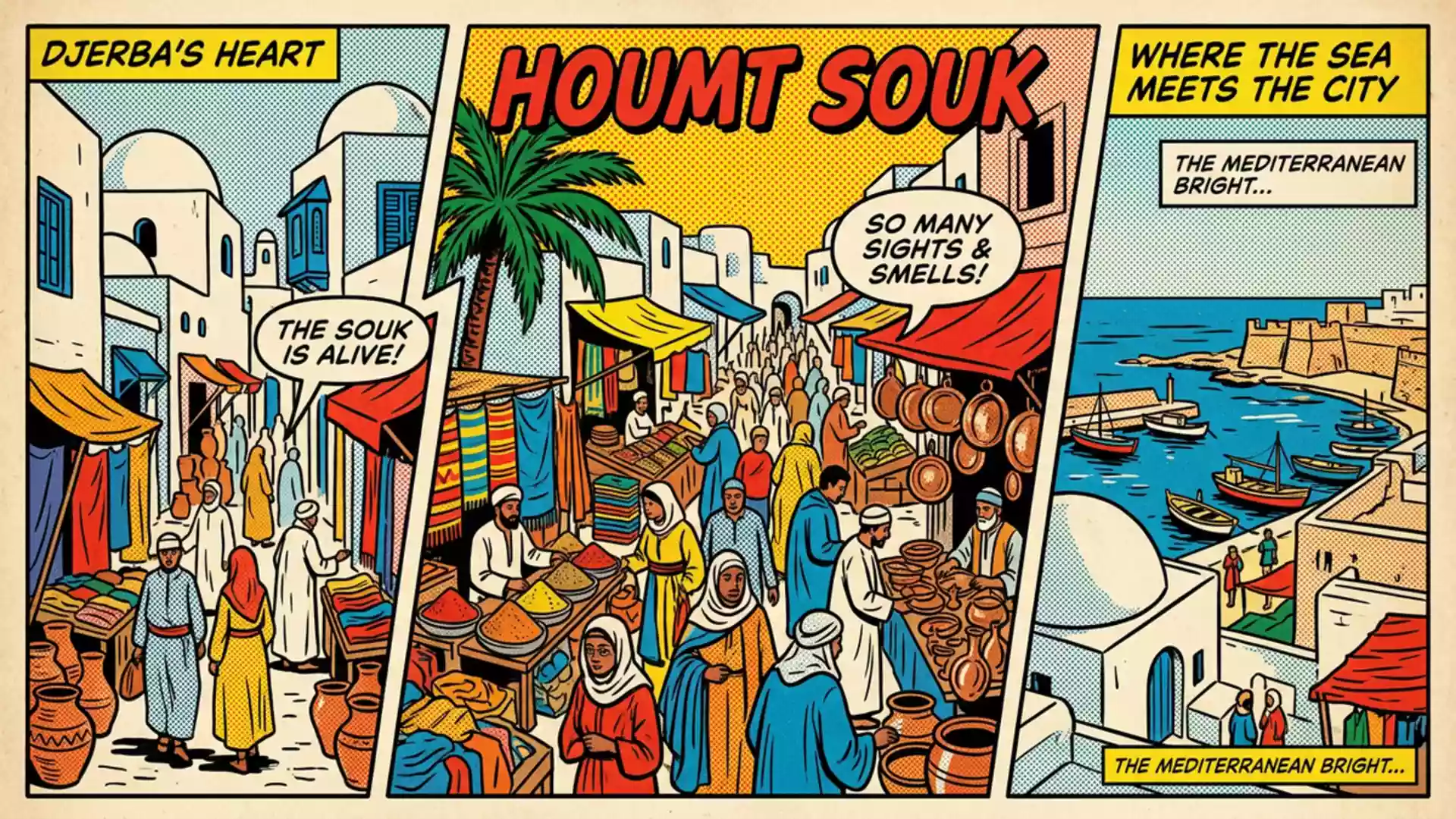
Houmt Souk, the market town at the heart of Djerba
Published on 09/03/2026 at 15:42 | Editorial responsibility: Rafael Müller, Editor-in-Chief AD HOC NEWS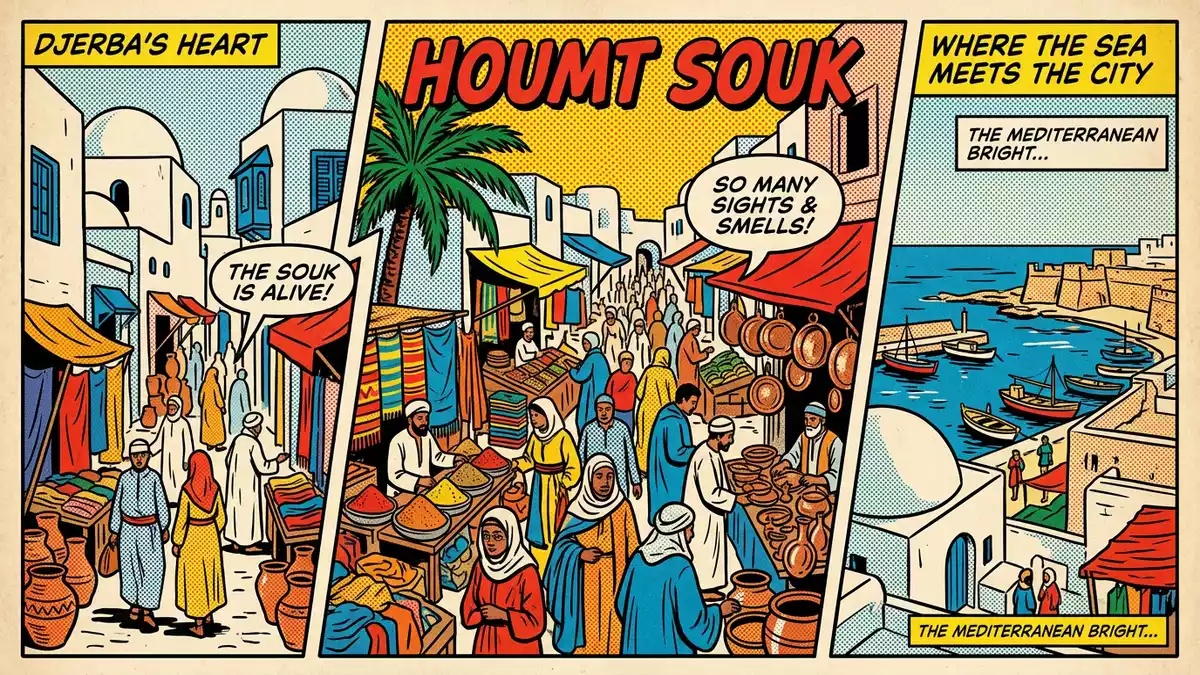
Houmt Souk on the Tunisian island of Djerba is a historic market town whose whitewashed streets and harbour have grown around trade for centuries. Its name, meaning “market neighbourhood”, signals a place where commerce and sea routes have shaped the town’s layout and atmosphere since at least the medieval period.the market neighbourhood
A town built around markets and the sea
Houmt Souk is the main town and administrative capital of Djerba, in south-eastern Tunisia, facing the Mediterranean at the northern edge of the island.administrative capital of Djerba Island The town forms the centre of the Djerba-Houmt Souk municipality, which in the early twenty-first century covered more than 170 km² (65.6 sq mi) and included several districts.covers 176.54 km²
Its name literally translates as “market neighbourhood”, reflecting its long-standing role as the principal trading centre of the island, where caravans from the Sahara once met maritime routes across the central Mediterranean.Markt-Nachbarschaft The town’s growth around its markets and harbour has left a compact urban core, with streets converging on squares lined with arcaded shops and fondouks, the traditional caravanserais of the Maghreb.
Whitewashed alleys, fondouks and the fishing harbour
The centre of Houmt Souk is a medina of whitewashed houses with flat roofs, punctuated by domed mosques and vaulted passages that shade the alleys. Many of the historic fondouks, the inns that once hosted travelling merchants and stored goods, stand around courtyards where arcades frame the space and upper galleries give onto rooms that have largely shifted towards small hotels, cafes or craft workshops.fondouks turned into charming hotels
North of the medina, the town meets the sea at a fishing harbour where small boats lie moored beside quays built in masonry. Houmt Souk is described as the principal fishing port of Djerba, with a particular focus on catching marine species such as molluscs and crustaceans.premier port de pêche de Djerba The proximity of the harbour to the markets gives a clear sense of how sea and commerce are intertwined here, with fish brought directly into town for sale in the dedicated market halls.
Fortresses, mosques and layered histories
Houmt Souk carries visible traces of different periods of rule over Djerba. On the seafront stands the fortress known as Borj El Kebir or Borj El Ghazi Mustapha, an Ottoman-era stronghold that guarded the approaches to the island and today anchors the northern edge of the town with its high stone walls and angular bastions.Borj El Ghazi Mustapha Within the urban fabric, mosques with cubic prayer halls, corner minarets and low domes reflect the Islamic architecture of southern Tunisia, while a nineteenth-century Catholic church marks the presence of European communities during the colonial period.a 19th-century Catholic church
The town’s role as “the market neighbourhood” has roots in caravan trade routes that connected the Sahara with coastal shipping, and Houmt Souk is described as the final station of an important caravan road in the wider region.letzte Station einer bedeutenden Karawanenstraße In recent decades, tourism has become a major economic focus alongside commerce, and heritage museums in town present traditional dress, jewellery and domestic objects from Djerba, placing Houmt Souk within broader Tunisian cultural history.Volkskundemuseum
Visiting Houmt Souk: what travellers from Western Europe should know
- Houmt Souk lies on the northern side of Djerba, in the governorate of Medenine in south-eastern Tunisia, and is reached by road from Ajim or El Kantara, the two main entry points to the island by ferry or causeway.
- The historic centre is a compact medina with paved streets, arcades and occasional steps around courtyards; many alleys are narrow, and walking between the markets, fondouks and harbour involves short distances on foot.
- Houmt Souk belongs to Tunisia, where the official language is Arabic and the currency is the Tunisian dinar.
- Entry requirements depend on your nationality; UK travellers can check the FCDO travel advice at gov.uk/foreign-travel-advice, Irish travellers the Department of Foreign Affairs at ireland.ie.
Searching for Houmt Souk on social platforms
These links open searches for Houmt Souk on each platform.
Frequently asked questions about Houmt Souk
Where is Houmt Souk located?
Houmt Souk is the main town of Djerba, an island in south-eastern Tunisia in the Mediterranean Sea, forming part of the Medenine governorate.
What can visitors expect in Houmt Souk?
Visitors encounter a compact medina with whitewashed houses, busy markets focused on textiles and crafts, historic fondouks, mosques and a working fishing harbour at the town’s edge.
What makes Houmt Souk distinctive on Djerba?
Houmt Souk stands out as the island’s historic trading centre, where markets, Ottoman-era fortifications and a fishing port lie within walking distance, reflecting centuries of commercial activity.