
Ho Hoan Kiem, the lake of the Returned Sword in Hanoi
Published on 08/29/2026 at 16:55 | Editorial responsibility: Rafael Müller, Editor-in-Chief AD HOC NEWS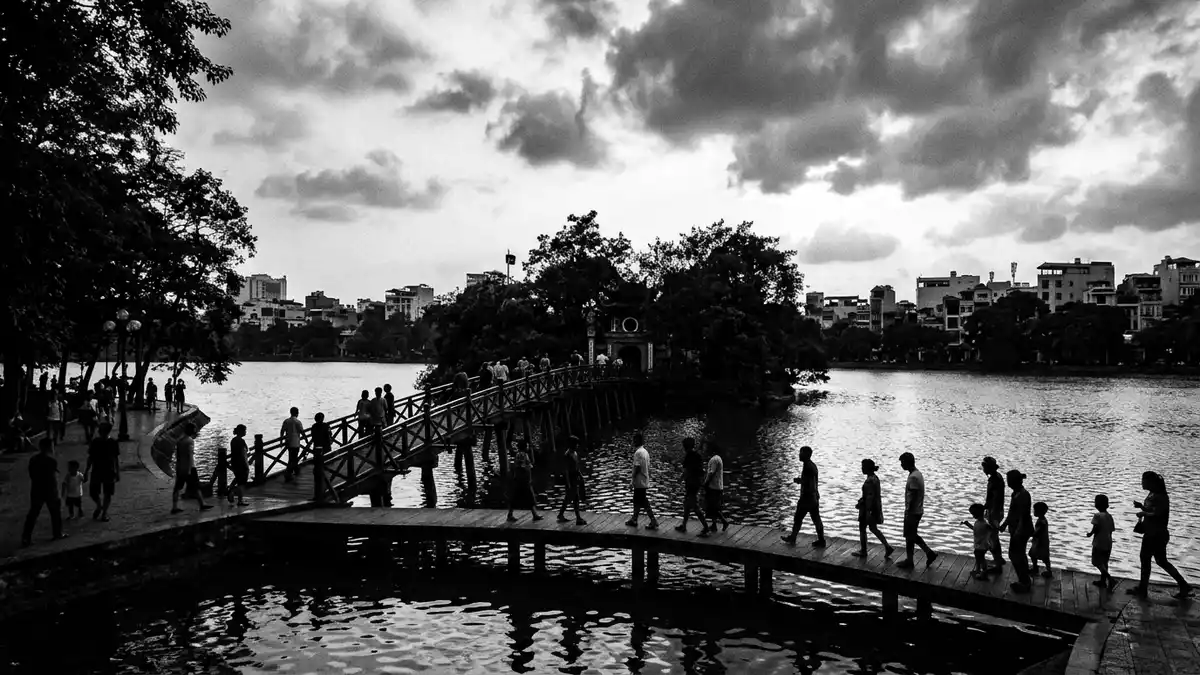
Ho Hoan Kiem, often known in English as Hoan Kiem Lake or the Lake of the Returned Sword, lies in central Hanoi and anchors the historic Hoan Kiem District. Its Vietnamese name refers to the legend of the sword returned by Emperor Le Loi, tying a modest stretch of water directly to the fifteenth century struggle that led to an independent Dai Viet kingdom. For visitors from Western Europe, this lake offers a rare combination of urban park, waterside promenade and layered religious architecture within a few city blocks.
Water, legend and the Lake of the Returned Sword
Ho Hoan Kiem is a freshwater lake in the middle of Hanoi’s Hoan Kiem District, edged by a continuous ring of streets and pavements that form a natural walking circuit. The water surface forms an open space within a dense urban grid, so that the reflections of trees, pavilions and towers are framed by traffic and shopfronts on all sides. The lake itself covers an area of roughly a dozen hectares, giving it enough breadth for views to stretch from one shore to the opposite line of trees and masonry.Hoan Kiem Lake is located in the heart of Hoan Kiem District
The legend linked to Ho Hoan Kiem centres on Le Loi, the fifteenth century leader whose campaigns expelled Ming forces from Dai Viet and who later reigned as emperor. In one of Vietnam’s best known stories, Le Loi received a sword associated with the Golden Turtle, or Kim Qui, and returned it to the divine realm on this very lake after independence was secured.Le Loi and Kim Qui are directly linked to the naming of Ho Hoan Kiem The modern name “Lake of the Returned Sword” preserves that association, and the combination of calm water and mythic narrative continues to shape how the lake is presented in Vietnamese culture.
Turtle Tower, Ngoc Son Temple and sacred architecture on the water
One of the most striking structures within Ho Hoan Kiem is Turtle Tower, a masonry tower that rises from a low islet near the southern part of the lake. The islet has long been associated with real turtles, and the tower’s Vietnamese name, Thap Rua, reflects that link between architecture and animal. From the shore, Turtle Tower appears framed by the lake’s surface in every direction, so that it reads as a focal point in almost any photograph taken from the promenade.Turtle Tower stands on a turtle islet near the southern end of Hoan Kiem Lake
At the northern end of Ho Hoan Kiem, a separate island carries Ngoc Son Temple, also known as the Temple of the Jade Mountain, which was established during the Nguyen Dynasty in the nineteenth century.Ngoc Son Temple was established under the Nguyen Dynasty on an island in the lake The approach from the eastern or northern shore leads across The Huc Bridge, a red-painted wooden bridge whose slight curve draws the eye from the lakeside promenade towards the temple buildings.The Huc Bridge links the shore to Jade Island and Ngoc Son Temple Once on the island, visitors step through a sequence of gates and halls built in traditional Vietnamese forms, with tiled roofs, carved timber and altars. Inside one of the main halls, glass cases display preserved specimens of the giant softshell turtles associated with the lake, tying the legendary Golden Turtle to an actual species that lived in these waters into the twenty-first century.A preserved giant softshell turtle from Hoan Kiem Lake is displayed inside Ngoc Son Temple
Ho Hoan Kiem as Hanoi’s civic and cultural foreground
Beyond its religious and legendary associations, Ho Hoan Kiem functions as a civic foreground for central Hanoi. The perimeter streets, such as Dinh Tien Hoang Street on the eastern side, create a clear boundary between the lake and the surrounding districts of offices, shops and residences.Ngoc Son Temple’s address on Dinh Tien Hoang Street underlines how close Ho Hoan Kiem lies to Hanoi’s Old Quarter The Old Quarter begins only a short distance to the north and west, so that traditional narrow shophouses stand within easy walking reach of the water’s edge.
Along the lakeside, planted promenades and small paved terraces provide places to sit and look towards Turtle Tower and Ngoc Son Temple, or back towards façades and traffic. The contrast between open water and dense city makes it possible to see layers of Hanoi’s history in a single sweep of the eye, from nineteenth century temple structures and civic monuments to concrete mid-rise buildings from later decades. Statues and memorials linked to figures such as Tran Hung Dao, the thirteenth century general venerated at Ngoc Son Temple, underline the way Ho Hoan Kiem brings military, imperial and religious memory into one compact landscape.Ngoc Son Temple is dedicated in large part to General Tran Hung Dao
Visiting Ho Hoan Kiem: what travellers from Western Europe should know
- Ho Hoan Kiem lies in the Hoan Kiem District of Hanoi, immediately south of the Old Quarter and bordered by streets such as Dinh Tien Hoang Street on its eastern side.
- The lakeside is mostly level, with paved paths and occasional short flights of steps around the banks and at the approaches to The Huc Bridge and the temple gates.
- Ngoc Son Temple stands on an island towards the northern end of the lake, linked to the shore by a pedestrian bridge, so any visit to the temple involves crossing the water on foot.
- The official language is Vietnamese and the currency is the Vietnamese dong. Entry requirements depend on your nationality; UK travellers can check the FCDO travel advice at gov.uk/foreign-travel-advice, Irish travellers the Department of Foreign Affairs at ireland.ie.
Searching for Ho Hoan Kiem on social platforms
These links open searches for Ho Hoan Kiem on each platform.
Frequently asked questions about Ho Hoan Kiem
Where is Ho Hoan Kiem located?
Ho Hoan Kiem is a lake in central Hanoi, in the Hoan Kiem District, close to the city’s Old Quarter and streets such as Dinh Tien Hoang Street.
What can visitors expect when walking around the lake?
Visitors find a paved circuit around the water, views towards Turtle Tower and Ngoc Son Temple, and a sequence of trees, statues and small terraces along the shore.
What makes Ho Hoan Kiem distinctive among Hanoi’s landmarks?
Ho Hoan Kiem combines a fifteenth century independence legend linked to Emperor Le Loi with Turtle Tower, Ngoc Son Temple and preserved lake turtles within a compact urban lake.


