
Himeji-jo and the white walls of early modern Japan
Published on 08/27/2026 at 14:02 | Editorial responsibility: Rafael Müller, Editor-in-Chief AD HOC NEWS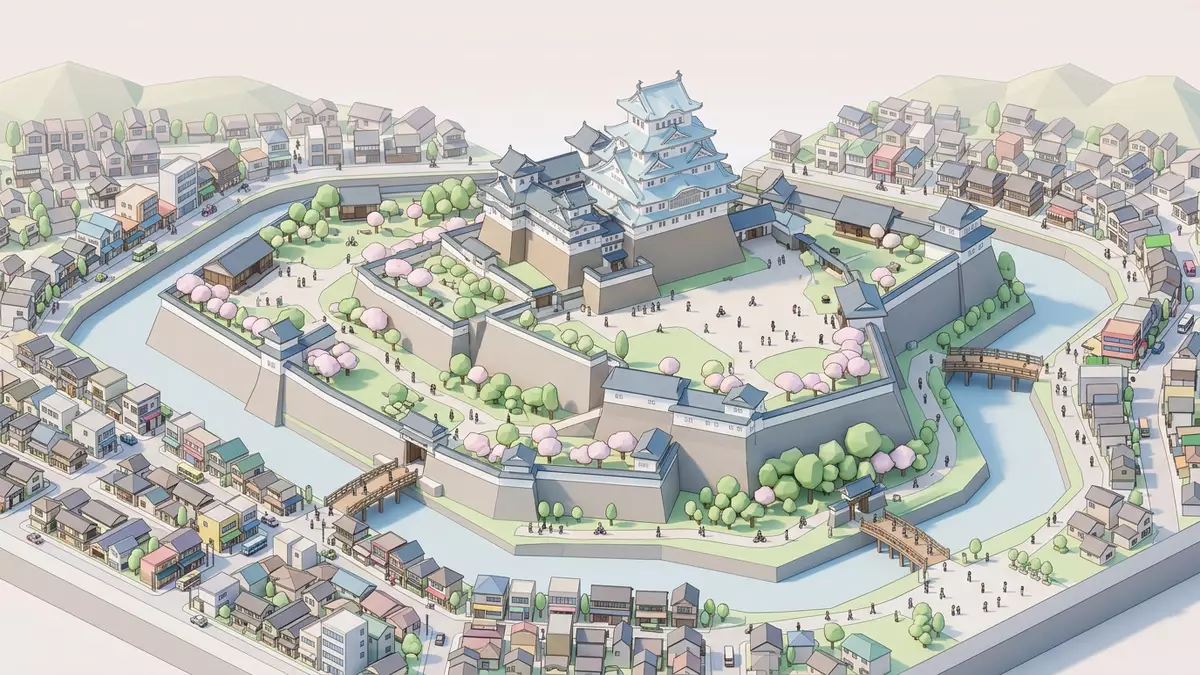
Himeji-jo, known in English as Himeji Castle, crowns a hill above the city of Himeji in western Japan and preserves a remarkably complete wooden castle from the early seventeenth century. Its layered white-plastered walls, rising above stone ramparts and moats, form a multi-roofed silhouette that has become one of the clearest surviving images of Japan’s feudal age.
The white castle on Himeyama hill
Himeji-jo stands on Himeyama hill at the edge of the Harima Plain, where a fortified site was created in the fourteenth century and later reshaped into a full castle complex in the early 1600s.Himeyama hill in the Harima Plain Toyotomi Hideyoshi established a castle here in the late sixteenth century, and under Ikeda Terumasa the present form was created in the years after 1600, at the beginning of the Edo period.Ikeda Terumasa’s early seventeenth-century fortress
The complex entered the World Heritage List in 1993 as Himeji-jo, recognised as an outstanding example of early seventeenth-century Japanese castle architecture and protected alongside its walls, keeps and gates.World Heritage inscription in 1993 The white plastered earthen walls, covering a network of wooden keeps and corridors, give the castle an appearance that contrasts with the darker timber visible in many other surviving Japanese castles.
Layered roofs and a combined-keep layout
At the heart of Himeji-jo stands the main keep, or dai-tenshu, which rises several storeys above its stone base and is linked by covered corridors to three smaller keeps in a combined-keep layout.combined-keep layout of main and small keeps From outside, the central mass appears as a five-tiered structure with multiple rooflines stepping upwards, though the interior contains additional levels connected by stairways and ladders.multi-level main keep interior
The castle complex comprises scores of buildings, including keeps, turrets, walls, gates and long covered passages that bind the hilltop into a single defensive and residential unit.extent of the castle buildings Many of these structures are recognised as Important Cultural Assets of Japan, and together they show the full range of early modern Japanese castle elements, from stone ramparts and moats to watchtowers and storage halls.castle elements and cultural asset designation
A feudal town wrapped around the castle
Himeji-jo was built as a hill-and-plain castle, or hirayama-jiro, with concentric moats and baileys that extended beyond the hill into the surrounding lowlands.hilltop castle with moats and baileys Within the inner bailey stood the main keep and residential halls, while further out the middle bailey housed samurai quarters and the outer areas incorporated the castle town with the homes of townspeople and religious buildings.inner, middle and outer baileys around the keep
The surviving core shows how military, administrative and domestic functions were combined, with defensible gates and passages leading to residential spaces and granaries within the same walled precinct. The extensive use of wood in both structural elements and interior finishes reflects building traditions of the early Edo period, while the white plastered exteriors help define Himeji-jo as a castle whose aesthetic qualities are as prominent as its defensive planning.wooden construction and plastered exterior walls
Visiting Himeji-jo: what travellers from Western Europe should know
- Himeji-jo stands on Himeyama hill in the city of Himeji in Hyogo Prefecture in western Japan, a short walk north from the main railway axis through the city.
- The castle’s central area rises above stone ramparts with a sequence of gateways and sloping paths, and visiting the main keep involves climbing several flights of wooden stairs.
- The wider castle grounds include moats and open spaces around the inner hill, so a visit involves moving between paved approaches and uneven historic surfaces within the complex.
- The official language is Japanese and the currency is the yen.
- Entry requirements depend on your nationality; UK travellers can check the FCDO travel advice at gov.uk/foreign-travel-advice, Irish travellers the Department of Foreign Affairs at ireland.ie.
Searching for Himeji-jo on social platforms
These links open searches for Himeji-jo on each platform.
Frequently asked questions about Himeji-jo
Where is Himeji-jo located?
Himeji-jo stands on Himeyama hill in the city of Himeji in Hyogo Prefecture in western Japan, overlooking the Harima Plain and the surrounding urban area.
What should visitors expect inside the castle?
The main keep and connected buildings are wooden structures with stairways, corridors and viewing points, set within a wider complex of stone ramparts, moats, gates and open courtyards.
What makes Himeji-jo distinctive among Japanese castles?
Himeji-jo combines a multi-level main keep, white plastered earthen walls and a complex system of moats, gates and baileys, and it preserves an early seventeenth-century castle town core recognised as a World Heritage Site.


