
Higashi Chaya-gai, Kanazawa’s streets of wooden teahouses
Published on 08/28/2026 at 13:40 | Editorial responsibility: Rafael Müller, Editor-in-Chief AD HOC NEWS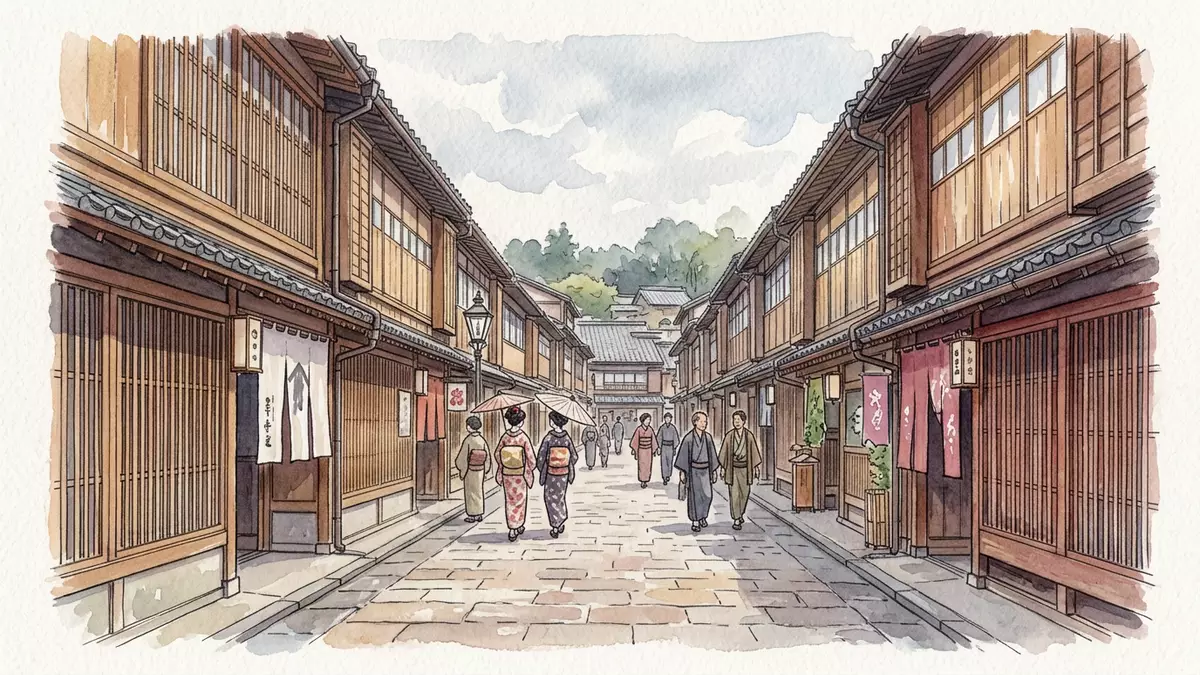
Higashi Chaya-gai in Kanazawa is a historic quarter of wooden teahouses where the streets still show the scale and atmosphere of an Edo-period entertainment district. Dating from the early nineteenth century, it preserves two-storey timber facades, lattice-fronted upper floors and narrow lanes that once framed evenings of music and dance for wealthy patrons.
Teahouse streets from the Edo period
Higashi Chaya-gai sits in the Higashiyama area of Kanazawa, in Ishikawa Prefecture on the Sea of Japan coast. It is one of three surviving chaya quarters in the city, alongside Nishi Chaya-gai and Kazuemachi, and is the largest of these traditional entertainment districts.the largest chaya district The name Higashi Chaya-gai literally means “Eastern Teahouse District”, reflecting its location east of Kanazawa’s core and its original role as a place of teahouses rather than residential streets.Eastern Teahouse District
The district was established in 1820, in the late Edo period, as a planned entertainment quarter for wealthy merchants and members of the local elite.established in 1820 Teahouses in Higashi Chaya-gai hosted evenings where geisha performed dance and music, served drinks and led parlour games. That association is still clear in the streetscape, which is lined with wooden chaya buildings set close together, creating a continuous frontage of board-and-lattice facades along the main lanes.two-storey wooden buildings
Wooden architecture and preserved interiors
Higashi Chaya-gai is distinguished by its rows of two-storey wooden buildings, with the main teahouses facing the central street. Upper floors are often hidden behind fine timber lattice screens, known locally as kimusuko, which filter views and light while keeping the entertainment rooms discreet from the street.distinctive lattice windows Many ground floors retain sliding doors and timber shopfronts, so that even where cafés or shops occupy the space, the overall line of the facades reads as a continuous chaya street.
Two historic teahouses, Shima and Kaikaro, are open to visitors and give access to interiors that date from the district’s foundation period.Shima built with the district Shima is recorded as having been built in 1820, alongside the creation of Higashi Chaya-gai, and is designated a National Important Cultural Property.Shima Important Cultural Property Kaikaro, a larger teahouse nearby, retains rooms with gold-leaf decoration on tatami edges and painted fusuma screens and still functions as a working geisha teahouse for private evening engagements.Kaikaro address Together with smaller chaya buildings, these interiors show how reception rooms, staircases and service areas were arranged vertically within the narrow timber plots.
Higashi Chaya-gai in Kanazawa’s urban fabric
The district is laid out on gently sloping ground in Higashiyama, close to the Asano River, which runs through eastern Kanazawa.along the Asano River From Kanazawa Station the area is reached by city buses, including services branded as Loop Buses, which stop at Hashibach?; from there, short streets lead uphill and into the chaya quarter.access via Loop Bus Within Higashi Chaya-gai, the main chaya street runs roughly parallel to the river, with narrow side alleys linking to smaller residential and artisan lanes.
Higashi Chaya-gai forms part of a wider ensemble of preserved districts in Kanazawa that includes samurai streets and temple areas, but its timber architecture and alignment of teahouses give it a distinct character. The overall streetscape, with cobbled or paved lanes, continuous facades and restrained signage, has been recognised as an Important Preservation District for Groups of Traditional Buildings under Japanese cultural protection schemes.Important Preservation District That status supports the retention of traditional roof materials, facade proportions and external detailing, keeping the area visually consistent for visitors moving between different parts of Kanazawa.
Visiting Higashi Chaya-gai: what travellers from Western Europe should know
- Higashi Chaya-gai lies in the Higashiyama district of Kanazawa, in Ishikawa Prefecture, and is reached from Kanazawa Station by city buses that stop at Hashibach?.
- Within the quarter, streets are narrow and largely level but surfaced in stone or paving, with some short slopes and internal staircases in historic teahouses.
- The official language is Japanese and the currency is the yen.
- Entry requirements depend on your nationality; UK travellers can check the FCDO travel advice at gov.uk/foreign-travel-advice, Irish travellers the Department of Foreign Affairs at ireland.ie.
Searching for Higashi Chaya-gai on social platforms
These links open searches for Higashi Chaya-gai on each platform.
Frequently asked questions about Higashi Chaya-gai
Where is Higashi Chaya-gai in Kanazawa?
Higashi Chaya-gai is in the Higashiyama district of Kanazawa, in Ishikawa Prefecture, on the eastern side of the city near the Asano River.
What can visitors expect when walking through the district?
Visitors walk between rows of preserved two-storey wooden teahouses, some with lattice-screened upper floors, and can enter selected historic interiors such as Shima and Kaikaro.
What makes Higashi Chaya-gai distinctive among Kanazawa’s historic areas?
Higashi Chaya-gai is Kanazawa’s largest chaya quarter, combining Edo-period timber streetscapes, designated cultural properties and a continuing geisha teahouse tradition in one compact district.


