
Higashi Chaya-gai: Kanazawa’s preserved teahouse streets
Published on 09/04/2026 at 18:43 | Editorial responsibility: Rafael Müller, Editor-in-Chief AD HOC NEWS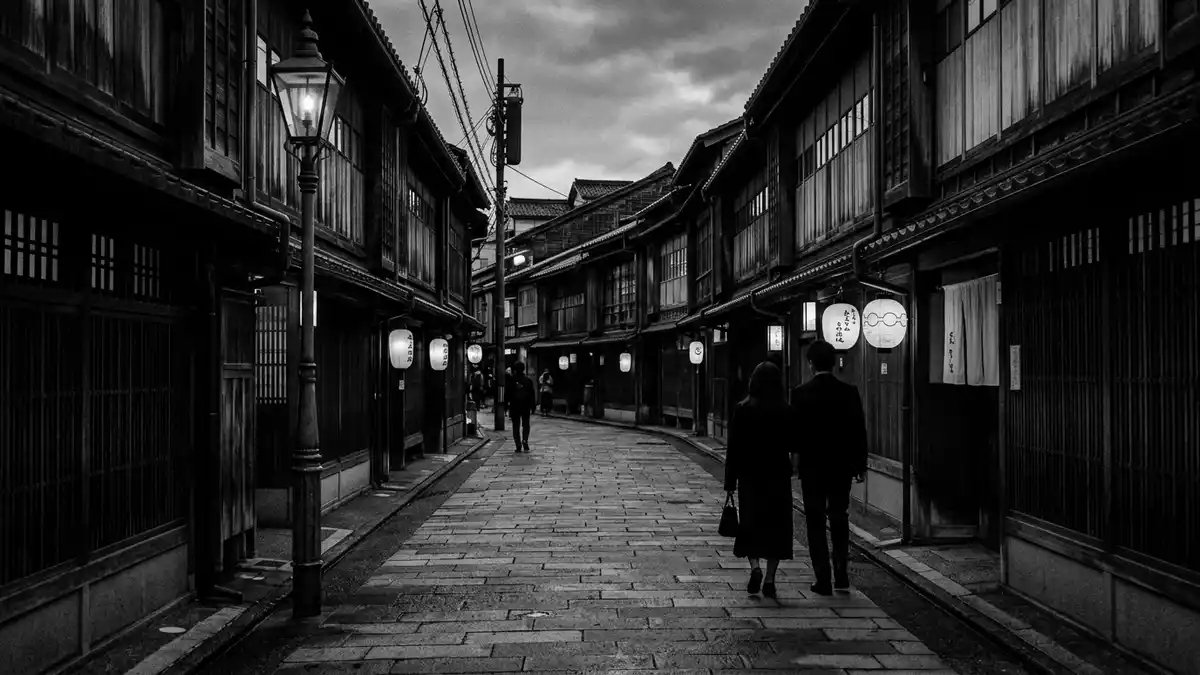
Higashi Chaya-gai in Kanazawa is a historic teahouse quarter where rows of wooden townhouses line narrow lanes on the east bank of the Asano River, preserving an Edo-period streetscape within the modern city. Chartered as a regulated entertainment district in 1820 during the late Edo period, it has kept its intimate scale and traditional architecture while its buildings have taken on new roles as museums, shops and cafés.
Edo-period geisha quarter on the Asano River
Higashi Chaya-gai occupies part of the Higashiyama area of Kanazawa, in Ishikawa Prefecture on the Sea of Japan coast. The quarter was chartered in 1820 by the Kaga domain as one of Kanazawa’s official chaya, or teahouse, districts where geisha performed music and dance for wealthy patrons in ochaya teahouses.Chartered by the Kaga Domain in 1820 The district’s layout dates from that founding, with a compact grid of lanes extending between the Asano River and the hillside behind Higashiyama.
Alongside Nishi Chaya-gai and Kazuemachi, Higashi Chaya-gai formed one of three recognised geisha quarters in Kanazawa, but it grew to become the largest of them.Kanazawa has three, well preserved chaya districts The quarter has been designated as an Important Preservation District for Groups of Traditional Buildings, recognising both its Edo-period plan and its concentration of historic wooden teahouses.Important Preservation District for Groups of Historic Buildings
Wooden teahouses and lattice-fronted streets
The defining image of Higashi Chaya-gai is its two-storey wooden teahouses standing close together along stone-paved streets, with timber façades and distinctive lattice screens shading the ground floors.cobblestone lanes and distinctive lattice windows The buildings were constructed as chaya-kenchiku, a specialised teahouse building type, with guest rooms on the upper storey and discreet entrances along the lane. Many retain interior features associated with geisha entertainment, including tatami rooms, decorative alcoves and small stages.
Several former ochaya now function as museums where visitors can walk through intact teahouse interiors. The Shima teahouse and the Kaikaro teahouse are among the best known of these, opened to the public to show the layered structure of a working geisha house.Two chaya, the Shima Teahouse and Kaikaro Teahouse Other buildings have been adapted as cafés, restaurants and craft shops, but external alterations are constrained by preservation rules so that façades, rooflines and lattice fronts continue to read as a coherent streetscape.old buildings have been refurbished into restaurants, cafes, and souvenir shops
Scale, layout and atmosphere of the district
Higashi Chaya-gai is not a large district by area, which contributes to its intimate character. Its main street runs for roughly 100 m through a cluster of narrow side lanes that together once contained many licensed teahouses.main street running approximately 100 meters The preservation area covers around 1.8 hectares and contains a high concentration of historic structures, with a smaller selection recognised as Important Cultural Properties or Tangible Cultural Properties at city and prefectural level.covers about 1.8 hectares and contains roughly 100 historic structures
The Asano River forms a natural edge on one side, with bridges linking Higashi Chaya-gai to other parts of Kanazawa and giving views back over the tiled roofs of the district.Located on the eastern bank of Asano River Within the lanes, the combination of stone paving, close-built timber façades and minimal signage keeps the focus on the period architecture rather than contemporary display. The preservation status has helped maintain building heights and materials, so that the quarter reads as a continuous historic environment rather than a series of isolated monuments.
Visiting Higashi Chaya-gai: what travellers from Western Europe should know
- Higashi Chaya-gai lies in the Higashiyama area east of central Kanazawa, on the eastern bank of the Asano River. The Kanazawa Loop Bus and Hokutetsu local buses serve Hashiba-cho, from where the lanes of the district are reached on foot.
The nearest rail hub is JR Kanazawa Station, which is linked to the city by the Hokuriku Shinkansen and conventional lines. - The district consists of stone-paved streets and alleys lined with close-built wooden townhouses. Moving between different parts of the quarter involves walking on firm paving with occasional slight gradients and kerbs, but no long staircase within the streets themselves.
- Higashi Chaya-gai sits within Kanazawa’s urban fabric and is bordered by the Asano River and other city neighbourhoods. Nearby sights that can be combined in the same day include Kenroku-en Garden and Kanazawa Castle Park to the west, reached by city bus or by a longer walk through central Kanazawa.
- Japan’s official language is Japanese and the currency is the yen (JPY). English-language signage is present at many major sites in Kanazawa, including key points within Higashi Chaya-gai and the nearby bus routes.
- Entry requirements depend on your nationality; UK travellers can check the FCDO travel advice at gov.uk/foreign-travel-advice, Irish travellers the Department of Foreign Affairs at ireland.ie.
Searching for Higashi Chaya-gai on social platforms
These links open searches for Higashi Chaya-gai on each platform.
Frequently asked questions about Higashi Chaya-gai
Where is Higashi Chaya-gai located?
Higashi Chaya-gai is in the Higashiyama area of Kanazawa, in Ishikawa Prefecture on the eastern bank of the Asano River in central Japan.
What can visitors expect on a visit to Higashi Chaya-gai?
Visitors walk through stone-paved streets lined with preserved wooden teahouses, some operating as cafés or shops and others opened as museums that show intact geisha-house interiors.
What makes Higashi Chaya-gai distinctive among historic districts?
It combines an Edo-period geisha-quarter layout from 1820 with a dense concentration of wooden teahouses, recognised through its status as an Important Preservation District for Groups of Traditional Buildings.


