

Hierve el Agua’s stone waterfalls above Oaxaca’s valleys
Published on 08/29/2026 at 07:07 | Editorial responsibility: Rafael Müller, Editor-in-Chief AD HOC NEWS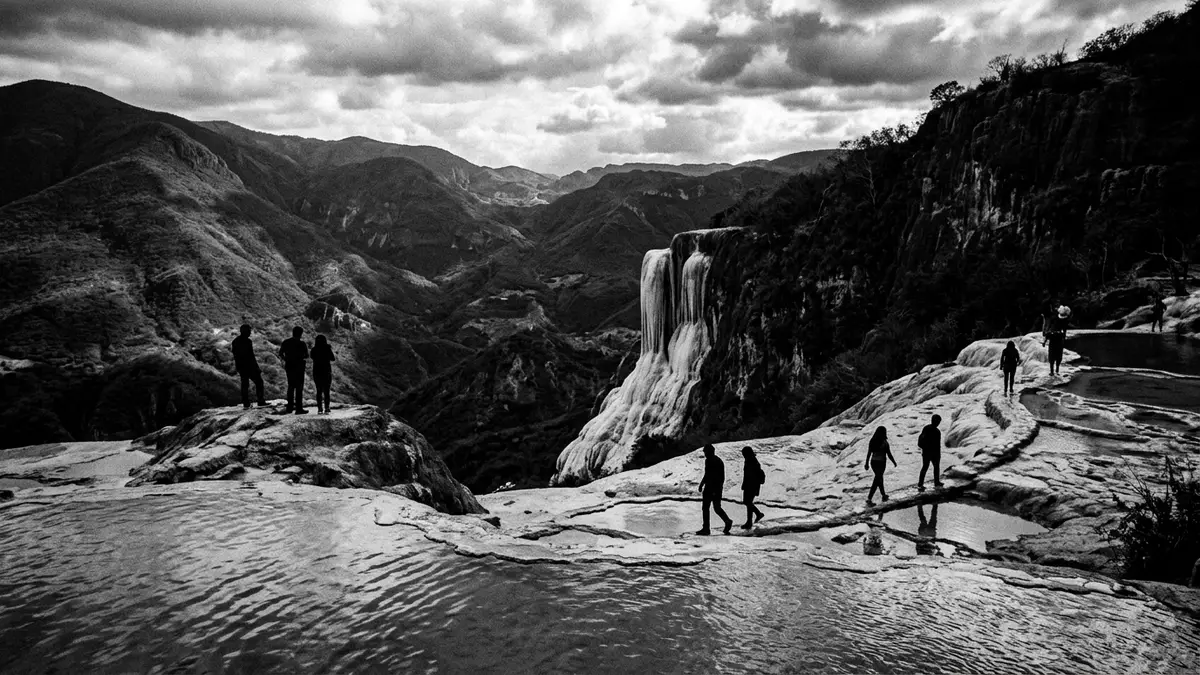
Hierve el Agua in the Mexican state of Oaxaca is a rare place where springs, cliffs and ancient engineering come together in a compact mountain amphitheatre. High above the valleys near San Lorenzo Albarradas, mineral-rich water has built pale rock formations that resemble frozen waterfalls beside terraces and channels linked to early irrigation works.
Stone waterfalls on a mountainside
Hierve el Agua is best known for its pale mineral formations that spill down a steep mountainside like waterfalls turned to stone. The site lies within the municipality of San Lorenzo Albarradas in Oaxaca, on a ridge above the village of San Isidro Roaguía, with views towards the surrounding ranges of the Sierra Madre.Travertine rock formations dominate one side of the natural amphitheatre, forming long ridges and vertical flutes of pale mineral that read from a distance as a hanging curtain of water.
The Spanish name Hierve el Agua translates as “the water boils”, a reference to spring water that emerges from the ground charged with dissolved gases. Beneath the name lies a simple geological process: fresh water rises through the limestone carrying calcium carbonate and other minerals, then reaches the open air and begins to deposit its load on the cliff face as the water trickles away. Over thousands of years, this has built thick mineral crusts and pendant forms similar to stalactites on the outside of the cliff instead of in a cave.Mineral springs supersaturated with calcium carbonate keep the process going in small flows that still reach the edge.
Two cascades and cliff-edge pools
The mineral “waterfalls” at Hierve el Agua appear in two main cascades that drop over the edge of the cliff in separate sheets of stone. One, often called Cascada Grande, is taller and broader, forming a thick apron of white and pale ochre mineral that can be seen clearly from the hiking paths below.Two large petrified waterfalls occupy the most prominent part of the cliff. The second, Cascada Chica, is smaller and sits slightly aside, its mineral drapery wrapping the rock in a more compact band.
Behind the cliff edge, the same springs feed shallow pools of turquoise and milky green water where the mineral-rich flow gathers before spilling away. Some of these pools sit directly on the rim of the amphitheatre, with the travertine surface forming broad natural shelves and undulating steps. The water carries calcium carbonate, magnesium and traces of sulphur, which stain some areas in yellow and ochre tones against the prevailing white.Calcified waterfalls and mineral pools together create a striking contrast between the pale deposits and the darker green hills beyond.
Ancient canals in a living landscape
Hierve el Agua is not only a geological spectacle but also an archaeological site linked to early irrigation in the Oaxaca region. Around the amphitheatre visitors can see terraces and stone channels that formed part of a pre-Hispanic irrigation system built more than 2,500 years ago, associated with the wider Zapotec cultural area centred on sites such as nearby Mitla.Terraces and canals from an ancient irrigation system run across the slopes around the springs, marking an early attempt to bring the mineral water under human control.
The rock itself is travertine, a kind of limestone deposited by mineral springs, and it forms layers that can be traced around the amphitheatre in ledges and shelves. From the top, paths lead out towards viewpoints where both cascades are visible, with the folded ridges of the Sierra Madre de Oaxaca behind. Taken together, the stone waterfalls, cliff-edge pools and archaeological remains give Hierve el Agua a layered character: a landscape shaped by slow geological deposition, adapted by early agricultural terraces and experienced today as a compact, walkable site high above the valleys.
Visiting Hierve el Agua: what travellers from Western Europe should know
- Hierve el Agua lies east of Oaxaca de Juárez, in the municipality of San Lorenzo Albarradas. It is reached by road via villages such as Mitla and San Isidro Roaguía.
- The terrain around the cascades includes uneven travertine surfaces, short steep paths and sections of rocky trail descending towards viewpoints below the cliffs.
- The site stands on a mountain ridge at moderate altitude, with exposed areas around the pools and cliff edge where sun and wind are unfiltered.
- The official language is Spanish and the currency is the Mexican peso. Entry requirements depend on your nationality; UK travellers can check the FCDO travel advice at gov.uk/foreign-travel-advice, Irish travellers the Department of Foreign Affairs at ireland.ie.
Searching for Hierve el Agua on social platforms
These links open searches for Hierve el Agua on each platform.Frequently asked questions about Hierve el Agua
Where is Hierve el Agua located?
Hierve el Agua is in the state of Oaxaca in southern Mexico, on a mountain ridge in the municipality of San Lorenzo Albarradas east of Oaxaca de Juárez.
What can visitors expect to see at Hierve el Agua?
Visitors see pale mineral formations that resemble waterfalls, shallow mineral pools near the cliff edge and remains of ancient terraces and irrigation channels on the surrounding slopes.
What makes Hierve el Agua distinctive among natural sites?
Hierve el Agua combines travertine “waterfalls”, spring-fed pools and visible pre-Hispanic irrigation works in one small amphitheatre, bringing geology and early agricultural engineering into direct contact.


