
Hierve el Agua and Oaxaca’s waterfalls turned to stone
Published on 09/22/2026 at 16:39 | Editorial responsibility: Rafael Müller, Editor-in-Chief AD HOC NEWS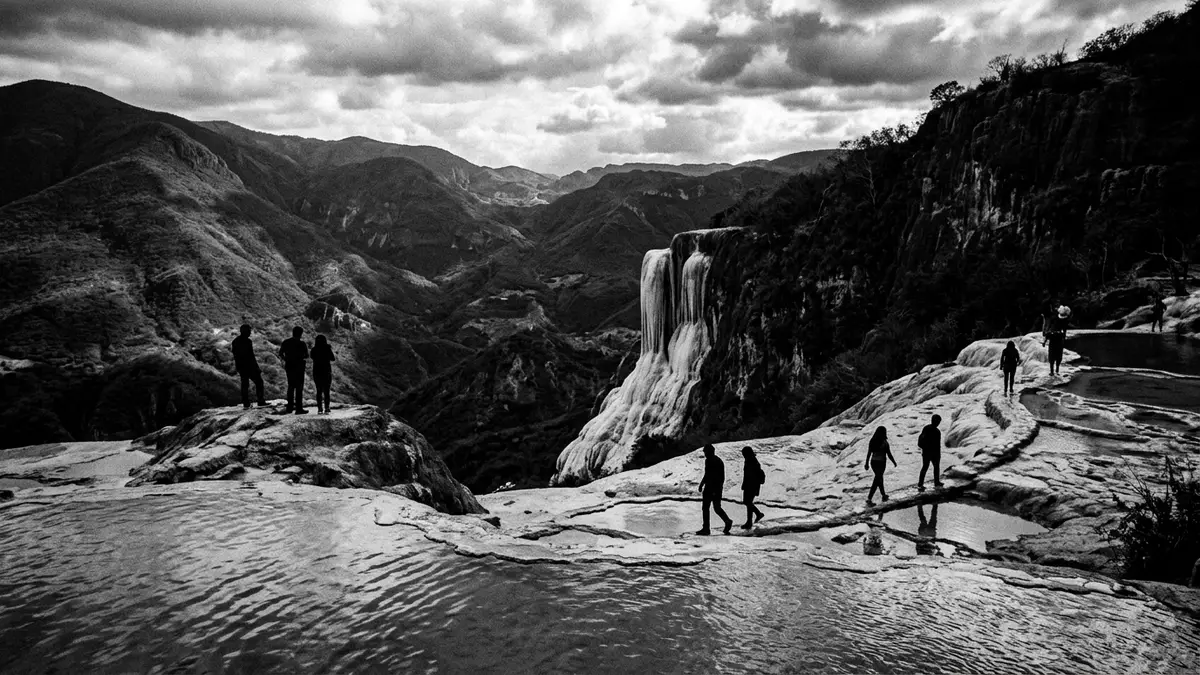
Hierve el Agua is a mountain site in Oaxaca where mineral springs have built pale travertine formations that resemble waterfalls suspended in stone. The Spanish name means “the water boils”, referring to the bubbling springs rather than hot water. Cascada Grande and Cascada Chica descend from the cliff above the valley, while natural pools occupy the upper terrace.
Hierve el Agua: water preserved in stone
The formations are made from calcium carbonate deposited by spring water. Water reaches the surface through cracks in the mountainside, then leaves mineral layers across the rock as it runs over the cliffs. The process resembles the formation of cave deposits, but here the pale stone lies in open air.
Cascada Grande is the larger formation, with a visible drop of about 30 metres (98 ft). Cascada Chica descends about 12 metres (39 ft). Their surfaces retain the lines and folds of flowing water, although the material beneath the springs is solid travertine. A description of the two formations records their different dimensions and names.
The springs, pools and mountain terraces
The springs emerge above the cliff formations and gather in pools bordered by mineral deposits. Their pale rims sit against the darker mountain slopes, creating a clear contrast between water, carbonate rock and the surrounding Oaxaca landscape.
Hierve el Agua lies near San Lorenzo Albarradas, east of Oaxaca City, in the mountain region associated with the central valleys of Oaxaca. Mitla is a nearby archaeological reference point. The site’s upper and lower areas present different views of the travertine shelves, the valley and the channels cut into the slopes.
The name can mislead visitors expecting a thermal spring. The water bubbles as it emerges, but Hierve el Agua is known for mineral springs rather than boiling water. The pools, cliffs and deposits form a connected landscape in which water remains visible at every level.
Zapotec canals beneath the mineral landscape
Hierve el Agua is also an archaeological site associated with the Zapotec civilisation. More than 2,500 years ago, people built terraces and canals around the springs. The surviving remains extend across the hillsides near the formations.
The canals and terraces show water management on steep ground. Mineral deposits helped preserve sections of the channels, leaving a visible record beside the natural formations. An archaeological account of Hierve el Agua describes the terraced hillside and spring-fed canals linked with the Zapotecs.
The function of parts of this system has also been examined through archaeological research. Irrigation is the established interpretation in many descriptions, while studies have considered whether some channels may have supported salt production through evaporation. The visible remains belong to a wider history of agriculture, water control and mineral-rich springs.
The combination of travertine waterfalls and pre-Hispanic waterworks gives Hierve el Agua two distinct physical layers. One was formed by carbonate deposits over a long geological period. The other was shaped by Zapotec construction during the first millennium BC and subsequent centuries.
Visiting Hierve el Agua: what travellers from Western Europe should know
- Hierve el Agua is in San Lorenzo Albarradas, Oaxaca, east of Oaxaca City. Road access follows Federal Highway 190 towards Mitla, with the approach continuing towards the site.
- The site occupies steep mountain terrain. Paths connect the upper spring area, viewpoints, pools and lower perspectives of the travertine formations.
- The lower route reveals sections of the ancient canals and terraces. These remains are part of the archaeological landscape, not separate ruins transported to the site.
- The official language is Spanish and the currency is the Mexican peso.
Searching for Hierve el Agua on social platforms
These links open searches for Hierve el Agua on each platform.
Frequently asked questions about Hierve el Agua
Where is Hierve el Agua?
Hierve el Agua is in San Lorenzo Albarradas, in Oaxaca, Mexico. The site lies east of Oaxaca City and near Mitla.
What can visitors see there?
Visitors can see mineral springs, travertine pools, pale cliff formations, mountain views and remnants of Zapotec canals and terraces.
What makes Hierve el Agua distinctive?
Its calcium carbonate deposits resemble two waterfalls turned to stone. The same landscape also contains ancient waterworks associated with the Zapotec civilisation.


