

Heng Shan in Hengyang, China’s southern sacred mountain
Published on 08/16/2026 at 14:58 | Editorial responsibility: Rafael Müller, Editor-in-Chief AD HOC NEWS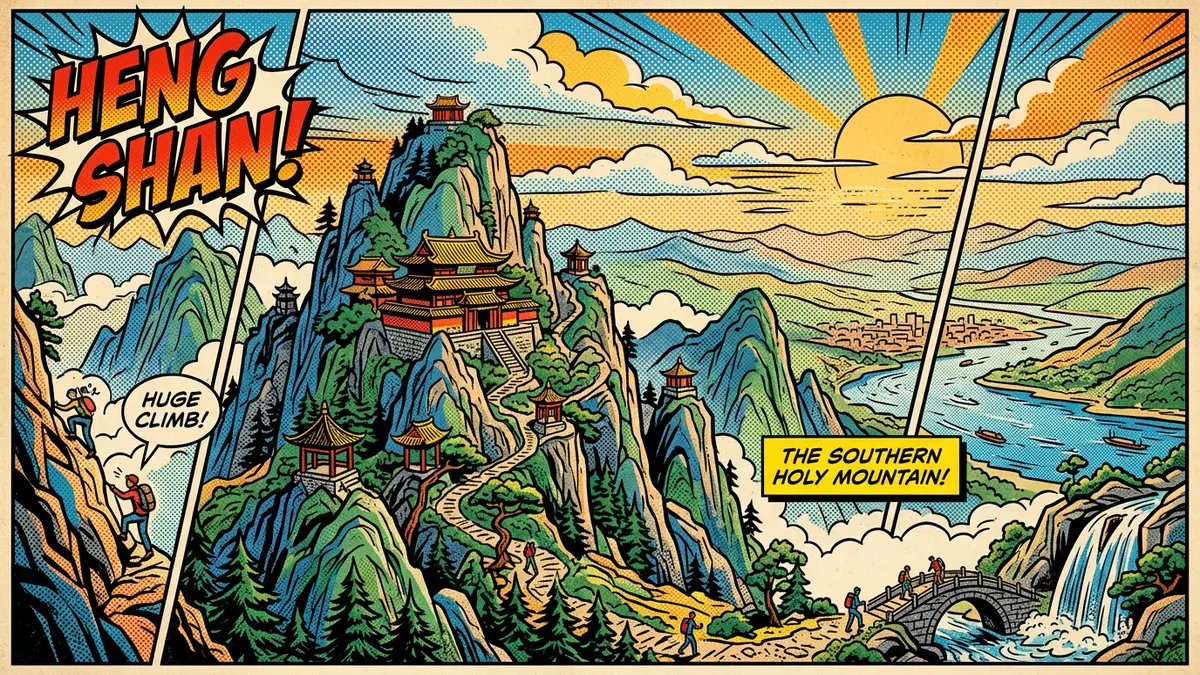
Heng Shan in Hengyang is the southern sacred mountain of China, a granite range where temple courtyards, stone steps and forested ridges thread together into a single landscape of worship and walking.
A sacred mountain of 72 peaks
Heng Shan, also known as Nanyue or the Southern Mountain, lies in Hunan Province near the city of Hengyang in south-central China. It is recognised as the southern member of China’s Five Great Mountains of traditional worship, a group that has framed imperial ritual and pilgrimage routes for centuriesFive Sacred Mountains. The range stretches across Hunan with a chain of peaks that reaches towards Changsha, creating a long, undulating skyline visible from roads and towns in the regionmountain range runs 150 kilometers.
Geographers and local descriptions count 72 named peaks within the Heng Shan range, with Zhurong Peak forming the highest point at about 1,300 m (4,265 ft) above sea levelZhurong Peak 1,300.2 meters. The terrain rises more steeply in the southern section near Zhurong Peak and descends in stages towards the north, where the range eventually meets the lower hills around Changshaterrain higher in the south. Granite and gneiss form the backbone of the mountain, giving cliffs and crags their pale, solid appearance along the main ridgesgranite and gneiss.
Temples, pilgrimage and Nanyue Grand Temple
Heng Shan is one of the most important sacred landscapes in Chinese religion, with Taoist and Buddhist traditions both deeply rooted on its slopesTaoist and Buddhist holy site. Over the centuries, rulers and local communities sponsored temples, monasteries and shrines that still stand along the ascent. The cluster at the mountain’s foot includes Nanyue Grand Temple, also called the Grand Temple of Mount Heng, which functions as one of the principal ritual centres before travellers move higher into the rangeNanyue Temple, the largest temple in Wuyue. Its layout derives from imperial palace architecture, reflecting a rebuilding project during the Qing Dynasty between 1644 and 1911 that followed the general plan of Beijing’s Forbidden Cityrenovated imitating the design.
The Great Temple on the Southern Sacred Mountain stands at the foot of Heng Shan in what is now Nanyue District, arranging its halls and courtyards along a central north–south axisGreat Temple on the Southern Sacred Mountain. Its gates lead towards inner courtyards lined with side halls, drum and bell towers and a main hall where ritual images occupy the central space. Around this core lie many smaller monasteries and hermitages along the lower slopes, some linked to particular schools of Buddhism or Taoism, which together give the mountain an unusually dense religious topography.
Climbing routes and mountain scenery
The ascent of Heng Shan begins in the town of Nanyue at the base, where streets of guesthouses and shops sit beneath the temple roofs. From here, paved paths and stairways lead upwards through mixed forest, with stone inscriptions and smaller shrines set beside the routeMount Heng article. Many travellers aim for Zhurong Peak as the high point of their walk, where a temple crowns the summit and views extend over the surrounding peaks and lowlandsZhurong Peak is the tallest. The approach involves sustained climbing on stone steps, and the air grows thinner and cooler as the route gains height.
Descriptions of Heng Shan often highlight a group of “marvels”, which name particular spots along the range. These include the height of Zhurong Peak, the elegance of the Sutra Collection Hall, the steep line of Huixian Bridge and the scale of Nanyue Grand Templethe eight marvels in Mount Hengshan. Other named places such as Water Curtain Cave and Mojingtai add variety to the climb, bringing together cliffs, cascades and terraces in compact viewpoints that interrupt the ascent.
Visiting Heng Shan: what travellers from Western Europe should know
- Heng Shan lies in Hunan Province in south-central China, with the main access point at Nanyue town in Nanyue District, north of Hengyang city.
- Travellers usually reach Hengyang by rail, including high-speed services to Hengyang East railway station, then continue by road into Nanyue at the mountain’s foot.
- The climb from the temple area to the high peaks follows long flights of stone steps, so the ascent involves sustained uphill walking rather than short ramps or level paths.
- Over the course of the range the terrain rises to about 1,300 m (4,265 ft) at Zhurong Peak, so the upper sections are at a noticeably higher elevation than the plainshighest point being Zhurong Peak.
- The official language is Chinese and the currency is the renminbi (yuan).
Searching for Heng Shan on social platforms
These links open searches for Heng Shan on each platform.
Frequently asked questions about Heng Shan
Where is Heng Shan located?
Heng Shan rises in Hunan Province near Hengyang in south-central China, with the main temple town of Nanyue at its base.
What can visitors expect on a visit to Heng Shan?
Visitors encounter a combination of historical temples, long stone stairways, forested slopes and summit views from peaks such as Zhurong Peak.
What makes Heng Shan distinctive among China’s mountains?
Heng Shan combines its role as the southern mountain of the Five Great Mountains with a dense concentration of Taoist and Buddhist temples on a multi-peak granite range.


