
Hawa Mahal’s honeycomb façade in Jaipur
Published on 09/04/2026 at 08:37 | Editorial responsibility: Rafael Müller, Editor-in-Chief AD HOC NEWS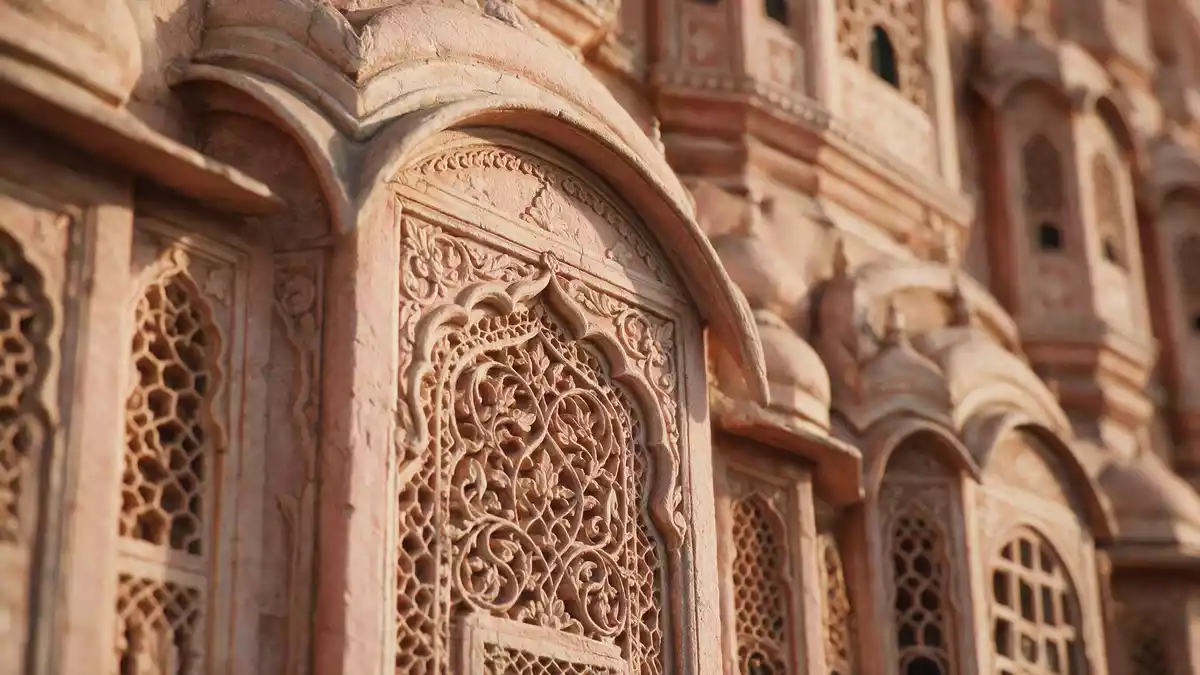
Hawa Mahal in Jaipur is a palace of red and pink sandstone whose stepped façade of tiny projecting windows turns a busy street into one of Rajasthan’s most recognisable views. Built in 1799 under Maharaja Sawai Pratap Singh as part of the City Palace complex, it is a late eighteenth-century expression of Rajput court architecture shaped into an extraordinary vertical screen.
A five-storey palace turned into a façade of windows
Hawa Mahal belongs to the historic centre of Jaipur, the planned city founded by Maharaja Sawai Jai Singh II in the eighteenth century, and forms an extension of the royal precinct facing the main thoroughfare of the old bazaar. The palace rises in five storeys above its base, with the upper levels reading less as enclosed rooms and more as layered galleries of openings.This five-storey arrangement gives the structure a distinctive stepped outline against the sky.
Completed in 1799 during the Rajput period, Hawa Mahal was commissioned by Maharaja Sawai Pratap Singh of the Kachhwaha Rajput dynasty and designed by the architect Lal Chand Ustad.The year of construction, the patron and the architect are well documented and tie the palace to a moment when Jaipur’s court was investing heavily in ornamental architecture. The building’s name, Hawa Mahal or “Palace of Winds”, points to the way air moves through its many openings, but its most striking feature remains the sheer density of windows carried on that tall façade.
The honeycomb of jharokha windows and jali screens
Viewed from the street, Hawa Mahal appears almost entirely made of small projecting windows known as jharokha, each carried on brackets and crowned with its own miniature roof. There are said to be 953 of these jharokha openings, stacked across the five storeys and set so close together that they form a continuous pattern rather than a conventional wall.The figure of 953 jharokha windows recurs in architectural descriptions of the palace.
Each of these small projecting elements is closed not with glass but with finely pierced jali screens in stone or plaster, turning the façade into a lattice that filters light and air while limiting direct views in or out.The combination of jharokha balconies and jali screens is characteristic of Rajput architecture and is strongly present here. From outside, the repetition of these elements creates a honeycomb effect in red and pink sandstone, with small domed pavilions and decorative mouldings adding vertical emphasis.
Rajput and Mughal influences in red and pink sandstone
Architecturally, Hawa Mahal is usually described as a Rajput building that incorporates Mughal elements, aligning it with the broader Indo-Islamic tradition of northern India.Rajput and Mughal styles meet in its use of domed kiosks, fluted pillars and arches alongside symmetrical planning and ornamental stone inlay. The palace’s material palette of red and pink sandstone echoes the colour scheme that gives Jaipur its “pink city” identity, and ties the façade visually to neighbouring structures along the old streets.
Hawa Mahal forms part of the City Palace complex rather than standing as a detached monument, and its elevation has been compared with the crown of the Hindu deity Krishna, giving the building an additional symbolic resonance.Descriptions of Hawa Mahal as resembling Krishna’s crown underline this association. Inside, the palace contains corridors and chambers aligned behind the façade, but for many visitors the defining experience is the view of that intricate outer wall from the street and from neighbouring roofs.
Visiting Hawa Mahal: what travellers from Western Europe should know
- Hawa Mahal stands on a main thoroughfare of the old city of Jaipur, directly attached to the City Palace complex and facing the historic bazaar streets.
- The palace is a multi-storey structure; reaching the upper levels involves climbing staircases that can feel steep and narrow compared with modern buildings.
- Jaipur lies in northern India; the official language is Hindi and the currency is the Indian rupee.
- Entry requirements depend on your nationality; UK travellers can check the FCDO travel advice at gov.uk/foreign-travel-advice, Irish travellers the Department of Foreign Affairs at ireland.ie.
Searching for Hawa Mahal on social platforms
These links open searches for Hawa Mahal on each platform.
Frequently asked questions about Hawa Mahal
Where is Hawa Mahal located?
Hawa Mahal stands in the historic centre of Jaipur in the Indian state of Rajasthan, forming part of the City Palace complex along a main bazaar street.
What should visitors expect on a visit?
Visitors encounter a tall palace attached to the city’s royal precinct, with interior corridors and upper levels reached by staircases and an exterior dominated by hundreds of small windows.
What makes Hawa Mahal distinctive?
The palace is distinctive for its five-storey honeycomb façade of jharokha windows and jali screens, built in 1799 in red and pink sandstone under Maharaja Sawai Pratap Singh.


