
Haw Kham in Luang Prabang preserves a royal residence
Published on 09/22/2026 at 06:13 | Editorial responsibility: Rafael Müller, Editor-in-Chief AD HOC NEWS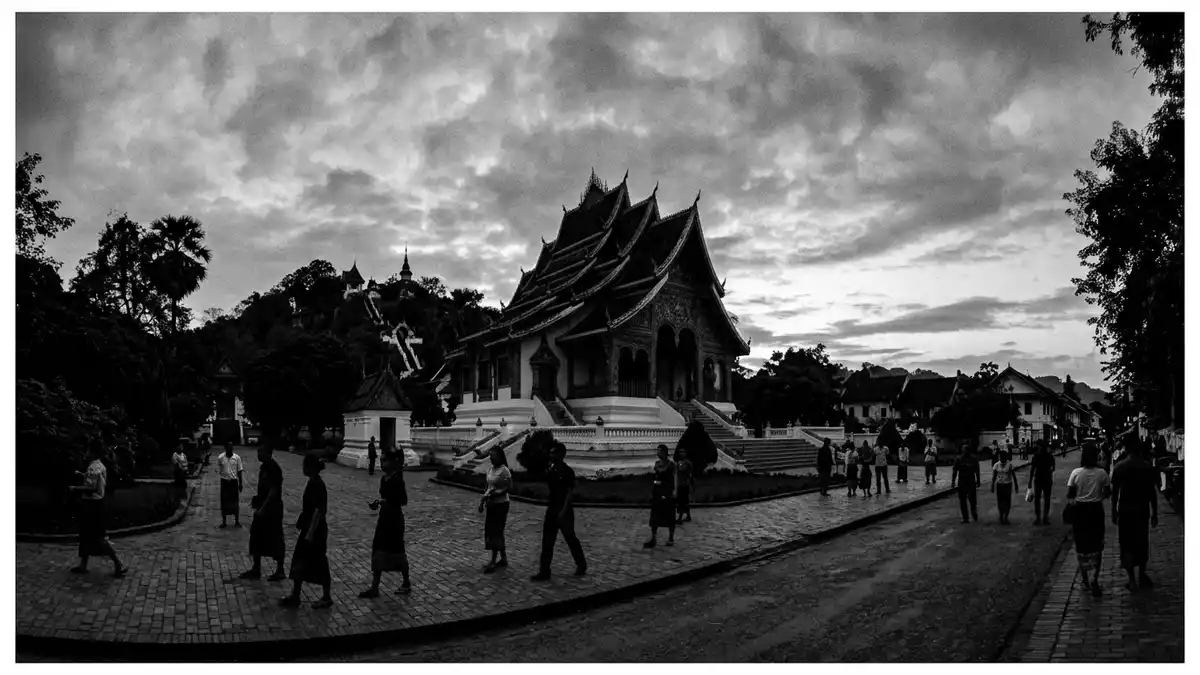
Haw Kham, the former Royal Palace of Luang Prabang, is a residence whose royal rooms became museum galleries. Built between 1904 and 1909 for King Sisavang Vong, it combines French Beaux-Arts planning with Lao architectural forms.
Haw Kham’s Lao and French architectural language
The palace is a low, formal building in brick, with a layered roof and decorative details associated with Luang Prabang. Its architectural style joins Lao motifs with French Beaux-Arts composition, a combination visible across the exterior and interior spaces. palace construction dates place the building within the reign of Sisavang Vong.
The entrance is reached by Italian marble steps. Above it, a three-headed elephant appears beneath a sacred white parasol, a symbol associated with the Lao monarchy. The palace plan has a double-cruciform arrangement, with rooms opening from a central entrance area.
Rooms that record the Lao royal court
Haw Kham became the National Museum of Luang Prabang after the monarchy ended in 1975. Its rooms retain the character of a royal residence while presenting objects connected with the court, diplomacy and religious life. royal palace interiors include reception rooms, living quarters, a throne room and spaces for ceremonial objects.
The king’s reception room contains royal busts and gilded lacquered screens illustrating scenes from the Ramayana. Murals painted in 1930 by the French artist Alix de Fauntereau show scenes from Lao life. The queen’s reception room contains portraits of King Savang Vatthana, Queen Khamphoui and Crown Prince Vong Savang.
Diplomatic gifts occupy another reception room. Paintings, silver, porcelain and objects from countries across Asia, Europe and North America document the international relationships of the Lao court. The collection includes a piece of Moon rock obtained through an Apollo mission.
From royal residence to national museum
King Sisavang Vong and his family occupied Haw Kham during the French colonial period. The palace served as a residence and workplace, linking domestic rooms with ceremonial and administrative spaces. A statue of Sisavang Vong stands on the grounds near the conference hall.
In 1930, the palace spire was renovated with elements drawn from Lao culture and the artistic traditions of Luang Prabang. The change forms part of the building’s visible architectural history, where European planning and Lao decorative language share the same complex. Haw Kham’s museum history connects the royal residence with the national collection.
The grounds contain the Haw Phra Bang temple, a lotus pond and buildings linked with palace administration and transport. The site belongs to Luang Prabang’s historic peninsula, where royal, religious and civic buildings occupy the same urban landscape.
Visiting Haw Kham: what travellers from Western Europe should know
- Haw Kham stands on Luang Prabang’s historic peninsula, near Sisavangvong Road and the Mekong riverfront. The palace is reached on foot through the central town.
- The visit moves through furnished royal rooms, reception chambers and living quarters. The grounds include Haw Phra Bang, a lotus pond and supporting palace buildings.
- Luang Prabang’s official language is Lao and the national currency is the Lao kip.
- Entry requirements depend on your nationality; UK travellers can check the FCDO travel advice at gov.uk/foreign-travel-advice, Irish travellers the Department of Foreign Affairs at ireland.ie.
Searching for Haw Kham on social platforms
These links open searches for Haw Kham on each platform.
Frequently asked questions about Haw Kham
Where is Haw Kham?
Haw Kham is in Luang Prabang, Laos, on the historic peninsula near the Mekong riverfront and Mount Phousi.
What can visitors see inside?
The museum contains royal reception rooms, bedrooms, living quarters, ceremonial objects, diplomatic gifts, portraits and religious collections.
What makes Haw Kham distinctive?
Its identity comes from the meeting of Lao architectural traditions and French Beaux-Arts design within a former royal residence.


