
Harvard Yard and the measured green heart of Cambridge
Published on 09/12/2026 at 21:07 | Editorial responsibility: Rafael Müller, Editor-in-Chief AD HOC NEWS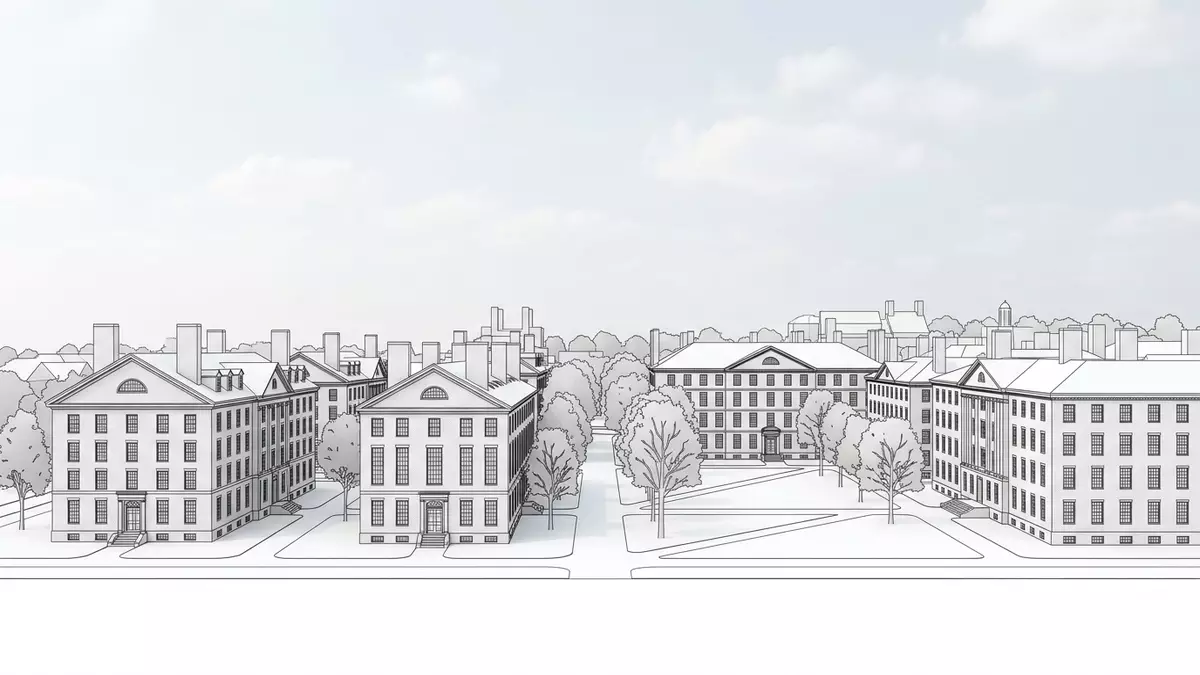
Harvard Yard is the historic green at the centre of Harvard University in Cambridge, a fenced campus space where red-brick buildings, trees and ironwork form a compact academic landscape. It is the oldest part of the university grounds and a place where dormitories, libraries, chapels and offices face onto a shared expanse of lawn.
A collegiate green shaped over centuries
Harvard Yard grew from early Harvard College land assembled in the seventeenth century into a defined campus space during the nineteenth century, when lawns, paths and planting began to organise the open ground. Under President John Thornton Kirkland, who led Harvard College between 1810 and 1828, work on the Yard introduced turf, formal walkways and groves of trees that turned a simple pasture into a planned collegiate green.President John Thornton Kirkland In 1813 the architect Charles Bulfinch set University Hall on the Yard, giving the expanse a stone focal point and fixing its architectural scale.University Hall in 1813
Later in the nineteenth century the enclosure and building fabric were tightened. The Memorial Fence, largely in iron with brick sections, was constructed from 1890 into the early twentieth century, encircling the green with brick piers and ornamental gates.Memorial Fence and gates Within that frame, academic buildings and dormitories were added under President Charles W. Eliot between 1869 and 1909, giving the Yard its present pattern of quadrangles and paths.building under Charles W. Eliot
Red brick, trees and measured edges
Harvard Yard covers roughly 22 to 25 acres (about 9 to 10 ha) of grass and planting, set within perimeter fencing that faces the surrounding streets of Cambridge.about 22.4 acres Massachusetts Avenue, Cambridge Street, Broadway and Quincy Street form much of its outer edge, with Harvard Square immediately to the west.bounded by campus streets Inside the fence, the ground is largely level and criss-crossed by paved and gravelled walkways that link clusters of buildings with grassed spaces between them.walkways and green
The visual character of the Yard comes from the combination of masonry and planting. Many of the surrounding halls and dormitories are brick structures of similar height and mass, set around smaller courts and larger lawns.brick buildings around quadrangles Trees, including long-established elms and pines, form lines along paths and stand in small groves, so that views across the grass pass between trunks to the facades beyond.elms and pine groves The enclosing fence is made of iron panels and brick piers and carries named ornamental gates that open towards different parts of Cambridge.
Buildings, statues and academic life
Harvard Yard is not only a landscape but also a dense concentration of academic and residential buildings. It contains most of the freshman dormitories of Harvard College, grouped especially around the western Old Yard, where Massachusetts Hall stands as one of the earliest surviving structures, completed in 1720.Massachusetts Hall 1720 Nearby, Tercentenary Theatre occupies an open space in the centre of the green, used for formal gatherings and commencement ceremonies.Tercentenary Theater
Several major libraries line the Yard, including Widener Library, Lamont Library and Houghton Library, alongside University Hall and Massachusetts Hall, which house administrative offices.libraries and offices Memorial Church and Holden Chapel bring ecclesiastical architecture into the mix, and the bronze statue of John Harvard stands on a paved area where visitors frequently pause.John Harvard statue Three buildings within the Yard are recognised as National Historic Landmarks, and the whole ensemble was listed on the National Register of Historic Places in 1987, underlining its heritage status within the wider Harvard University campus.National Register listing in 1987
Visiting Harvard Yard: what travellers from Western Europe should know
- Harvard Yard lies in Cambridge, Massachusetts, east of the Charles River and beside Harvard Square, with its gates opening towards streets such as Massachusetts Avenue and Cambridge Street.
- The terrain within the Yard is largely level lawn with paved and gravel paths; access between buildings involves walking on these routes and using internal staircases.
- The closest transport focus is Harvard Square on Massachusetts Avenue, served by urban rail and bus routes that connect the university district with the rest of Cambridge and nearby Boston.
- The official language is English and the currency is the United States dollar.
- Entry requirements depend on your nationality; UK travellers can check the FCDO travel advice at gov.uk/foreign-travel-advice, Irish travellers the Department of Foreign Affairs at ireland.ie.
Searching for Harvard Yard on social platforms
These links open searches for Harvard Yard on each platform.
Frequently asked questions about Harvard Yard
Where is Harvard Yard located?
Harvard Yard is in Cambridge, in the state of Massachusetts in the United States, bounded by streets including Massachusetts Avenue, Cambridge Street, Broadway and Quincy Street.
What can visitors expect when walking through Harvard Yard?
Visitors encounter a level green space enclosed by iron and brick fencing, with red-brick halls, libraries, chapels and dormitories linked by paths and shaded by mature trees.
What makes Harvard Yard distinctive within the Harvard campus?
Harvard Yard combines seventeenth-century college origins, nineteenth-century landscape planning and a concentration of historic academic buildings in one enclosed green that serves as the symbolic heart of the university.


