
Harmandir Sahib and the shimmering heart of Amritsar
Published on 09/10/2026 at 20:55 | Editorial responsibility: Rafael Müller, Editor-in-Chief AD HOC NEWS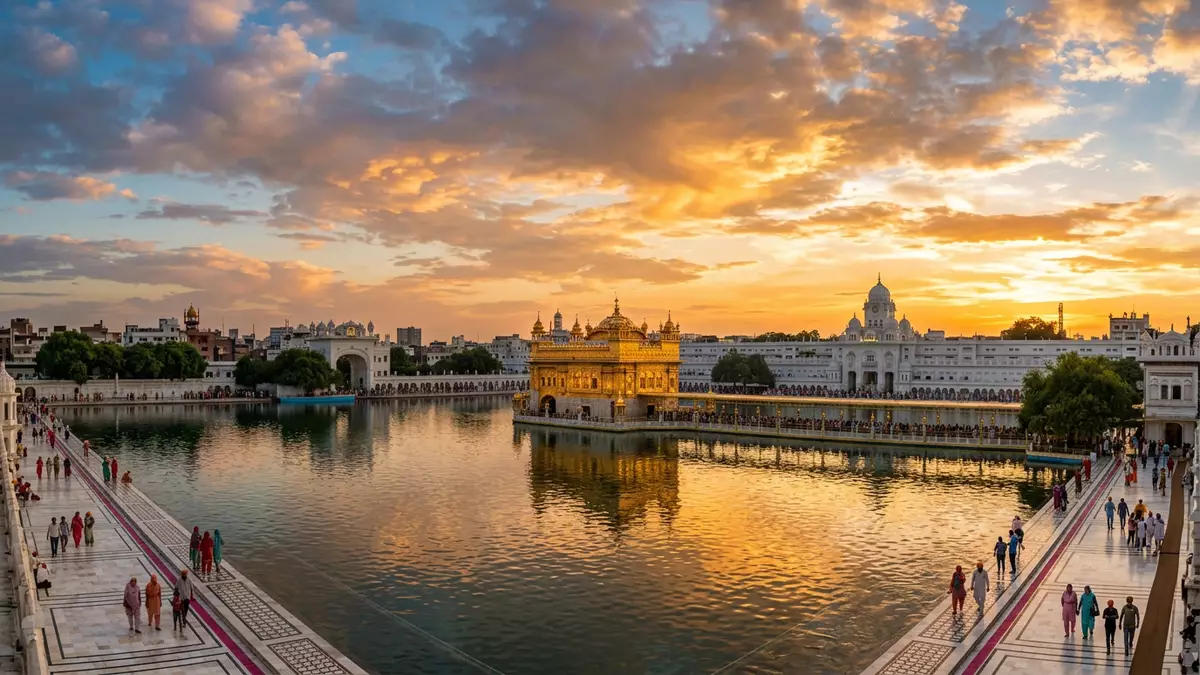
Harmandir Sahib in Amritsar, the holiest gurdwara of Sikhism, rises from the centre of a rectangular sacred pool, its marble and gilded copper surfaces reflected in the water around it. Conceived under Guru Ram Das in the sixteenth century and completed under Guru Arjan, it anchors both the faith’s spiritual life and the city that grew around the Amrit Sarovar, the “Pool of Nectar”.
A temple in the middle of the Amrit Sarovar
The story of Harmandir Sahib begins with Guru Ram Das, the fourth Sikh Guru, who founded Amritsar in 1577 and oversaw the excavation of the man-made tank known as the Amrit Sarovar.Amrit Sarovar and city foundation The water body gave both the city and the shrine their setting: the gurdwara sits on a platform in the middle of the tank, approached by a causeway from the edge of the complex.
Construction of the first Harmandir Sahib followed under Guru Arjan, the fifth Guru, whose period of leadership spans the late sixteenth and early seventeenth centuries.Guru Arjan and early temple The foundation stone was laid by the Sufi saint Mian Mir of Lahore, and the completed shrine housed the Adi Granth, the early Sikh scripture compiled under Guru Arjan. From the outset, Harmandir Sahib was given entrances on all four sides, signalling that the sanctuary was open to worshippers of all backgrounds.
Marble, gold and a blend of architectural traditions
The present appearance of Harmandir Sahib reflects reconstructions in the eighteenth century and extensive embellishment under Maharaja Ranjit Singh in the nineteenth century.Rebuilding and later work The lower levels of the temple are faced in pale marble, while the upper storeys are clad in gilded copper panels, a treatment that gave rise to the informal English name “Golden Temple”. Above the sanctum rises a bulbous dome plated in gold, catching the light across the surface of the tank.
Architecturally, Harmandir Sahib combines elements associated with Mughal and Rajput traditions, creating a form now recognised as a distinct Sikh architectural idiom.Blend of Hindu and Islamic styles Curving chhatri pavilions, cusped arches and inlaid floral ornament appear alongside inscribed panels carrying verses from the Guru Granth Sahib. Inside, walls are decorated with frescoes and mirror work, and the marble floors of the parikrama, the circumambulatory path around the tank, give the entire complex a sense of continuity between interior and exterior space.
Sikh scripture and daily practice at Harmandir Sahib
At the heart of Harmandir Sahib is the Guru Granth Sahib, the central scripture of Sikhism, enthroned within the main sanctum of the gurdwara.Guru Granth Sahib in the sanctum The surrounding complex includes the Akal Takht, established under Guru Hargobind as a seat of temporal authority, underscoring the combined spiritual and community roles carried by the site.
Harmandir Sahib is the focal point of Sikh pilgrimage and daily worship, with a constant recital of scripture within the shrine and a strong emphasis on equality and service in the wider precinct.Role in Sikh practice The four entrances in the surrounding marble colonnades open the complex towards all directions, and the langar halls around the tank form part of the same ensemble, turning the act of sharing food into a physical extension of the sanctum’s openness.
Visiting Harmandir Sahib: what travellers from Western Europe should know
- Harmandir Sahib stands in the centre of Amritsar in the Indian state of Punjab, with the gurdwara and tank forming a walled complex surrounded by city streets.
- Access to the shrine involves walking along the marble parikrama around the Amrit Sarovar and crossing a causeway to the sanctum, with surfaces that can be smooth under bare feet.
- The surrounding city includes other Sikh institutions and markets, and the wider region is linked to major Indian rail routes and an airport serving Amritsar.
- The official language is Punjabi and the currency is the Indian rupee.
- Entry requirements depend on your nationality; UK travellers can check the FCDO travel advice at gov.uk/foreign-travel-advice, Irish travellers the Department of Foreign Affairs at ireland.ie.
Searching for Harmandir Sahib on social platforms
These links open searches for Harmandir Sahib on each platform.Frequently asked questions about Harmandir Sahib
Where is Harmandir Sahib located?
Harmandir Sahib stands in Amritsar in the Indian state of Punjab, within a walled complex built around the Amrit Sarovar.
What should visitors expect on a first visit?
Visitors encounter a marble walkway around the sacred pool, a causeway leading to the gilded sanctum, and associated Sikh institutions arranged around the water.
What makes Harmandir Sahib distinctive among Sikh sites?
Its location in the middle of the Amrit Sarovar, the combination of marble and gold cladding, and its role as home of the Guru Granth Sahib give it a central, distinctive place in Sikhism.


