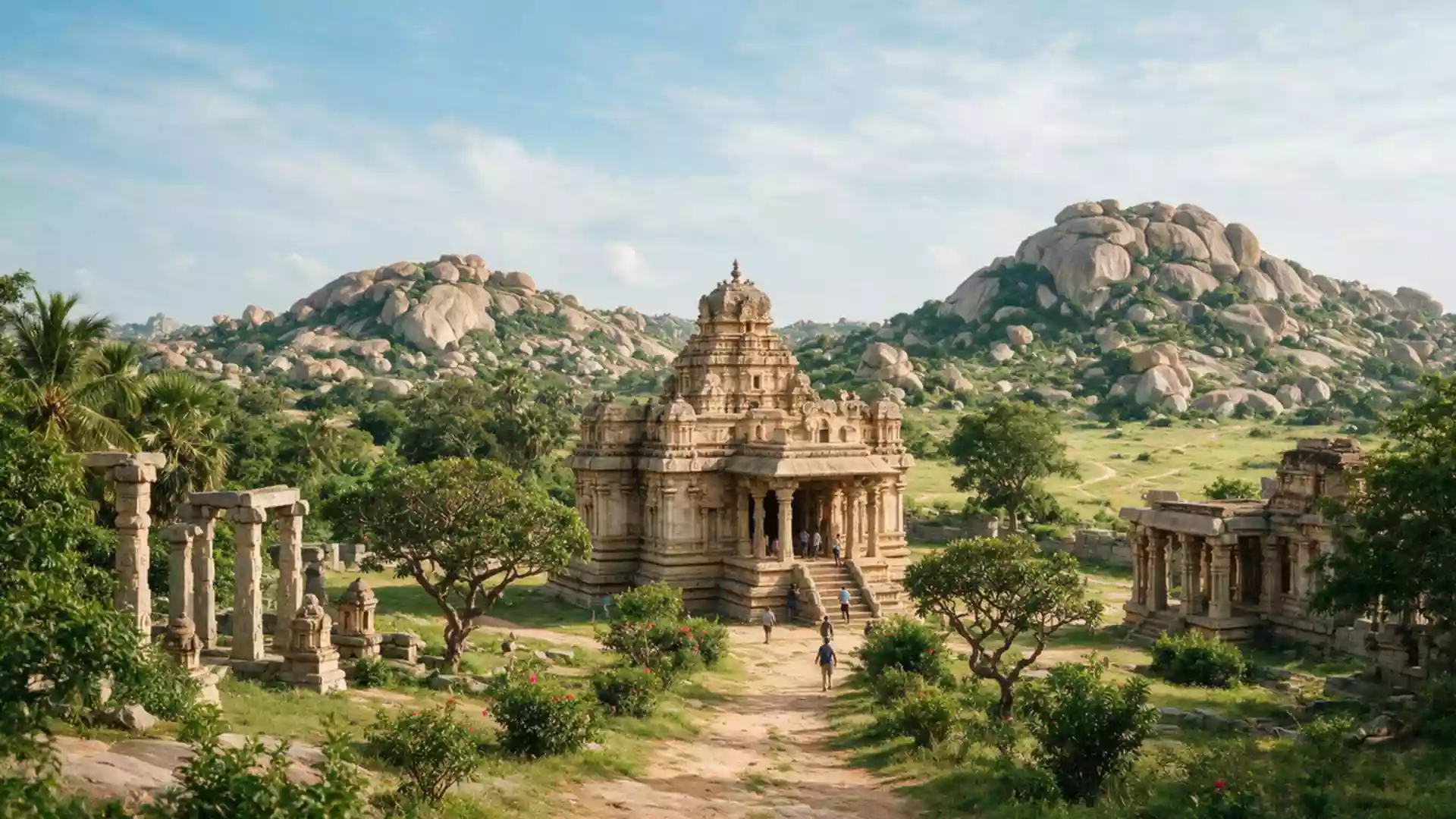
Hampi’s stone landscape of the Vijayanagara kings
Published on 09/11/2026 at 21:44 | Editorial responsibility: Rafael Müller, Editor-in-Chief AD HOC NEWS
Hampi in India is a vast archaeological landscape where the former capital of the Vijayanagara Empire spreads across a rocky river valley along the Tungabhadra River in Karnataka. The Group of Monuments at Hampi was inscribed as a UNESCO World Heritage site in 1986, recognising the cultural importance of this medieval Hindu capital and its extensive remains from the fourteenth to sixteenth centuries.
A capital city carved into boulders
The most striking first impression of Hampi is the way the ruins sit among immense granite boulders and low hills beside the Tungabhadra River in eastern Karnataka. Temples, palaces and market streets were laid out across more than 4,000 ha (about 40 km2) of terrain, integrating architecture with the distinctive rock formations that frame the site.The austere, grandiose site of Hampi includes royal quarters, sacred complexes and riverside structures that follow the line of the valley.
The medieval city of Vijayanagara grew here as the seat of a major Hindu kingdom in South India between the fourteenth and sixteenth centuries. Hampi’s ruins preserve that urban layout in stone, with fortifications, processional routes and temple axes still legible in the landscape.Hampi served as a capital of the Vijayanagara Empire from the fourteenth century, concentrating political, religious and commercial life along the river and across the surrounding plateaus.
Temples, bazaars and royal architecture in stone
The Group of Monuments at Hampi includes a dense cluster of Hindu temples and associated structures that show the architectural ambition of the Vijayanagara rulers. The Virupaksha Temple, dedicated to Shiva and still an active place of worship, rises near the river with tall gateway towers and an inner complex of courtyards and shrines.Surviving monuments at Hampi number well over 1,000 individual structures, ranging from major temple complexes to small shrines cut into the rock.
Further east, the Vittala Temple complex is known for its richly carved stone pillars and a distinctive stone chariot shrine within its courtyard. Nearby, the remains of colonnaded bazaars line former processional streets, framing routes that once linked sacred spaces with the royal core of the city.Royal structures, market streets and water systems at Hampi together outline a planned capital, with palace platforms, elephant stables and audience halls occupying higher ground south of the river.
A World Heritage landscape of history and pilgrimage
UNESCO recognises Hampi as a cultural World Heritage site under criteria (i), (iii) and (iv, highlighting both artistic achievement and historical testimony. The inscription in 1986 formalised protection for a landscape that contains major archaeological remains of one of the largest cities in the world during the sixteenth century.The World Heritage listing emphasises the ensemble of forts, royal and sacred complexes, shrines and water structures spread across the valley.
Beyond its formal status, Hampi remains a living cultural site, with villages, fields and places of Hindu pilgrimage coexisting alongside archaeological zones. The Tungabhadra River continues to define the setting, with ghats and riverside shrines marking points of ritual use along the banks.The Hampi World Heritage area extends across multiple districts and includes both monumental ruins and functioning settlements, making it a complex mix of past and present within one continuous stone landscape.
Visiting Hampi: what travellers from Western Europe should know
- Hampi lies in the Vijayanagara district of Karnataka in southern India, near the town of Hosapete, and is reached overland from regional transport hubs serving this part of the country.
- The terrain around the monuments consists of uneven stone surfaces, stepped temple platforms and paths that rise over boulder-strewn hills, so visiting major clusters involves walking on rock and climbing stairways.
- The Tungabhadra River runs through the site, with ghats and riverside shrines; crossing between areas may involve routes that take account of the river and its banks.
- The official language in this region is Kannada and the currency is the Indian rupee.
- Entry requirements depend on your nationality; UK travellers can check the FCDO travel advice at gov.uk/foreign-travel-advice, Irish travellers the Department of Foreign Affairs at ireland.ie.
Searching for Hampi on social platforms
These links open searches for Hampi on each platform.
Frequently asked questions about Hampi
Where is Hampi and what kind of place is it?
Hampi is an archaeological and cultural landscape in Karnataka, India, centred on the ruins of the former Vijayanagara capital along the Tungabhadra River.
What should visitors expect when exploring Hampi?
Visitors encounter extensive stone ruins spread across hills and riverbanks, including temple complexes, palace platforms, market streets and fortifications set among granite boulders.
What makes Hampi distinctive among historic sites in India?
Hampi combines the remains of a major medieval Hindu capital with a dramatic rocky setting, and its Group of Monuments has been recognised as a UNESCO World Heritage site since 1986.