

Hampi’s stone landscape of the Vijayanagara empire
Published on 08/21/2026 at 21:05 | Editorial responsibility: Rafael Müller, Editor-in-Chief AD HOC NEWS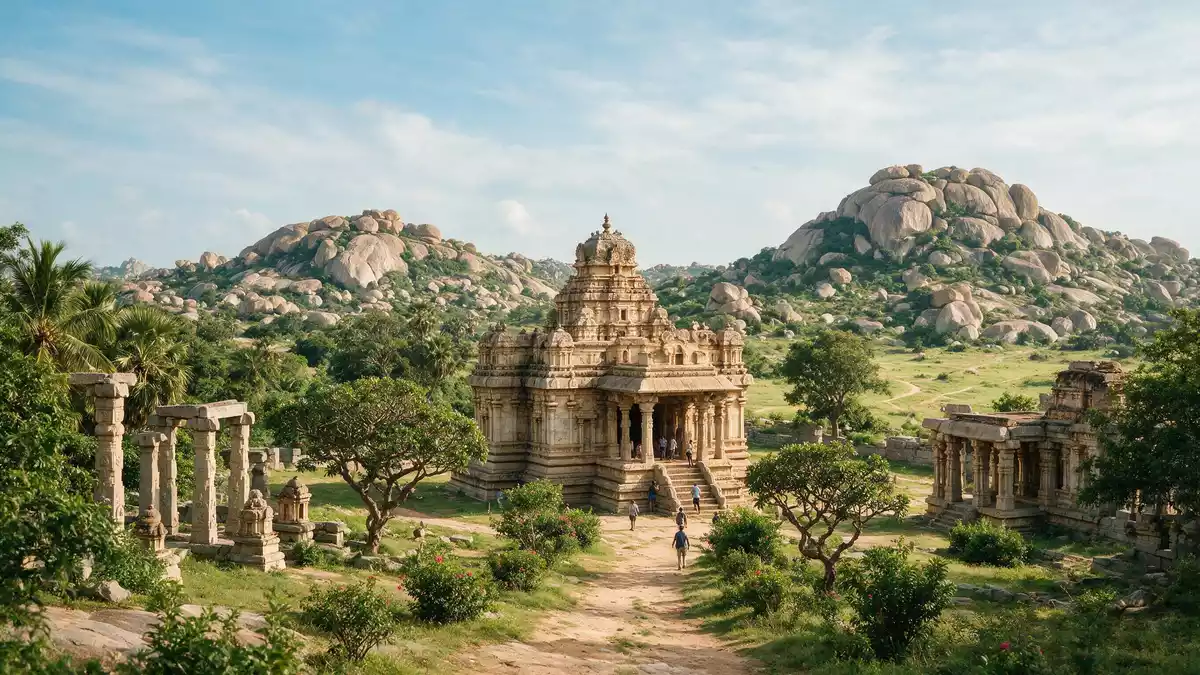
Hampi in Karnataka is the ruinous heart of the former Vijayanagara empire, spread across a landscape of granite boulders, rock-strewn hills and the Tungabhadra river. The Group of Monuments at Hampi is recognised as a UNESCO World Heritage Site, inscribed in 1986 as a cultural property linked to the fourteenth- to sixteenth-century capital of this Hindu kingdom.Group of Monuments at Hampi
Granite boulders, river and ruins
Hampi lies in the Vijayanagara district of east-central Karnataka, on the banks of the Tungabhadra, where clusters of temples, palace platforms and market streets rise among granite outcrops.Hampi in Vijayanagara district The setting is defined by rounded boulders and ridges, some stacked in dramatic formations, with built structures stepping up and across this irregular terrain. Between them, the riverbed and irrigated plains hold shrines, ceremonial structures and former settlements that once formed part of the imperial city.Hampi World Heritage Site
The World Heritage property covers a core area measured in thousands of hectares, with stone monuments scattered across plateaus, river islands and low hills.vast Hampi landscape Granitic rock is the dominant building and landscape material, cut into columns, beams and platforms as well as left in place as natural backdrops to gopurams, mandapas and shrines. Standing among ruined masonry and surviving temples, the relationship between worked stone and the raw boulder field is unmistakable: flights of steps, colonnades and walls extend out from formations that would have shaped the city’s outline.
Capital of the Vijayanagara empire
Hampi was the capital of the Vijayanagara empire, a South Indian Hindu kingdom founded in the fourteenth century and lasting into the sixteenth century.capital of the Vijayanagara empire The city’s rise and fall frame the chronology of its monuments: royal enclosures with platforms for audience halls, granaries and defensive walls date from this period, as do ceremonial streets lined with pillared mandapas and temple complexes dedicated to deities such as Shiva and Vishnu. The site’s significance lies both in its scale and in the density of surviving stone structures connected to imperial rule.
UNESCO recognises Hampi under cultural criteria that highlight its outstanding testimony to a vanished civilisation and the interchange of human values in architecture and urban planning.UNESCO cultural criteria Within this framework, the Group of Monuments at Hampi includes royal precincts, religious complexes, defensive elements and functional buildings such as bazaars and water structures. Many walls and pillars survive only in outline, but the spatial organisation of courts, processional routes and sacred zones remains legible, with ruined platforms and gateways marking transitions between secular and ritual areas.UNESCO World Heritage Site
Virupaksha Temple: a living shrine
Amid the ruins, the Virupaksha Temple stands out as a functioning Dravidian temple complex within Hampi’s archaeological zone.Virupaksha Temple in Hampi Its origins date to about the seventh century CE, linked to worship of Virupaksha, a form of Shiva, and Pampa, a local goddess associated with the river.early Pampa sanctuary Inscriptions refer to Shiva worship here in the ninth and tenth centuries, and additions took place under dynasties such as the Chalukyas and Hoysalas before most of the present built fabric was created in the Vijayanagara period.Vijayanagara-period expansion
The Virupaksha complex includes a towering entrance gopuram, pillared halls and subsidiary shrines, all linked into a sequence of courtyards and passageways.Virupaksha temple complex Unlike many surrounding structures, it has retained an unbroken history of worship from about the seventh century, making it a rare example of a major temple that bridges Hampi’s imperial past and its present religious life.continuous worship at Virupaksha Visitors encounter both architectural detail and lived ritual here, framed by views out towards boulder hills, river plains and the remains of processional streets that once linked this sanctuary to other parts of the city.
Visiting Hampi: what travellers from Western Europe should know
- Hampi lies in Karnataka in southern India, inland from the Arabian Sea and reached via transport connections to towns such as Hospet, Ballari or Hubballi.
- The terrain around Hampi involves walking over uneven granite, climbing flights of stone steps to clusters of monuments and moving between river plains and rocky hills.
- In the dry season the Tungabhadra’s exposed rocks and lower water levels reveal additional shrines and structures along the riverbed and banks.
- The official language in Karnataka is Kannada and the currency is the Indian rupee.
- Entry requirements depend on your nationality; UK travellers can check the FCDO travel advice at gov.uk/foreign-travel-advice, Irish travellers the Department of Foreign Affairs at ireland.ie.
Searching for Hampi on social platforms
These links open searches for Hampi on each platform.Frequently asked questions about Hampi
Where is Hampi and what kind of place is it?
Hampi is an archaeological and religious site in Karnataka, India, centred on the ruins of the former Vijayanagara capital along the Tungabhadra river.
What can visitors expect when exploring Hampi?
Visitors encounter extensive granite ruins, surviving temples such as Virupaksha, rock-strewn hills, river plains and ceremonial streets that once formed part of an imperial city.
What makes Hampi distinctive among historic sites in India?
Hampi combines a vast boulder landscape with dense remains of a fourteenth- to sixteenth-century Hindu capital, including a continuously active temple within a largely ruinous city.


