
Hampi’s stone city on the Tungabhadra river
Published on 09/04/2026 at 07:20 | Editorial responsibility: Rafael Müller, Editor-in-Chief AD HOC NEWS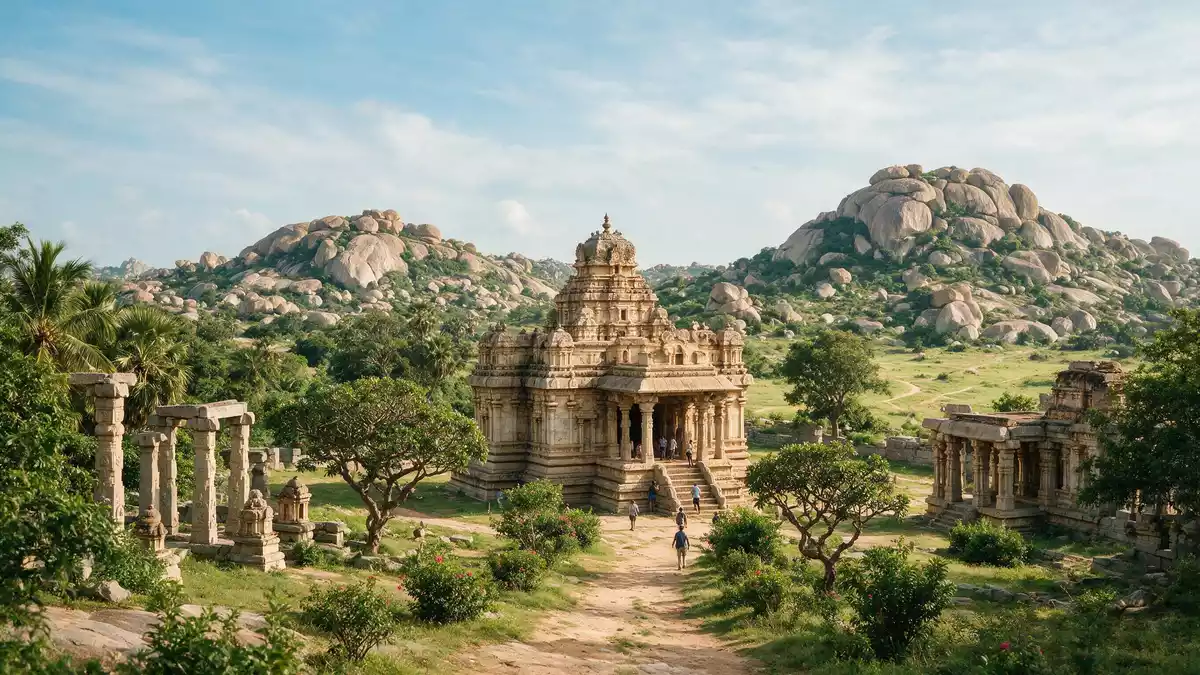
Hampi in Karnataka is a sprawling landscape of stone where the former capital of the Vijayanagara Empire lies scattered around the Tungabhadra river, with Virupaksha Temple still active at its centre. The Group of Monuments at Hampi was inscribed as a UNESCO World Heritage Site in 1986, recognising the remains of this fourteenth? to sixteenth?century Hindu kingdom.
Granite hills and a river of ruins
Hampi occupies a basin along the Tungabhadra river in east?central Karnataka, framed by granite hills that break into boulders, outcrops and ridges around the former city.Tungabhadra basin in Central Karnataka The setting gives the ruins a distinct character: temples, pavilions and gateways rise from pale stone platforms, while massive rocks form a backdrop that feels almost architectural in itself.
The World Heritage inscription covers a core area measured in thousands of hectares and more than a thousand surviving structures, spread across riverbank, plateau and low hills.about 1,600 monuments across roughly 4,100 hectares Within this protected zone are temple complexes, royal enclosures, market streets and defensive works that together trace the outline of a medieval metropolis settled into a rocky Deccan landscape.
Capital of the Vijayanagara Empire
From the fourteenth century Hampi served as a principal centre of the Vijayanagara Empire, a Hindu power that controlled large parts of southern India until the mid?sixteenth century.capital of the powerful Vijayanagara Empire The city flourished between about 1336 and 1565, its rulers building palaces, audience halls, defensive walls and ceremonial routes that wove religious and royal precincts into one urban fabric.
Archaeological studies describe Hampi as an example of the last great Hindu kingdom, with its architecture cited in the World Heritage listing for both artistic achievement and historical importance.ruinous remains of the medieval capital The city’s decline followed the Battle of Talikota in 1565, when a coalition of Deccan sultanates defeated Vijayanagara forces, leaving royal compounds and many religious structures in ruins while the sacred core around Virupaksha Temple continued to function.
Virupaksha Temple, a living sanctuary
At the western edge of the site, Virupaksha Temple forms a living centre within the wider archaeological zone.Hindu temple located in Hampi Dedicated to Virupaksha, a form of Shiva, the sanctuary traces its origins to a small shrine established around the seventh century, several centuries before Vijayanagara power rose around it.small shrine grew into a large complex
Under rulers such as Deva Raya II in the fifteenth century, the temple complex expanded significantly, with gateways, halls and subsidiary shrines added in the Dravidian style typical of southern India.expanded by Lakkan Dandesha under Deva Raya II Inscriptions from the ninth and tenth centuries and later paintings on its ceilings record an unbroken line of worship, making Virupaksha a rare example of a major temple at Hampi that continues its ritual life within an otherwise ruinous cityscape.
Patterns of stone and space
Moving through Hampi reveals how planners and builders used stone to shape both sacred and secular space. Long processional streets paved with slabs run towards temple compounds, flanked by colonnaded platforms that once carried market activity and ritual gatherings.temples, markets and other structures In the royal area, platforms, audience halls and remnants of fortifications stand in open ground, their foundations tracing the outlines of vanished upper structures.
The density of surviving architecture means that built and natural elements are closely interwoven: shrines perch on hilltops, pavilions sit beside the river, and stone stairways climb boulder fields to viewpoints over the former capital.Group of Monuments at Hampi travel guide Together these remains form a continuous terrain of masonry and rock that allows visitors to read the broad plan of a medieval city even where only foundations and fragments survive.
Visiting Hampi: what travellers from Western Europe should know
- Hampi lies in the Vijayanagara district of Karnataka in southern India, along the south bank of the Tungabhadra river, reached by road from nearby towns.
- The archaeological landscape stretches over a wide area with uneven ground, stone steps and boulder?strewn slopes, so visiting the main clusters of monuments involves walking across varied terrain.
- Many structures stand without roofs and with exposed stone surfaces, and some vantage points require ascending hill paths or stairways that gain moderate height above the river plain.
- The official language in this part of India is Kannada and the currency is the Indian rupee.
- Entry requirements depend on your nationality; UK travellers can check the FCDO travel advice at gov.uk/foreign-travel-advice, Irish travellers the Department of Foreign Affairs at ireland.ie.
Searching for Hampi on social platforms
These links open searches for Hampi on each platform.
Frequently asked questions about Hampi
Where is Hampi and what kind of place is it?
Hampi is an archaeological and religious landscape in Karnataka in southern India, spread around the Tungabhadra river in the Vijayanagara district.
What should visitors expect when exploring Hampi?
Visitors encounter extensive stone ruins, active temples and open ground on uneven rocky terrain, with distances between main clusters that require walking or local transport.
What makes Hampi distinctive compared with other historic sites?
Hampi combines the remains of a former imperial capital with an active temple at Virupaksha, set within a granite landscape where natural boulders and masonry sit side by side.


