

Hampi’s stone city of Vijayanagara ruins
Published on 08/31/2026 at 10:49 | Editorial responsibility: Rafael Müller, Editor-in-Chief AD HOC NEWS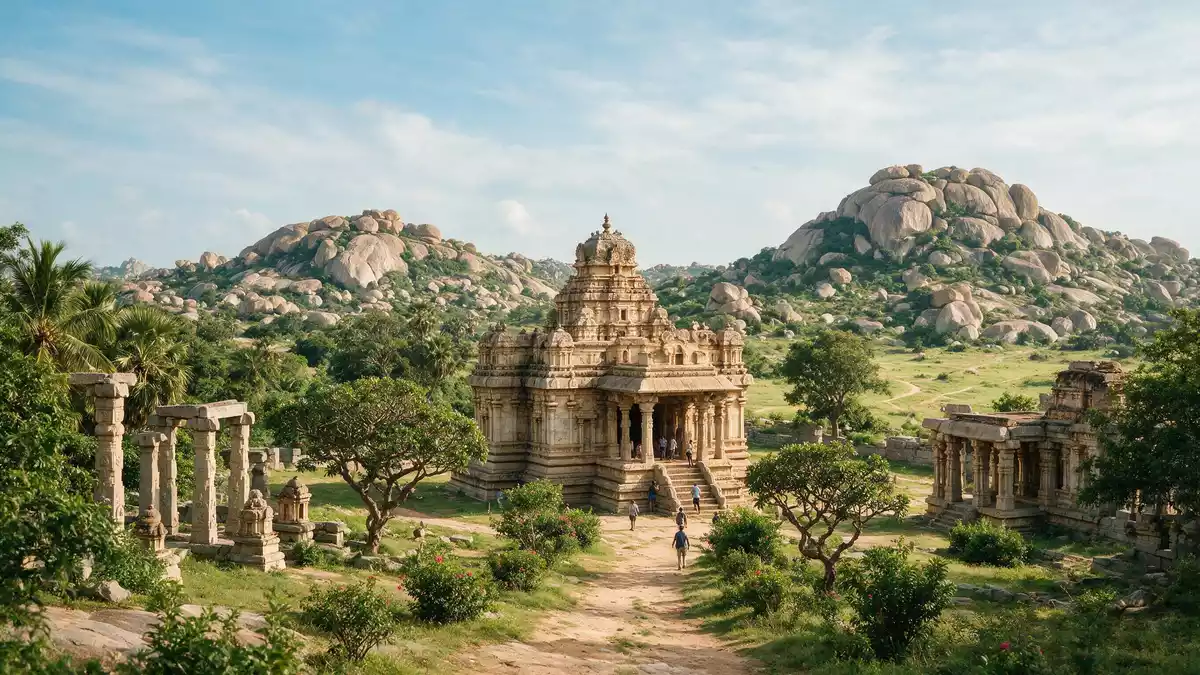
Hampi in Karnataka, India, lies in a landscape of granite hills and the Tungabhadra River, where the ruins of the Vijayanagara capital form a vast stone city in the open air. The Group of Monuments at Hampi is inscribed as a UNESCO World Heritage Site, reflecting its scale and the concentration of religious, royal and civil architecture from the fourteenth to sixteenth centuries.
A capital of the Vijayanagara Empire in stone
Hampi occupies the site of Vijayanagara, the capital of the Vijayanagara Empire that dominated much of southern India between 1336 and the mid-sixteenth century. The remains extend across a core zone measured in thousands of hectares, with temples, palaces, pavilions and fortifications spread among hills and riverbanks.Group of Monuments at Hampi The city’s position in the Tungabhadra basin in central Karnataka linked stone architecture and water, with embankments, channels and tanks integrated into the terrain.the Tungabhadra basin in Karnataka
The built remains at Hampi date mainly from the period between the fourteenth century and about 1570 CE, when successive Vijayanagara rulers extended the capital with new temple complexes and royal quarters.monuments built between 1336 and 1570 CE The overall ensemble includes sacred and secular districts, with distinct temple zones, royal enclosures, defensive walls and riverside shrines. Granite, quarried from the surrounding hills, is the dominant material, giving the site a continuity of colour and texture across its towers, colonnades and platforms.
Temples, markets and royal enclosures
Among the most recognisable structures at Hampi is the Virupaksha Temple, a major Shaiva temple whose towering entrance gopuram rises over an active place of worship in the midst of the ruins.Virupaksha Temple as a major shrine Nearby, colonnaded streets mark former bazaar areas, where rows of stone pillars once framed market activity between temple compounds and the wider city. Further east, the Vittala Temple complex stands out for its sculpted mandapas and the celebrated stone chariot, a shrine with large stone wheels that has become one of Hampi’s defining images.Vittala Temple and stone chariot
South of the main temple districts, the former royal area contains enclosures, platforms and audience halls associated with the Vijayanagara court. High walls, gateways and elevated viewing platforms structure these compounds, which once housed palaces and administrative buildings now reduced to foundations and standing pavilions.royal and sacred complexes, temples and halls Water structures such as stepped tanks and stone-lined channels punctuate these spaces, reflecting the importance of controlled water both for ritual use and for supplying the capital.
Granite boulders, river landscapes and living villages
Hampi’s setting is as distinctive as its architecture, with clusters of granite boulders forming hills that surround and interpenetrate the ruins. Many shrines and pavilions stand on ridges or among these rock formations, while others sit close to the Tungabhadra River, where carved features and ghats reach down to the water.hilly terrain formed by granite boulders The World Heritage documentation emphasises that the Hampi site includes natural, defensive, water and sacred systems alongside archaeological remains, giving the area a layered character in which landscape and construction are closely linked.interrelated natural and cultural systems
Hampi also incorporates living settlements, with multiple villages and agricultural land within the wider World Heritage area. Traditional cultivation and pilgrimage activity coexist with archaeological conservation, especially around major temples that remain active religious centres.an important Hindu place of pilgrimage with villages This blend of ongoing ritual life and extensive ruins makes Hampi markedly different from sites that are purely archaeological parks, as movement between fields, shrines and historic pathways is part of its everyday use.
Visiting Hampi: what travellers from Western Europe should know
- Hampi lies in the Indian state of Karnataka, in the Vijayanagara district in the interior of southern India, reached overland from regional centres such as Hospet and Ballari.
- The terrain around the monuments is uneven, with paths crossing granite boulders, riverbanks and stone stairways, so visiting the site involves walking on rock surfaces and climbing steps.
- The Tungabhadra River flows beside major parts of the ruined city, and viewpoints from boulder hills overlook temple complexes, royal enclosures and agricultural land along the valley.
- The official language in Karnataka is Kannada and the national currency is the Indian rupee.
- Entry requirements depend on your nationality; UK travellers can check the FCDO travel advice at gov.uk/foreign-travel-advice, Irish travellers the Department of Foreign Affairs at ireland.ie.
Searching for Hampi on social platforms
These links open searches for Hampi on each platform.
Frequently asked questions about Hampi
Where is Hampi and what is its historical context?
Hampi is in Karnataka, India, on the Tungabhadra River at the site of Vijayanagara, the capital of the Vijayanagara Empire from the fourteenth century onwards.Vijayanagara on the Tungabhadra
What can visitors expect when exploring Hampi?
Visitors encounter extensive stone ruins including major temples such as Virupaksha and Vittala, former market streets, royal enclosures, water structures and shrines spread across a hilly, boulder-filled landscape.major archaeological remains of the capital
What makes Hampi distinctive among heritage sites in India?
Hampi combines a dense concentration of medieval Hindu monuments with a dramatic granite and river landscape, functioning both as an archaeological complex and an active pilgrimage region recognised as a UNESCO World Heritage Site since 1986.inscription year 1986


