

Hampi’s stone city of Vijayanagara ruins
Published on 08/29/2026 at 21:24 | Editorial responsibility: Rafael Müller, Editor-in-Chief AD HOC NEWS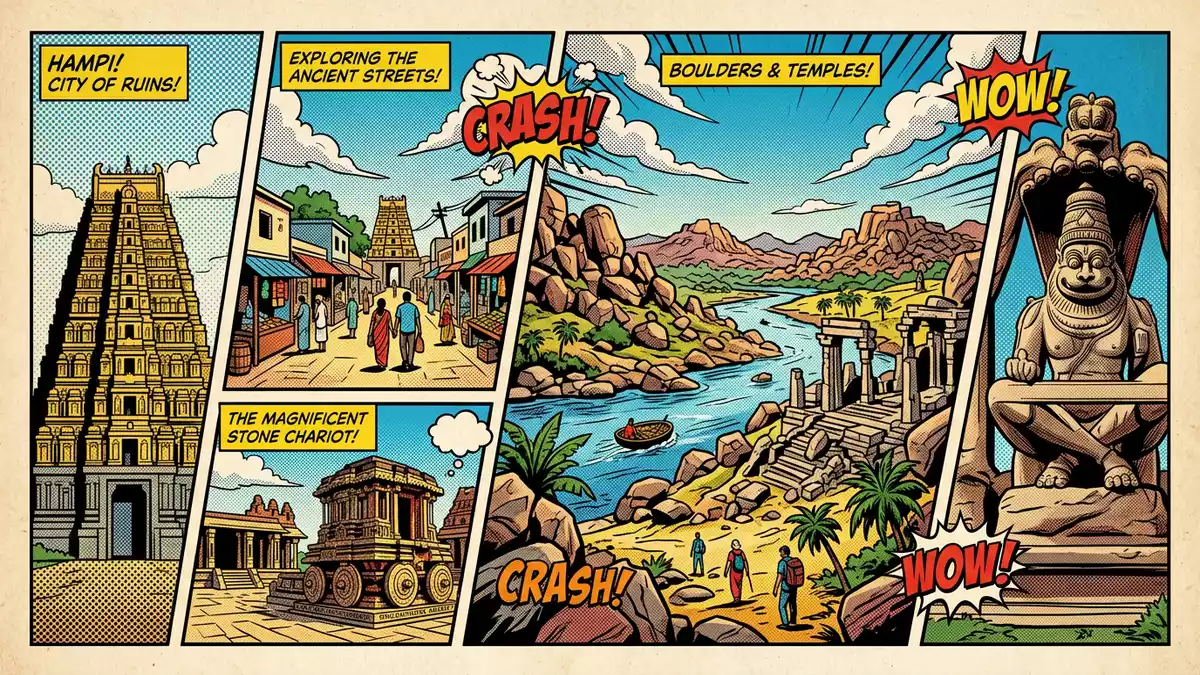
Hampi in Karnataka, India, lies along the Tungabhadra River in a landscape of granite hills scattered with carved stone monuments from the former capital of the Vijayanagara Empire in the fourteenth to sixteenth centuries.Vijayanagara Empire capital The surviving temples, market streets and royal compounds form the Group of Monuments at Hampi, a UNESCO World Heritage site inscribed as a cultural property in 1986.
Ruins of a Hindu capital in a river valley of boulders
Hampi occupies the Tungabhadra basin in central Karnataka, where the river runs between hills formed from granite boulders and plateaus.Tungabhadra basin in central Karnataka The ruins extend over more than 4,000 hectares (about 16 sq mi), with monuments spread between the present-day village of Hampi and neighbouring settlements in the districts of Ballari and Koppal.World Heritage Site districts and extent Visitors encounter stone pavilions beside the river, processional routes crossed by colonnaded bazaars, and freestanding temples rising above sheets of bedrock.
The setting combines an archaeological landscape with ongoing village and agricultural life, giving a sense of a former metropolis embedded in farmland and rocky hills.living site with villages and agriculture The World Heritage inscription covers a core area of just over 4,100 hectares with a larger buffer zone, recognising both the built remains and the terrain that frames them.core and buffer zones From many points, rows of pillars, stepped platforms and shrines line up against the backdrop of massive boulders, making the stone of the city and the hills feel closely related.
Temples, markets and royal compounds in carved stone
The Group of Monuments at Hampi comprises a dense concentration of religious and secular buildings constructed largely in granite, with elements of carved masonry and sculpted decoration.forts, royal and sacred complexes More than 1,600 individually identified remains include forts, riverside features, royal and sacred complexes, temples, shrines, pillared halls, mandapas, memorial structures and water works.about 1,600 monuments Among the best known structures are the Virupaksha Temple, an active place of worship with a towering entrance gateway, and the Vijaya Vittala complex, where the stone chariot and rows of slender pillars have become visual emblems of Hampi.Virupaksha and Vittala complexes
The royal centre preserves platforms and enclosures where the courtly life of Vijayanagara unfolded, with foundations of palaces, audience halls and ceremonial structures laid out on open rock terraces.royal and civil remains Nearby, long colonnaded streets mark former market areas leading from the temples, underlining the close connection between ritual spaces and trade during the city’s peak.group of buildings in natural setting Water structures, including stepped tanks and channels cut into the rock, demonstrate the importance of hydraulic engineering for this plateau city beside the river.
From Vijayanagara capital to World Heritage site
Hampi formed part of the capital area of the Vijayanagara Empire, which rose in southern India in the fourteenth century and remained powerful until the sixteenth century.fourteenth to sixteenth centuries The city described in sixteenth-century accounts as a major Hindu metropolis fell in the later sixteenth century, leaving an extensive field of ruins among the hills and along the river.capital and later ruins For centuries, pilgrims continued to visit the Virupaksha Temple and other shrines here, keeping religious life present amid the abandoned secular quarters.
The Group of Monuments at Hampi was inscribed on the UNESCO World Heritage List in 1986 as a cultural property under criteria that recognise its architectural creativity and testimony to Vijayanagara civilisation.year of inscription and criteria The inscription initially covered a set of monuments protected by the Archaeological Survey of India and later extended across the wider site, which is managed through a dedicated World Heritage Area Management Authority.protected monuments and management Hampi’s official recognition reflects both the scale of the remains and the way they illustrate a significant phase in South Asian urban and religious history.
Visiting Hampi: what travellers from Western Europe should know
- Hampi lies in the state of Karnataka in southern India, in a rural landscape along the Tungabhadra River, reached by road from nearby Hosapete and other regional centres.
- Many of the monuments stand on exposed rock or uneven ground among granite boulders, so visiting the main complexes involves walking over stone surfaces and climbing steps.
- The official language of Karnataka is Kannada and the national currency is the Indian rupee.
- Entry requirements depend on your nationality; UK travellers can check the FCDO travel advice at gov.uk/foreign-travel-advice, Irish travellers the Department of Foreign Affairs at ireland.ie.
Searching for Hampi on social platforms
These links open searches for Hampi on each platform.Frequently asked questions about Hampi
Where is Hampi in India?
Hampi is in the state of Karnataka in southern India, in the Tungabhadra River basin in central Karnataka between the districts of Ballari and Koppal.location in Karnataka
What should visitors expect on a visit to Hampi?
Visitors encounter an extensive field of granite-built ruins, including temples, royal platforms, bazaars and water structures spread over hills and river terraces, alongside active village life.archaeological remains and living site
What makes Hampi distinctive among historic sites?
Hampi stands out for the scale of its Vijayanagara-period remains, the number and variety of granite monuments, and their setting among boulder-strewn hills beside the Tungabhadra River, recognised through its UNESCO World Heritage status.Group of Monuments at Hampi inscription


