
Hampi’s granite landscape and the remains of Vijayanagara
Published on 09/24/2026 at 11:56 | Editorial responsibility: Rafael Müller, Editor-in-Chief AD HOC NEWS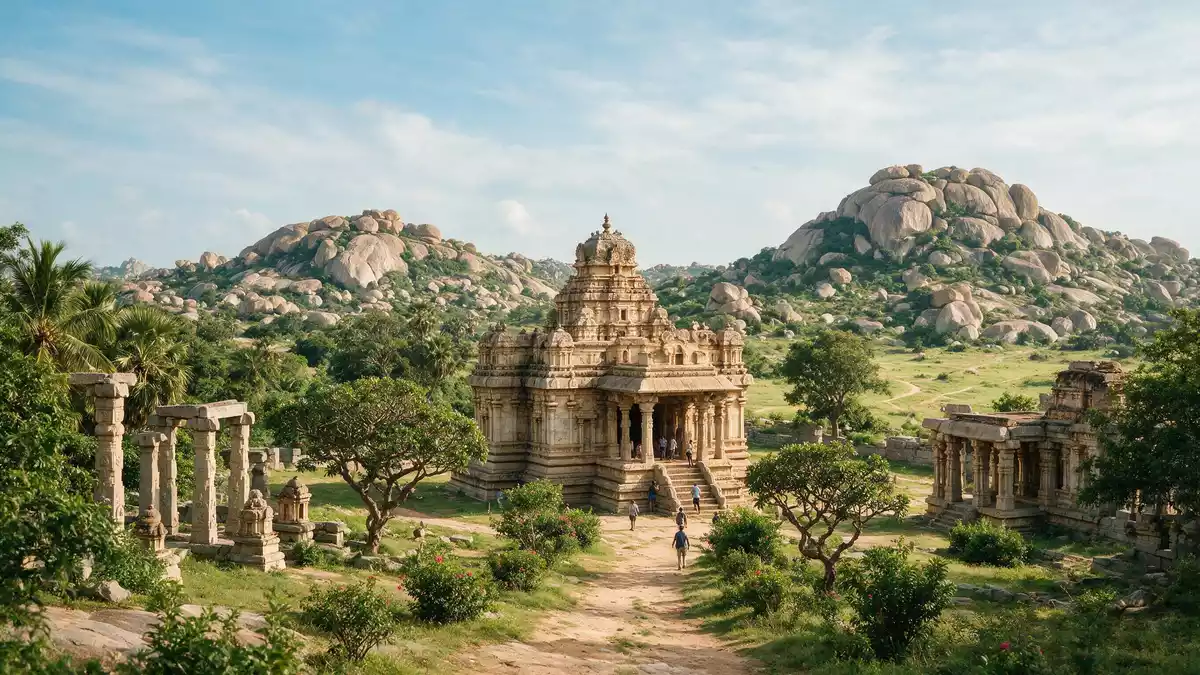
Hampi spreads across granite boulders, temple towers and the banks of the Tungabhadra River in Karnataka, India. The visible landscape joins monumental architecture with exposed rock, while the ruins preserve the former capital of the Vijayanagara Empire.
Granite hills around a vanished capital
Hampi is a settlement within the wider remains of Vijayanagara, whose capital developed from the fourteenth century. The Group of Monuments at Hampi entered the UNESCO World Heritage List in 1986.
The site lies beside the Tungabhadra, with granite hills, boulder fields and cultivated ground surrounding temple compounds and royal structures. Paths, steps, gateways and pillared halls connect fragments of a large urban landscape.
Vijayanagara was founded in 1336 by Harihara I and Bukka Raya I. Hampi served as its capital during the fourteenth to sixteenth centuries, a period associated with Dravidian temple architecture, courtly buildings and extensive religious activity.
Temples, bazaars and royal stonework
Virupaksha Temple remains an active religious centre beside the river. Its tall entrance tower rises above a complex of halls, shrines and courtyards, linking living worship with the archaeological landscape.
The Vittala Temple is associated with a celebrated stone chariot and a pillared hall. Carved granite columns, gateways and open mandapas show the architectural language of the Vijayanagara period. The Hampi heritage landscape also includes market streets, water structures and royal precincts.
Other named monuments include the Lotus Mahal, Elephant Stables, Queen’s Bath and Hazara Rama Temple. Their forms vary from enclosed ceremonial spaces to open halls and decorated façades, creating a broad architectural record rather than a single building type.
From imperial centre to archaeological landscape
The capital’s monuments reflect the political and religious culture of the Vijayanagara Empire. Temple complexes, ceremonial avenues, gateways and waterworks appear alongside secular buildings with different architectural details.
Krishnadevaraya ruled from 1509 to 1529 and is associated with major building activity at Hampi. The surviving structures record the scale of the court, the role of temple institutions and the organisation of a capital beside the Tungabhadra.
In 1565, the city was conquered and extensively damaged. Its remains became dispersed across the boulder-strewn terrain, where granite walls, carved pillars and temple towers retain their relationship with the river and surrounding hills.
The site’s value lies in this combination of architecture and landscape. Hampi is not a single enclosed monument, but a wide field of temples, shrines, palaces, fortifications, memorials, streets and water structures. A history of Hampi’s monuments presents the site as the surviving fabric of a former imperial capital.
Visiting Hampi: what travellers from Western Europe should know
- Hampi lies in Karnataka beside the Tungabhadra River. Rail connections serve Hosapete, the principal town used for access to the monument area.
- The terrain combines granite boulders, uneven ground, open paths and stone steps. Several monuments are separated across a broad landscape.
- Hampi’s sacred area includes Virupaksha Temple and riverside features, while the royal area contains structures such as the Lotus Mahal and Elephant Stables.
- The official language is Kannada and the currency is the Indian rupee.
- Entry requirements depend on your nationality; UK travellers can check the FCDO travel advice at gov.uk/foreign-travel-advice, Irish travellers the Department of Foreign Affairs at ireland.ie.
Searching for Hampi on social platforms
These links open searches for Hampi on each platform.
Frequently asked questions about Hampi
Where is Hampi?
Hampi is in Karnataka, southern India, beside the Tungabhadra River. The ruins occupy the area of the former Vijayanagara capital.
What can visitors expect at Hampi?
Visitors encounter temples, pillared halls, gateways, royal buildings, boulder fields and river landscapes. The monuments are spread across uneven terrain with stone steps and open paths.
What makes Hampi distinctive?
Hampi combines Vijayanagara architecture with a granite landscape. Virupaksha Temple, the Vittala Temple, royal structures and ancient waterworks form parts of the same archaeological setting.


