
Hallgrimskirkja and the basalt skyline of Reykjavik
Published on 09/07/2026 at 22:05 | Editorial responsibility: Rafael Müller, Editor-in-Chief AD HOC NEWS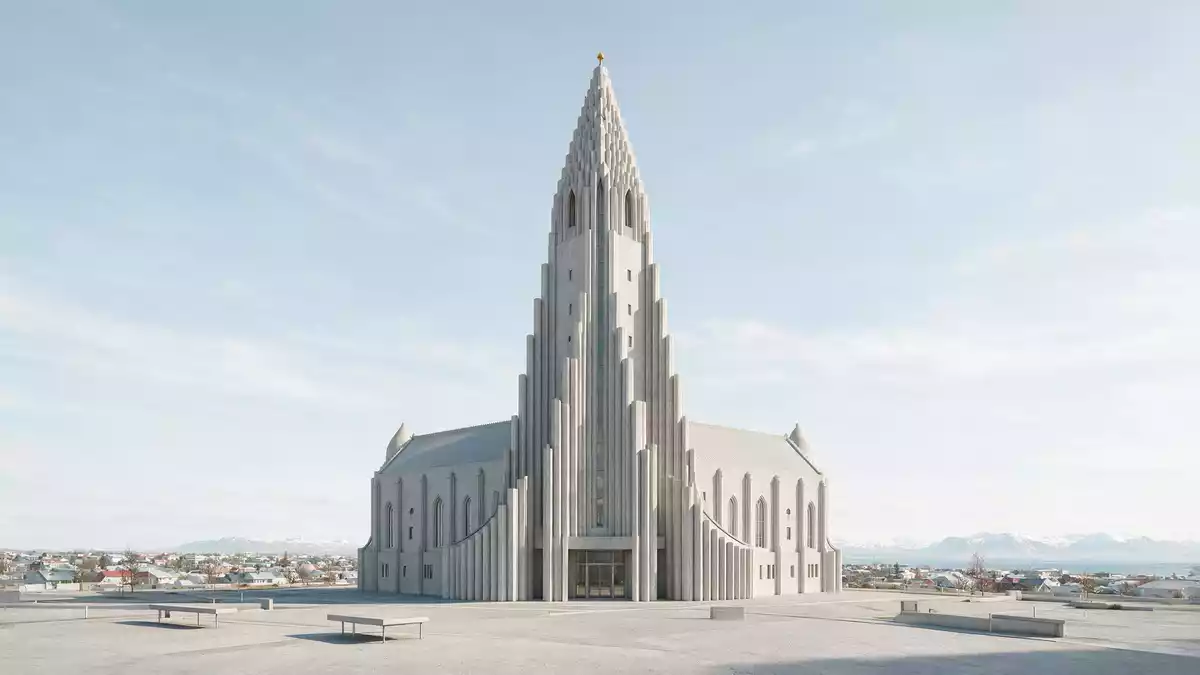
Hallgrimskirkja is the concrete church that commands the skyline of Reykjavik, its tall tower stepping upwards like frozen basalt as it crowns a hill above the Icelandic capital. Conceived in the late 1930s and built over several decades in the mid?twentieth century, it has become a central Lutheran parish church and one of the most recognisable structures in Iceland.
Basalt in concrete: Hallgrimskirkja’s distinctive form
Hallgrimskirkja is a Lutheran parish church constructed in reinforced concrete, with a tower that rises to around 73 m (240 ft) above the streets of Reykjavik and a broad nave stretching back from its steeply stepped façade.The tower is 73 metres high The building stands on a hill and is approached along streets that gradually climb towards its forecourt, giving the impression that the church emerges directly from the city’s rising ground.
The architect Guðjón Samúelsson, the State Architect of Iceland, began designing Hallgrimskirkja in 1937.Guðjón Samúelsson started work on the design in 1937 He drew on Icelandic geological forms, translating hexagonal basalt columns and mountain profiles into a façade where vertical ribs of concrete rise from a wider base to a narrow tower. Inside, the same vocabulary carries through in tall, pale walls and an elongated nave, while the exterior presents a series of vertical planes that resemble cliff faces of cooled lava.
From design competition to mid?century construction
The story of Hallgrimskirkja begins with an Icelandic Parliament design competition in 1929, which specified that the church should seat around 1,200 people and carry a high tower on its front.A design competition in 1929 set out the requirements for a tall?tower church Samúelsson’s scheme was commissioned in 1937, and the first phase of construction began in 1945 when work started at the rear of the planned church.
The ground floor at the back of the building was consecrated for services in 1948, giving Hallgrimskirkja an early role as a working parish space while the main nave and tower remained under construction.Construction began in 1945 and the crypt was consecrated in 1948 Further stages included completing the steeple and wings in the 1970s, and the church was finally consecrated on 26 October 1986, ending a building effort that spanned more than four decades.The church was consecrated in 1986 after a 41?year build
Name, parish life and the great organ
Hallgrimskirkja takes its name from Hallgrímur Pétursson, the seventeenth?century Icelandic clergyman and poet known for his “Hymns of the Passion”, linking the church to a long Lutheran devotional tradition.The church is named after Hallgrímur Pétursson It functions as a parish church within the Evangelical?Lutheran Church of Iceland, hosting services, concerts and community gatherings beneath its high concrete vaults.The parish belongs to the Evangelical?Lutheran Church of Iceland
Inside the nave stands a large pipe organ built by the German firm Klais, installed in the early 1990s and housed in a sculptural wooden case that rises towards the upper wall of the church.A Klais organ was completed in the sanctuary in 1992 Its pipes add a further vertical accent to the interior, echoing the upward movement of the exterior concrete forms and giving Hallgrimskirkja a strong presence as a venue for organ and choral music.
Visiting Hallgrimskirkja: what travellers from Western Europe should know
- Hallgrimskirkja stands on a hill in central Reykjavik, with its address on Hallgrimstorg and streets leading up from the surrounding neighbourhoods.
- The forecourt and interior are reached by paved approaches and internal stairways, and the tower climb uses enclosed stairs and lift access within the concrete structure.
- The official language is Icelandic and the currency is the Icelandic króna.
- Entry requirements depend on your nationality; UK travellers can check the FCDO travel advice at gov.uk/foreign-travel-advice, Irish travellers the Department of Foreign Affairs at ireland.ie.
Searching for Hallgrimskirkja on social platforms
These links open searches for Hallgrimskirkja on each platform.
Frequently asked questions about Hallgrimskirkja
Where is Hallgrimskirkja located?
Hallgrimskirkja is in central Reykjavik, Iceland, on a hill with its address on Hallgrimstorg and streets radiating out into the surrounding city.
What can visitors expect inside Hallgrimskirkja?
Visitors encounter a tall concrete nave with simple finishes, a large Klais pipe organ and spaces used for Lutheran worship and concerts beneath the high roof.
What makes Hallgrimskirkja distinctive among churches?
Its stepped concrete tower, inspired by Icelandic basalt landscapes, its long twentieth?century construction period and its dedication to poet?clergyman Hallgrímur Pétursson give Hallgrimskirkja a distinctive character.


