
Hallgrimskirkja and the basalt skyline of Reykjavik
Published on 08/29/2026 at 13:41 | Editorial responsibility: Rafael Müller, Editor-in-Chief AD HOC NEWS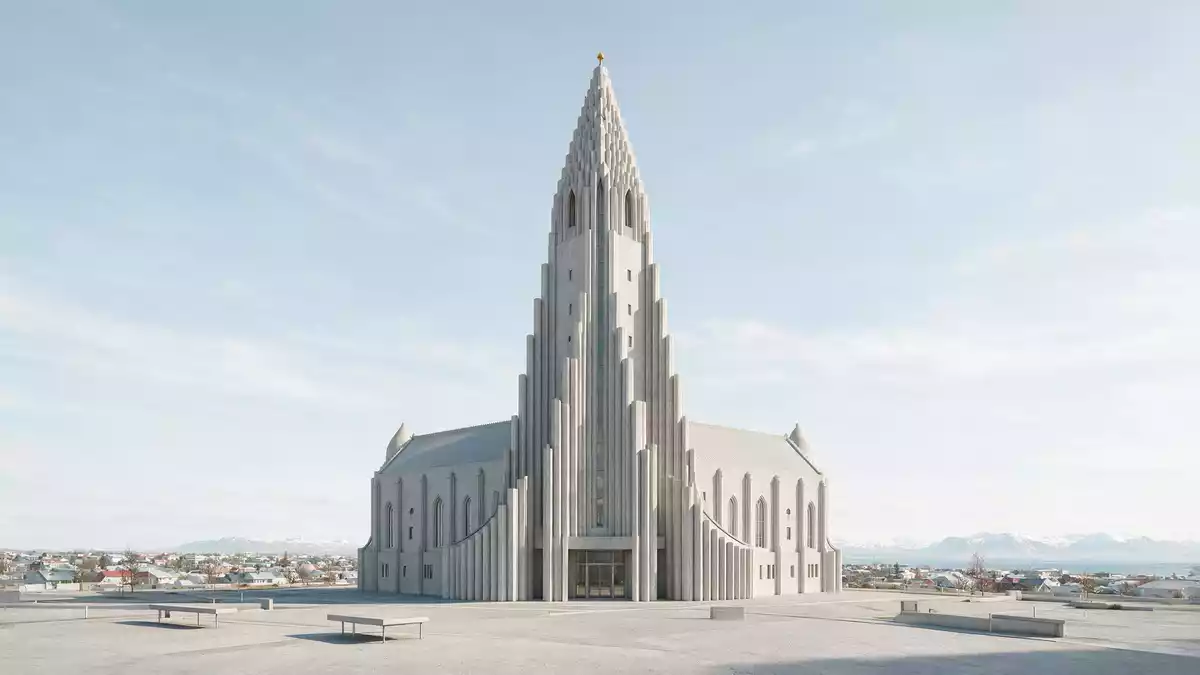
Hallgrimskirkja is the concrete church that dominates the hill of Skólavörðuholt in Reykjavik, its stepped façade and tower echoing the basalt formations of Iceland’s volcanic landscape. Conceived by state architect Guðjón Samúelsson in the late 1930s and consecrated in 1986, it combines Lutheran parish life with the presence of a national landmark visible across the capital.
Basalt translated into concrete
The most striking aspect of Hallgrimskirkja is its exterior: a tall central tower flanked by rows of tapering concrete elements that recall Iceland’s columnar basalt cliffs. Guðjón Samúelsson, born in 1887 and serving as state architect, began work on the design in 1937, drawing on Icelandic rock forms and mountains for the church’s profile.State Architect Guðjón Samúelsson began designing the church in 1937 The result is a piece of expressionist architecture that stands apart from the surrounding neighbourhood of low houses, its vertical rhythm leading the eye up towards the tower.
Architecturally, the church combines elements of expressionism with references to Gothic revival, but filtered through mid twentieth-century concrete construction.Hallgrimskirkja is described as expressionist with Neo-Gothic elements The mass of the tower reads as a single vertical volume, while the wings at its base step down towards the street. Comparisons are frequently made with Grundtvig’s Church in Copenhagen, another expressionist brick church completed in 1940, yet Hallgrimskirkja’s use of bare, pale concrete and basalt-inspired forms ties it closely to Iceland’s geology.The exterior is likened to basalt lava flows and to Grundtvig’s Church in Copenhagen
A long construction in the age of independence
Planning for Hallgrimskirkja began when the Icelandic Parliament launched a design competition in 1929, specifying a high tower and space for a large congregation. The commission went to Guðjón Samúelsson, whose design emerged in 1937, and ground works for the church started in 1945 as Iceland moved through the mid twentieth century towards full independence.The building history records the 1929 competition and construction from 1945 Construction progressed in stages, with the crypt at the back of the church consecrated in 1948 and the wings at the base of the tower taken into use in the 1970s.
The overall building took around four decades to complete, and Hallgrimskirkja was finally consecrated on 26 October 1986.Construction began in 1945 and the church was consecrated in 1986 By then the tower and its viewing level had long been a reference point on the city’s skyline, and the church’s history had become intertwined with twentieth-century Reykjavik and Iceland’s development as a modern state.The church’s construction is closely related to twentieth-century Icelandic history
Inside the nave and up the tower
Stepping through the main entrance leads into a tall, light-filled nave, laid out in a traditional longitudinal plan but framed by plain concrete surfaces and slender supports. At the far end, the sanctuary stands beneath a cylindrical volume that has been compared to Viking helmets, continuing the interplay between church architecture and Nordic references.The sanctuary’s cylindrical form has been described as evoking Viking war helmets Above the entrance, a substantial pipe organ dominates the west end of the nave, its pipes reflecting the vertical lines of the exterior.
The instrument is a Klais concert organ installed in the early 1990s, giving Hallgrimskirkja a strong role in Reykjavik’s musical life alongside its parish functions.A large Klais organ was completed in the sanctuary in 1992 From the base of the tower, lifts and internal circulation lead up to viewing levels high above the city. At around 73–74.5 m (roughly 240–244 ft), Hallgrimskirkja is both the largest church in Iceland and among the tallest structures in the country, and the tower offers broad views over Reykjavik’s streets, the harbour and the surrounding mountains.Hallgrimskirkja is the largest church in Iceland and its tower is about 73 m high
Visiting Hallgrimskirkja: what travellers from Western Europe should know
- Hallgrimskirkja stands on the hill of Skólavörðuholt in central Reykjavik, with streets radiating downhill towards the city centre and the seafront; city buses and local roads serve the area.
- The church sits above a noticeable slope, and approaches from the lower streets involve walking uphill; inside, access to the tower includes enclosed vertical circulation and confined interior spaces.
- The official language is Icelandic and the currency is the Icelandic króna.
Searching for Hallgrimskirkja on social platforms
These links open searches for Hallgrimskirkja on each platform.
Frequently asked questions about Hallgrimskirkja
Where is Hallgrimskirkja located?
Hallgrimskirkja stands on Skólavörðuholt, a hill in central Reykjavik in Iceland, overlooking the surrounding streets and the wider city.
What can visitors expect inside Hallgrimskirkja?
Visitors encounter a tall concrete nave with a large pipe organ, a sanctuary at the far end and, from the tower levels, expansive views across Reykjavik and its landscape.
What makes Hallgrimskirkja distinctive among churches?
Its basalt-inspired concrete exterior, twentieth-century expressionist design and prominent tower make Hallgrimskirkja a landmark that ties church architecture directly to Iceland’s geology and capital skyline.


