
Halaszbastya and Budapest’s neo-Romanesque terraces
Published on 09/15/2026 at 22:02 | Editorial responsibility: Rafael Müller, Editor-in-Chief AD HOC NEWS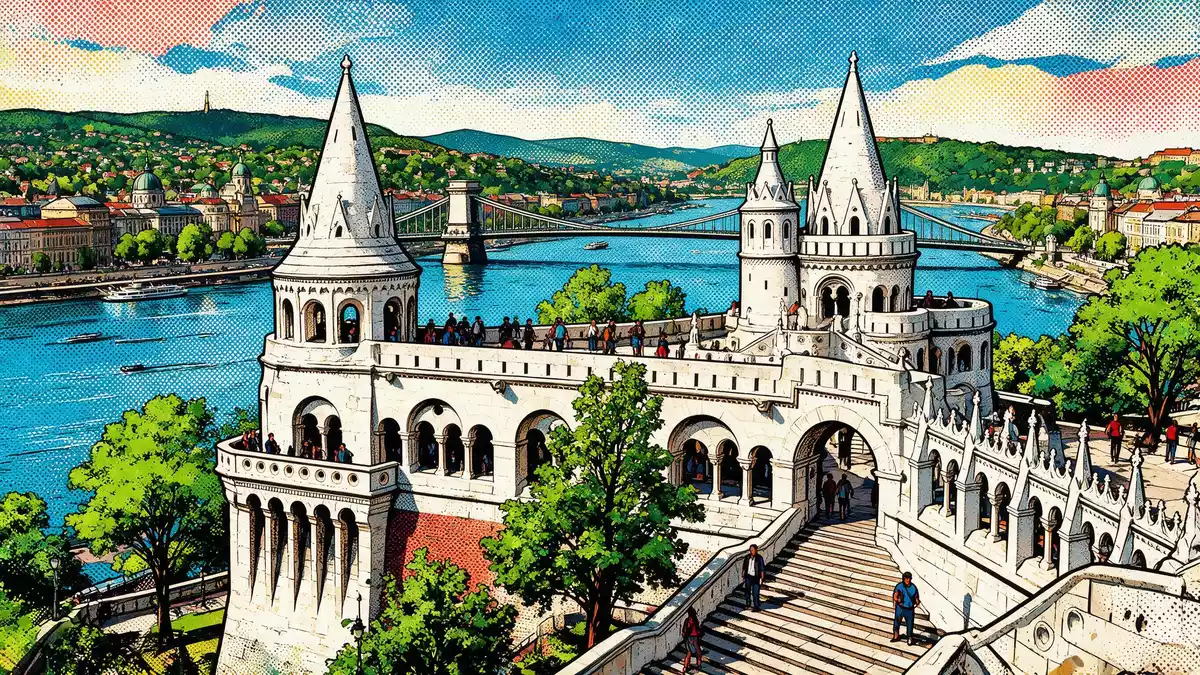
Halaszbastya is Budapest’s white neo-Romanesque terrace on Castle Hill, designed by Frigyes Schulek and completed in 1902. Its arcades, towers and long walls make the place read as a piece of architecture first, and a viewpoint second.
Schulek’s white terrace above Castle Hill
The terrace belongs to the Buda Castle District, beside Matthias Church and within the Budapest UNESCO World Heritage area. Its formal name in English is Fisherman’s Bastion, though Halaszbastya is the Hungarian form used on site and in maps.Buda Castle District Matthias Church
Frigyes Schulek also worked on the restoration of Matthias Church, and that shared authorship gives the square its strong architectural unity.Frigyes Schulek The terrace dates from the turn of the twentieth century, and its Neo-Romanesque forms recall arcaded cloisters, round towers and thick masonry.
Seven towers and long arcades
The best-known feature is the row of seven towers, with white stonework, narrow openings and covered walkways tying the parts together. The structure stretches along the castle edge as a sequence of terraces, stairs and viewing platforms.
The long façade is the detail that stays in the eye. It runs beside the church and the square in a way that frames the older buildings rather than hiding them.seven towers The white surfaces and arcades sit in clear contrast to the darker stone of the castle fabric around them.
A landmark tied to the Buda Castle Quarter
Halaszbastya is part of the Buda Castle Quarter’s protected ensemble, which includes one of Budapest’s most important historic hill districts. The terrace sits high enough to open wide views across the Danube towards the Pest side.UNESCO World Heritage Site Budai Várnegyed
The name refers to the fishermen’s guild that once defended this stretch of the castle wall. That historical reference sits lightly on a place that is now read above all as a terrace of towers, arches and stone balustrades.fishermen’s guild
Visiting Halaszbastya: what travellers from Western Europe should know
- The terrace stands on Castle Hill in Budapest, near Matthias Church and the Buda Castle District. It is reached on foot through the hilltop streets and stairways of the quarter.
- The setting includes stone steps, level terraces and a height above the river plain. Those features shape the walk more than any long approach does.
- The upper and lower parts of the bastion are visually distinct. The lower terraces sit beneath the higher towers and arcades.
- The site belongs to a dense historic ensemble, with the church, square and castle fabric close by. A visit can include several stone-built landmarks within the same hilltop area.
Searching for Halaszbastya on social platforms
These links open searches for Halaszbastya on each platform.
Frequently asked questions about Halaszbastya
Where is Halaszbastya?
Halaszbastya stands on Castle Hill in Budapest’s Buda Castle District, next to Matthias Church. It is part of the hilltop historic quarter above the Danube.
What does a visit involve?
The place is a terrace complex of stairs, arcades and towers on uneven hill ground. The experience is architectural as much as scenic.
What makes it distinctive?
Its white Neo-Romanesque form, seven towers and close link with Frigyes Schulek give it a clear profile. The bastion reads as a designed hilltop ensemble rather than a military remnant.


