
HaKotel HaMa'aravi, the Western Wall of Jerusalem
Published on 09/09/2026 at 06:51 | Editorial responsibility: Rafael Müller, Editor-in-Chief AD HOC NEWS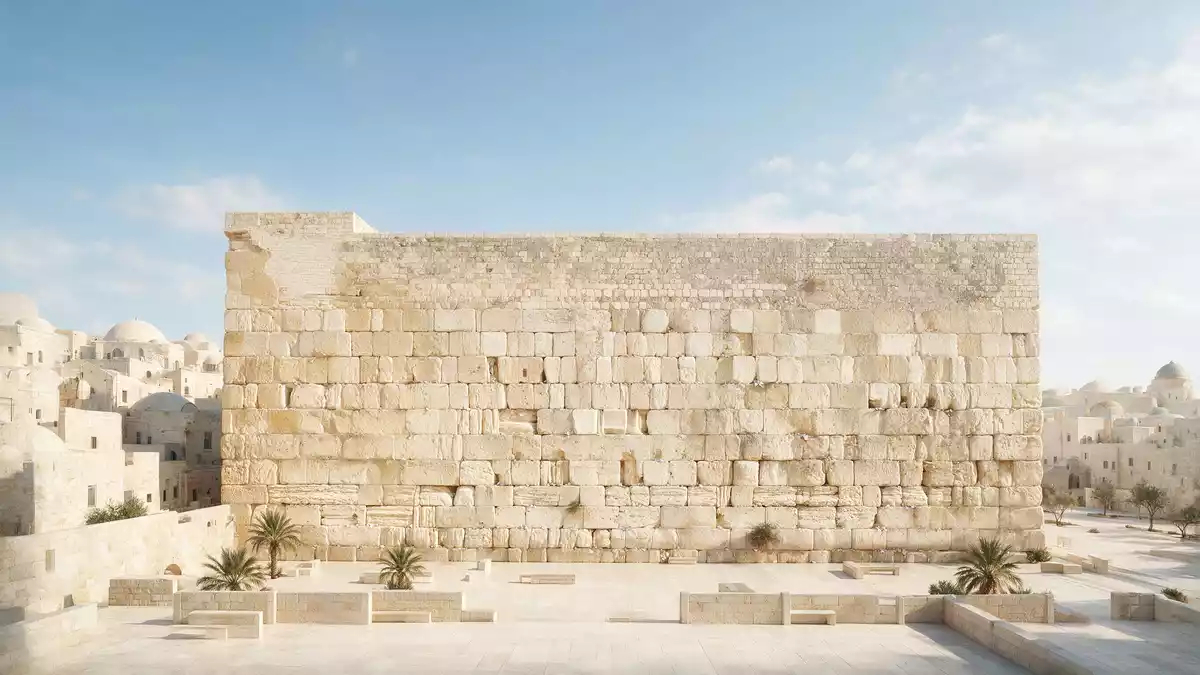
HaKotel HaMa'aravi, known in English as the Western Wall, is an exposed section of ancient masonry on the western side of the Temple Mount in Jerusalem, where layered stone, Jewish history and daily prayer come together in a single compact space. Rising above a paved plaza in the Old City, this surviving part of the Second Temple complex has become one of the most enduring physical points of contact between the city’s past and the religious life of the Jewish people.
The surviving western wall of the Temple Mount
HaKotel HaMa'aravi forms part of the long retaining wall built to support the expanded Temple Mount during the reign of Herod the Great in the first century BC, when the Second Temple complex was enlarged above the natural hill of Jerusalem.Herod’s expansion of the mount The wall itself runs along the western edge of the plateau, but only a short length of its stonework is visible as the prayer area familiar from photographs; much of the remaining structure continues behind later buildings or through underground passages.
As seen from the open plaza, the exposed section of HaKotel HaMa'aravi is around 50 m (160 ft) long and about 20 m (65 ft) high, with additional courses of stone descending below the present ground level.Measurements of the visible stretch Individual blocks vary in size, with the lowest visible courses composed of large, finely dressed stones typical of monumental Herodian work, and higher sections made up of smaller stones added in later periods. Together they form a vertical surface where differences in stone size, colour and tooling record successive phases of construction and repair over many centuries.Description of the retaining wall
From Second Temple enclosure to place of prayer
The history of HaKotel HaMa'aravi is closely tied to the fate of the Second Temple, the central sanctuary of Judaism in antiquity. The temple on the mount above the wall was destroyed by Roman forces in 70 CE, but the retaining walls that framed the platform, including the western side, remained standing and gradually acquired their own religious significance.Destruction of the Second Temple Over time, the section now called HaKotel HaMa'aravi came to be regarded as the closest accessible point to the former location of the Holy of Holies, the innermost and holiest area of the temple.
In Jewish tradition the Western Wall is one of the holiest places where Jews can pray, framed by accounts that speak of the divine presence resting on this surviving stretch of masonry.Religious significance in Jewish tradition The site has carried different names, including “Western Wall” and “Wailing Wall”, but the Hebrew term HaKotel HaMa'aravi, meaning “the western wall”, is the form used in many religious contexts.Hebrew and English names The view from the plaza presents a cross-section of Jerusalem’s sacred topography: the stones of the retaining wall rising below the elevated Temple Mount and its later structures.
The plaza, stones and surrounding Old City
HaKotel HaMa'aravi stands within the walls of the Old City of Jerusalem, close to the boundary between the Jewish Quarter and the elevated esplanade of the Temple Mount.Location within the Old City Approaches lead through stone-lined alleys and gateways, opening suddenly into the broad open plaza that stretches away from the base of the wall. The open space frames the view of the stones and separates the vertical surface of the masonry from the irregular roofs of the surrounding quarters.
The plaza is divided into areas used by different groups of worshippers, with an arrangement that sets a larger section towards one side and a smaller section towards the other.Layout of the prayer areas From the paved ground, the wall rises in straight courses, and the joints between individual stones are clearly visible, some supporting vegetation that has taken root in the narrow gaps. The contrast between the broad horizontal surface of the plaza and the high vertical plane of the stones gives the site its characteristic spatial relationship, with the wall forming a backdrop to religious life and movement in the open space below.
Visiting HaKotel HaMa'aravi: what travellers from Western Europe should know
- HaKotel HaMa'aravi lies on the western side of the Temple Mount within the Old City of Jerusalem, reached on foot along the narrow streets and passageways that lead out from the Jewish Quarter.
- The open plaza in front of the wall is paved, with a gradual slope and step-free areas, while access routes may include short flights of steps and changes in level typical of an old hill city.
- The Temple Mount and surrounding quarters frame the site, with views towards the elevated platform above the wall and out to neighbouring roofs and lanes.
- The official language is Hebrew and the currency is the Israeli new shekel.
- Entry requirements depend on your nationality; UK travellers can check the FCDO travel advice at gov.uk/foreign-travel-advice, Irish travellers the Department of Foreign Affairs at ireland.ie.
Searching for HaKotel HaMa'aravi on social platforms
These links open searches for HaKotel HaMa'aravi on each platform.Frequently asked questions about HaKotel HaMa'aravi
Where is HaKotel HaMa'aravi located in Jerusalem?
HaKotel HaMa'aravi stands along the western edge of the Temple Mount within the Old City of Jerusalem, close to the Jewish Quarter and reached by narrow streets.
What can visitors expect when they come to the Western Wall?
Visitors encounter a broad paved plaza facing the high stone surface of the wall, with distinct areas used for prayer and a clear view of the massive masonry rising above.
What makes HaKotel HaMa'aravi distinctive among Jerusalem’s sacred sites?
HaKotel HaMa'aravi is distinctive as a surviving part of Herod’s expanded temple enclosure and as one of the closest accessible points to the former Holy of Holies on the Temple Mount.


