
HaKotel HaMa'aravi and Jerusalem's wall of layered stone
Published on 09/24/2026 at 02:01 | Editorial responsibility: Rafael Müller, Editor-in-Chief AD HOC NEWS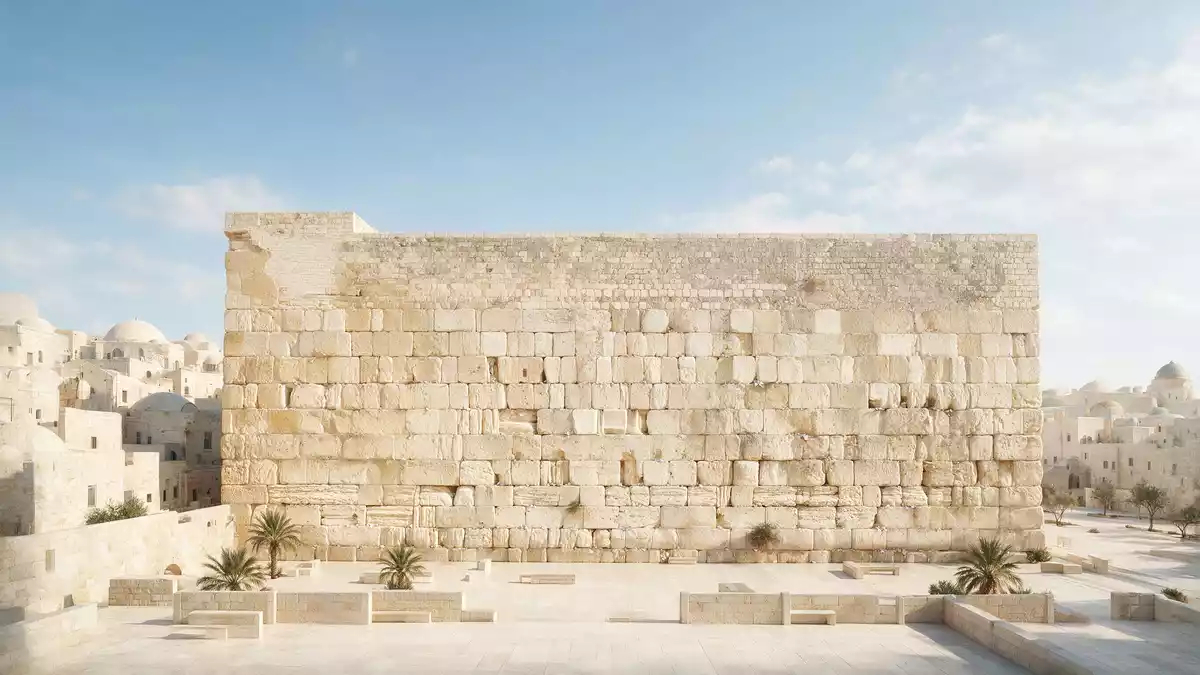
HaKotel HaMa'aravi is a limestone retaining wall in Jerusalem's Old City, where a visible section of ancient masonry meets a living Jewish prayer site. Its exposed stones belong to a much longer structure associated with Herod the Great and the Temple Mount.
HaKotel HaMa'aravi: a visible fragment of a longer wall
The prayer area presents only part of the Western Wall. The complete retaining structure extends for about 488 metres (1,601 ft), while the section at the plaza measures about 57 metres (187 ft) in length. Much of the wall continues beyond the open prayer area, with sections concealed below ground or behind the built fabric of the Old City.
The visible masonry is built from large limestone blocks. Many stones have dressed edges that create recessed borders around their faces, a feature associated with Herodian construction. The lowest courses belong to the ancient retaining structure, while smaller stones appear in upper sections added during subsequent periods.
At the plaza, the exposed wall rises to roughly 19 metres (62 ft) above ground. Its foundations continue below the level of the prayer area, giving the masonry a vertical depth that cannot be understood from the visible face alone. The wall is therefore both an architectural surface and part of a buried support structure.
Herod the Great and the Temple Mount platform
Herod the Great expanded the Temple Mount during the late first century BCE. The retaining walls enclosed and supported an enlarged platform, and the western wall formed its principal western boundary. The work belongs to the building history of the Second Temple period.
The wall's stones were cut and placed in courses without the use of visible mortar between their main faces. Their scale varies across the structure. Lower blocks are massive, while upper masonry includes smaller units associated with later additions and repairs.
The Second Temple was destroyed by Roman forces in 70 CE. The retaining wall remained as part of the Temple Mount's western boundary, and its surviving masonry became connected with Jewish remembrance of the Temple and Jerusalem. The visible site therefore combines Roman-period construction with religious memory extending across many centuries.
HaKotel HaMa'aravi is also known as the Western Wall and the Wailing Wall. The Hebrew name means “the western wall”. Its name identifies both its position and its place within Jewish religious language. the Hebrew name
Prayer, memory and the stones of Jerusalem
The Western Wall is a place of Jewish prayer and pilgrimage. Worshippers stand before the masonry, read prayers, and place handwritten notes in gaps between stones. The practice links a physical wall with personal devotion, communal memory and the destruction of the ancient Temple.
The plaza is divided into prayer areas, with separate spaces for men and women. Religious practice shapes the use of the open area, while the wall itself remains a shared historic element within Jerusalem's Old City. Visitors encounter architecture, archaeology and active worship in the same setting.
The wall's significance is connected with the Temple Mount, a site sacred to Judaism and also central to Muslim religious life. The wider area has a complex political and religious history. Its stones belong to a structure from the late first century BCE, while the plaza carries meanings formed through later centuries.
Jewish devotion at the wall developed after the destruction of the Second Temple. The site became a place for mourning, prayer and pilgrimage, and the masonry came to represent the continuing connection between the Jewish people and Jerusalem. the Herodian retaining wall
HaKotel HaMa'aravi also belongs to the historic fabric of the Old City of Jerusalem, whose walls and monuments form a dense record of religious, imperial and urban history. The wall is not an isolated monument. It is one visible edge of a larger platform and part of a district where sacred spaces stand close together.
The masonry rewards attention to its details. The dressed margins around individual stones, the changing scale of the blocks and the buried continuation of the wall reveal several layers of construction. The site can therefore be read from close range as a sequence of stone courses, religious customs and historical periods.
Visiting HaKotel HaMa'aravi: what travellers from Western Europe should know
- HaKotel HaMa'aravi is in the Old City of Jerusalem, beside the Temple Mount and the Western Wall Plaza. Access through the Old City's gates leads towards the plaza and its prayer areas.
- The approach includes paved lanes, steps and changes in level within the Old City. The prayer plaza itself is open, while the wall face rises above the standing areas.
- The official language is Hebrew and Arabic, and the currency is the Israeli new shekel.
- Entry requirements depend on your nationality; UK travellers can check the FCDO travel advice at gov.uk/foreign-travel-advice, Irish travellers the Department of Foreign Affairs at ireland.ie.
Searching for HaKotel HaMa'aravi on social platforms
These links open searches for HaKotel HaMa'aravi on each platform.
Frequently asked questions about HaKotel HaMa'aravi
Where is HaKotel HaMa'aravi?
HaKotel HaMa'aravi is in the Old City of Jerusalem, on the western side of the Temple Mount. The prayer plaza lies beside the wall's exposed section.
What can visitors expect at the site?
The site combines an open prayer plaza, ancient limestone masonry and active Jewish religious practice. The approach through the Old City includes lanes, steps and changes in level.
What makes HaKotel HaMa'aravi distinctive?
The visible prayer section forms part of a much longer retaining wall associated with Herod the Great. Its stones preserve the scale of the Temple Mount's late first-century BCE expansion.


