
Hakone Jinja on Lake Ashi: a forest shrine of water and mountains
Published on 09/17/2026 at 15:51 | Editorial responsibility: Rafael Müller, Editor-in-Chief AD HOC NEWS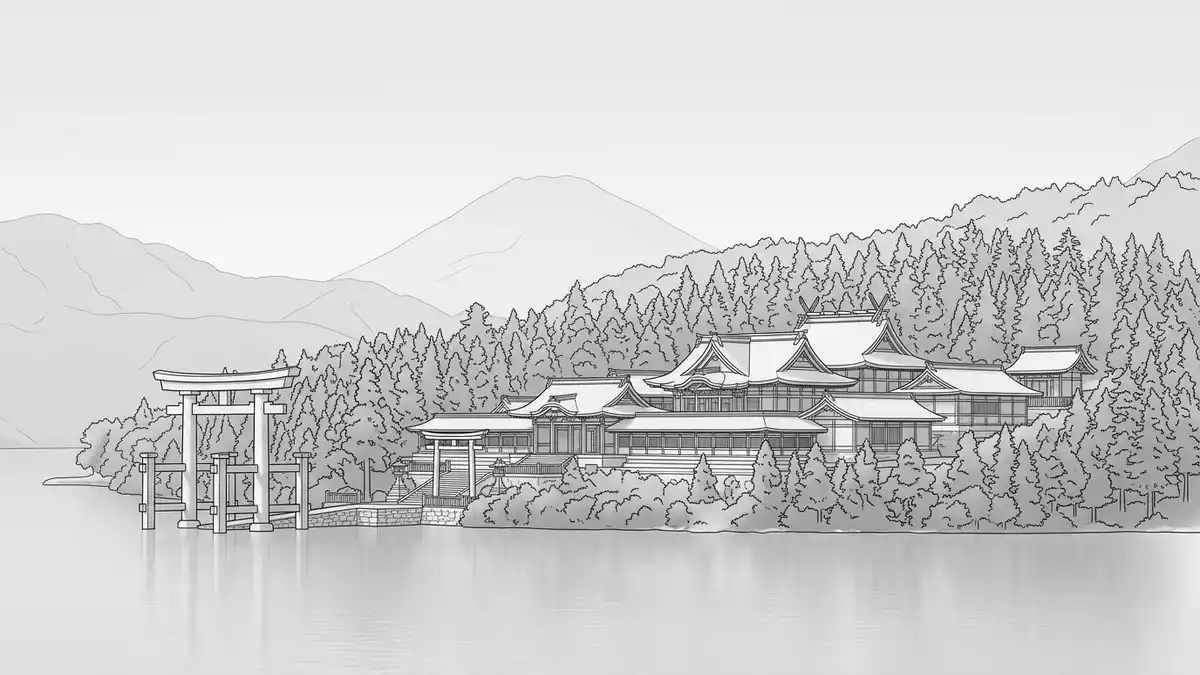
Hakone Jinja is a Shinto shrine in Hakone, in eastern Japan, where forested slopes meet the waters of Lake Ashi and vermilion gates rise from the shoreline. Its history reaches back to the eighth century and ties mountain worship, lake legends and the rise of the samurai together in one compact site.
Hakone Jinja between lake and volcano
Hakone Jinja stands in the Moto-Hakone area on the shore of Lake Ashi, with the wooded flanks of Mount Hakone rising behind the shrine buildings and paths. The setting forms part of the wider Fuji-Hakone-Izu landscape, where a volcanic caldera holds lakes, peaks and hot springs within reach of Tokyo.Hakone-jinja Shrine in Fuji-Hakone-Izu
The shrine’s main complex lies slightly uphill among tall cedar and other trees, above the lakeside path and piers. From the precincts, glimpses of Lake Ashi open between trunks and roofs, with boats crossing the water and views towards the surrounding ridges. The combination of water, forest and volcanic terrain gives Hakone Jinja a distinct physical presence within Hakone, contrasting with nearby spa districts and transport hubs.
Founding legends and samurai devotion
Hakone Jinja is traditionally dated to 757, when the priest Mangan Shonin established a sanctuary at Lake Ashi for deities linked to the surrounding mountains and waters.Mangan Shonin founding Hakone Shrine in 757 This places its origins in the Nara period, a time when court-backed Buddhism and older Shinto practices coexisted and remote mountain sites gained ritual significance.
Hakone Jinja’s influence grew in the Kamakura period from the late twelfth to early fourteenth century, when warrior leaders such as Minamoto no Yoritomo were associated with the shrine and made regular pilgrimages there.Minamoto no Yoritomo and Kamakura-era patronage The shrine’s records and local tradition also link Hakone Jinja to a dragon legend at Lake Ashi, in which a fearsome creature is subdued and becomes a guardian spirit, reflecting the way religious narratives are tied to the geography of Hakone.
Torii gates, forest approaches and lakeside presence
The form in which visitors encounter Hakone Jinja today includes a main hall dating to 1667 in its present form, a series of shrine buildings on the hillside and torii gates that mark approaches from land and water.Hakone Shrine’s present main hall and Peace Torii The complex sits among dense forest, with paths and stairways leading up from the lakeside and from nearby streets in Moto-Hakone.
One torii stands at the edge of Lake Ashi itself, with its uprights set into the water and its lintel framing views across the lake towards the hills. This gate is sometimes called the “Peace Torii” and dates to 1952, when it was erected to commemorate the peace treaty that ended the postwar Allied occupation of Japan.Peace Torii built in 1952 at Lake Ashi Higher torii mark the forest approach to the main precincts, where stone lanterns, smaller auxiliary shrines and the main worship hall line up along the ridge.
Visiting Hakone Jinja: what travellers from Western Europe should know
- Hakone Jinja stands in Moto-Hakone on the shore of Lake Ashi in Hakone, Kanagawa Prefecture. It is reached by local buses from Hakone-Yumoto and by boats that serve piers on the lake.
- Approaches to the main shrine buildings involve stairways and sloping paths through the forest, with several flights of steps between the lakeside and the upper precincts.
- The shrine is part of a wider network of sites in Hakone linked to Fuji-Hakone-Izu National Park, and sits near lakeside walking routes and viewpoints over Lake Ashi.
- The official language is Japanese and the currency is the yen.
- Entry requirements depend on your nationality; UK travellers can check the FCDO travel advice at gov.uk/foreign-travel-advice, Irish travellers the Department of Foreign Affairs at ireland.ie.
Searching for Hakone Jinja on social platforms
These links open searches for Hakone Jinja on each platform.
Frequently asked questions about Hakone Jinja
Where is Hakone Jinja located?
Hakone Jinja stands in Moto-Hakone on the shore of Lake Ashi, in Hakone Town in Kanagawa Prefecture, within the Fuji-Hakone-Izu region of eastern Japan.Hakone Shrine on the shores of Lake Ashi
What can visitors expect on a visit to Hakone Jinja?
Visitors encounter forested approaches, stairways and shrine buildings, along with torii gates on the hillside and a gate standing at the water’s edge of Lake Ashi.
What makes Hakone Jinja distinctive among Hakone’s sites?
Hakone Jinja combines eighth-century foundations, a main hall dating to the seventeenth century in its present form and a lakeside torii from 1952, tying together religious history and the geography of Lake Ashi.


