
Hakone Chokoku no Mori Bijutsukan places sculpture in the landscape
Published on 09/23/2026 at 12:03 | Editorial responsibility: Rafael Müller, Editor-in-Chief AD HOC NEWS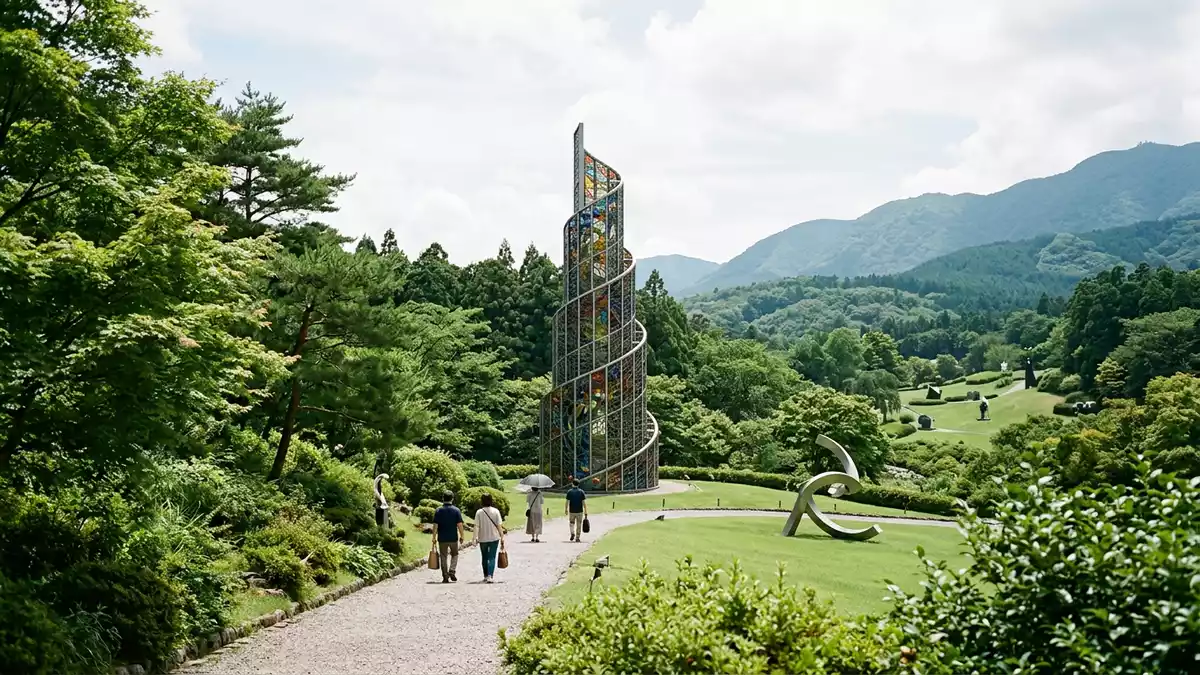
Hakone Chokoku no Mori Bijutsukan spreads sculpture across gardens in Hakone, Japan. The museum combines open lawns, wooded slopes and indoor galleries, making the landscape part of the setting for modern art.
Opened in 1969, it brought an outdoor sculpture museum to a mountainous hot-spring region. Works by Japanese and international artists appear beside paths, terraces and buildings, while the Picasso Pavilion provides a contrasting indoor focus.
Sculpture across Hakone’s gardens
The museum occupies grounds measuring about 70,000 square metres. Sculptures stand outdoors among grass, trees and changing elevations, creating separate views of works rather than a single enclosed gallery sequence. 70,000-square-metre grounds anchor the museum’s scale.
The collection includes artists such as Auguste Rodin, Henry Moore, Joan Miró, Constantin Brâncu?i and Taro Okamoto. Henry Moore’s reclining figures, Miró’s abstract forms and other large works occupy distinct parts of the grounds, with the mountain landscape visible beyond them.
From Japan’s first open-air museum to a broader collection
The museum opened on 1 August 1969 and is identified as Japan’s first open-air art museum. Its history includes the construction of a main gallery at the opening and the later addition of the Picasso Pavilion in 1984. museum history from 1969 records these stages.
Its subject is broader than outdoor sculpture alone. Indoor exhibitions extend the collection into painting, ceramics, prints and other forms, while the grounds retain the museum’s defining relationship between three-dimensional art and open space.
The Picasso Pavilion and Symphonic Sculpture
The Picasso Pavilion opened in 1984 and centres on works acquired from Maya Picasso. The collection includes more than 300 works, with ceramics forming a documented core. Picasso Pavilion collection gives the indoor section a distinct identity.
Another prominent work is Gabriel Loire’s Symphonic Sculpture, an 18-metre tower of stained glass with an interior spiral staircase. Coloured glass forms the enclosure, while the staircase rises through the centre of the work. Gabriel Loire’s tower is among the museum’s named architectural landmarks.
Visiting Hakone Chokoku no Mori Bijutsukan: what travellers from Western Europe should know
- The museum is at 1121 Ninotaira in Hakone, Kanagawa Prefecture. The Hakone Tozan Railway serves the route towards Gora, with the museum located near the line.
- The grounds combine lawns, wooded sections, sloping paths and indoor galleries. Symphonic Sculpture contains a spiral staircase, while outdoor works occupy spaces across the hillside.
- Hakone lies in a mountainous region associated with hot springs and views towards Mount Fuji. The museum’s outdoor displays therefore share their setting with forested terrain and volcanic landscapes.
- The official language is Japanese and the currency is the Japanese yen.
- Entry requirements depend on your nationality; UK travellers can check the FCDO travel advice at gov.uk/foreign-travel-advice, Irish travellers the Department of Foreign Affairs at ireland.ie.
Searching for Hakone Chokoku no Mori Bijutsukan on social platforms
These links open searches for Hakone Chokoku no Mori Bijutsukan on each platform.
Frequently asked questions about Hakone Chokoku no Mori Bijutsukan
Where is Hakone Chokoku no Mori Bijutsukan?
It is in Ninotaira, Hakone, in Kanagawa Prefecture, Japan. The museum lies near the Hakone Tozan Railway route towards Gora.
What can visitors see there?
The grounds contain outdoor sculptures by Japanese and international artists, alongside indoor galleries and the Picasso Pavilion.
What makes the museum distinctive?
Its collection is distributed through gardens and wooded spaces instead of being confined to one building. The Picasso Pavilion and Symphonic Sculpture add major indoor landmarks.


