
Habana Vieja, Havanna’s layered streets of stone and sea
Published on 08/21/2026 at 09:04 | Editorial responsibility: Rafael Müller, Editor-in-Chief AD HOC NEWS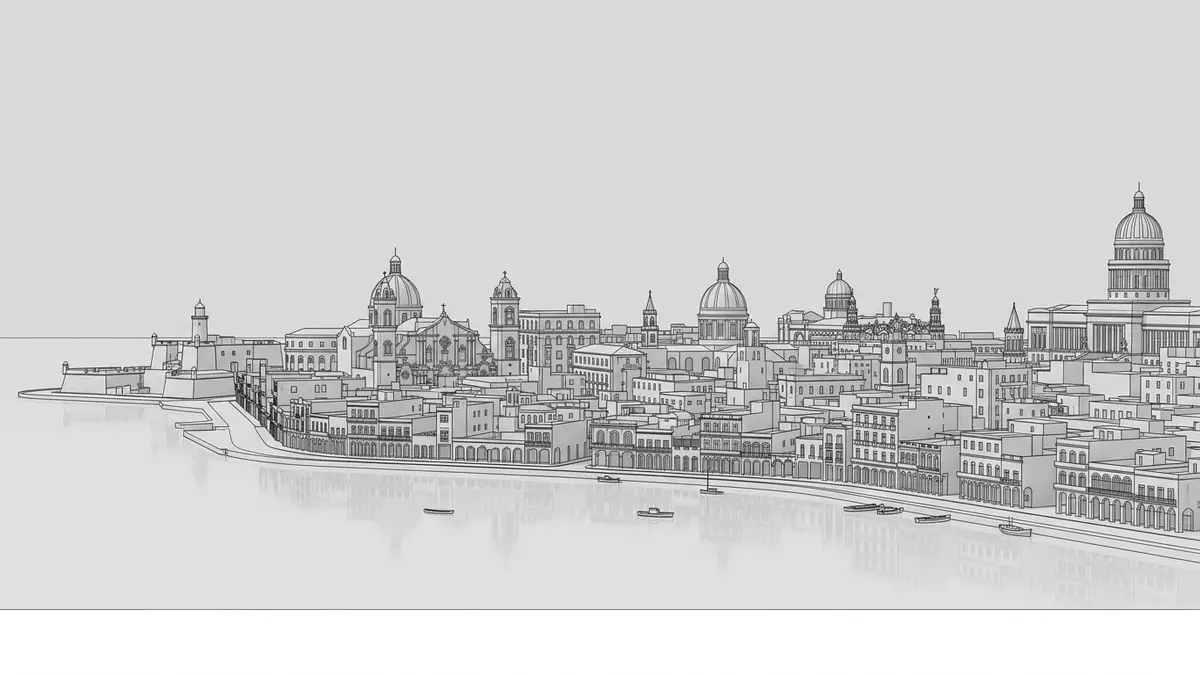
Habana Vieja, Old Havana, is the historic centre of Havanna on the edge of Havana Bay, a compact district where Spanish colonial town planning, Caribbean light and centuries of stonework meet in dense streets and open plazas. Founded by the Spanish in the early sixteenth century and later ringed by fortifications, it is formally recognised as a World Heritage Site, a status that underlines the concentration of historic buildings and urban spaces within its modest area.World Heritage Site
From harbour and fortresses to a planned colonial core
Habana Vieja grew around Havana’s natural harbour, its relationship with the bay still visible in the way streets and plazas step back from the water and frame views towards the sea. The district includes the historic fortification system that guarded one of the most important ports in the Caribbean under Spanish rule, with stone ramparts, bastions and lookout points forming a belt between the town and the open water.fortification system
The urban core itself took shape after 1519, when Havana was founded by the Spanish and developed into a major shipyard during the seventeenth century, anchoring imperial trade routes between Europe and the Americas.founded in 1519 Within the area now known as Habana Vieja, streets follow a grid punctuated by plazas, each with a distinct role in colonial life, and lined with religious, administrative and commercial buildings that still shape the silhouette of the district.
Four plazas and a mix of baroque and neoclassical stone
One of the most striking features of Habana Vieja is its set of four main plazas, each developed for a different function and surrounded by buildings that reflect that role.four main plazas Plaza de Armas served as a military and administrative centre, with a fortress and official residences around a central square. Plaza de la Catedral grew into a religious focus, dominated by Havana Cathedral and ecclesiastical buildings. Plaza Vieja became a commercial hub, used for markets and civic gatherings, while Plaza de San Francisco de Asís linked the town directly to maritime trade through its proximity to the harbour and its convent complex.
Architecturally, Habana Vieja presents an unusually coherent streetscape of baroque churches, neoclassical palaces and long façades of town houses with arcades, balconies, wrought-iron grilles and internal courtyards.arcades and courtyards Many of these buildings date from the sixteenth to eighteenth centuries, their stone walls and timber details giving the streets a layered appearance where older religious and civic structures stand beside later commercial houses. The mix of monumental churches and more modest dwellings reflects the district’s role as both a centre of power and a lived-in neighbourhood.
Habana Vieja as a living historic district
Habana Vieja forms one of the municipalities of modern Havana, covering the eastern section of the city’s inner urban area and including parts of the waterfront where the Malecón sea drive meets the entrance to the bay.eastern urban section It occupies roughly 4.37 km² (about 1.69 sq mi), a compact territory where thousands of historic buildings stand along narrow streets and small squares.4.37 km² area Within this area, restored façades and heavily weathered structures stand close together, underlining that the district is both heritage site and home to a dense urban population.
The World Heritage inscription in 1982 recognised this combination of baroque and neoclassical monuments and a relatively homogeneous ensemble of private houses, all shaped during the centuries of Spanish colonial rule and later Cuban history.mix of monuments For visitors, the streets of Habana Vieja present sequences of churches, convents, palaces and simple dwellings arranged in short blocks, often with stone paving underfoot and glimpses into shaded courtyards behind heavy timber doors, giving a sense of a district whose historic fabric remains largely intact.
Visiting Habana Vieja: what travellers from Western Europe should know
- Habana Vieja lies on the eastern side of central Havanna along Havana Bay, reached by road from other districts such as Centro Habana and Vedado and easily explored on foot once inside the historic core.
- Streets in Habana Vieja are narrow and many are paved with stone; moving between plazas often involves walking along uneven surfaces and crossing small changes in level, so footwear suited to short urban walks is helpful.
- The Malecón waterfront runs near the entrance to Habana Vieja, providing a clear orientation line between the bay, the fortresses at the harbour mouth and the inner streets of the old town.
- The official language is Spanish and the currency is the Cuban peso.
- Entry requirements depend on your nationality; UK travellers can check the FCDO travel advice at gov.uk/foreign-travel-advice, Irish travellers the Department of Foreign Affairs at ireland.ie.
Searching for Habana Vieja on social platforms
These links open searches for Habana Vieja on each platform.Frequently asked questions about Habana Vieja
Where is Habana Vieja within Havanna?
Habana Vieja occupies the eastern section of Havana’s inner city along Havana Bay, forming one of the capital’s municipalities and including the historic harbourfront streets.
What should visitors expect when walking through Habana Vieja?
Visitors encounter narrow, stone-paved streets, a sequence of historic plazas and a dense fabric of churches, palaces and town houses, many with internal courtyards behind their façades.
What makes Habana Vieja distinctive among Caribbean historic centres?
Habana Vieja combines a system of harbour fortifications, four major plazas with defined colonial roles and a broad mix of baroque and neoclassical buildings within a relatively small urban area.


