

Gyeongbokgung, Seoul’s royal axis between mountain and city
Published on 08/28/2026 at 09:26 | Editorial responsibility: Rafael Müller, Editor-in-Chief AD HOC NEWS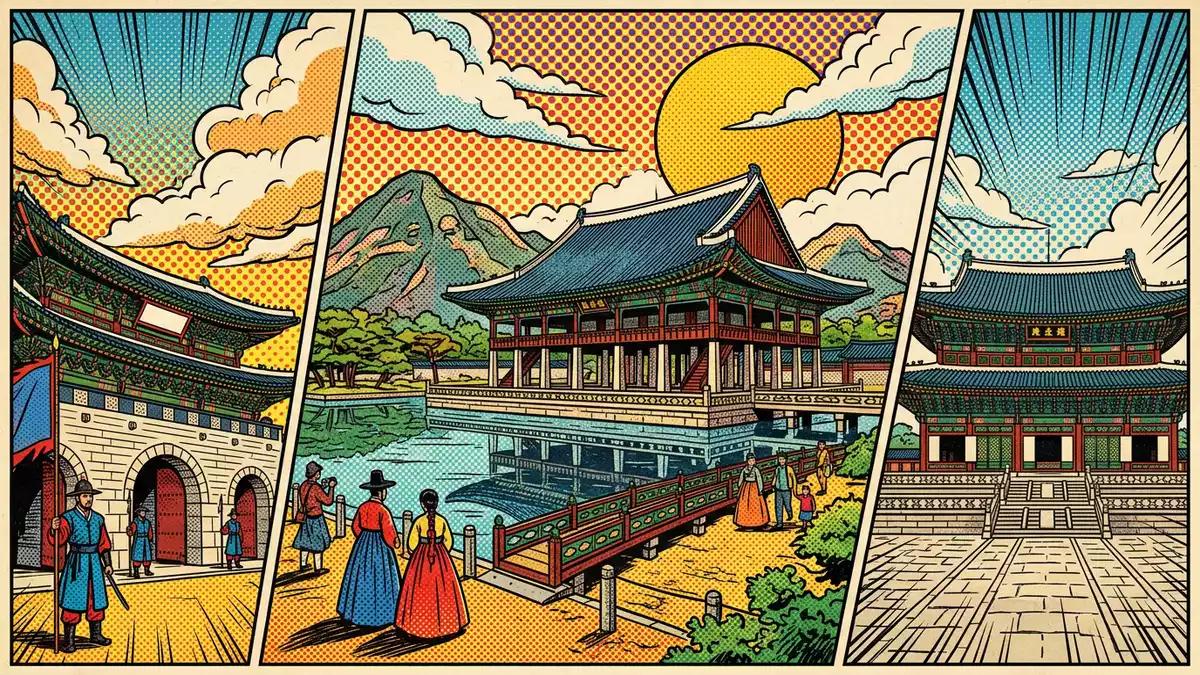
Gyeongbokgung in Seoul is the former main royal palace of the Joseon dynasty, laid out along a clear axis between the city and the mountain backdrop of Bugaksan. Built in 1395 under King Taejo Yi Seong-gye, it still presents long lines of wooden halls on stone platforms, ceremonial courtyards and pavilions reflected in water, giving a tangible sense of how power and ritual were organised in pre-modern Korea.
A palace founded with a mountain behind it
Gyeongbokgung was established in 1395, three years after Yi Seong-gye founded the Joseon dynasty in 1392 and moved the royal seat to Hanyang, the city later known as Seoul.Established in 1395 as the primary palace The name “Gyeongbokgung” can be translated as “palace of great blessing and prosperity for the new dynasty”, signalling its role as the administrative centre and royal residence at the start of Joseon rule.Name meaning palace of great blessing
The palace complex occupies ground at the southern foot of Bugaksan, a forested ridge that rises behind the inner courts and throne hall. Its long north–south axis links the mountain to the city’s historic centre, reflecting Korean geomantic ideas of a protective height to the rear and the wider urban plain to the front.Situated at the southern foot of Bugaksan Around this axis, a walled precinct spreads into outer and inner courts, with gates, audience halls and residential quarters following a structured sequence.
Wood, stone and water in the royal precinct
Within Gyeongbokgung’s perimeter wall, the architecture follows the vocabulary of late medieval Korean palaces: timber framing above raised stone platforms, tiled roofs with gentle curves and bracketed eaves, and paintwork in dancheong patterns of reds, greens and blues.Traditional wooden palace architecture The main throne hall, Geunjeongjeon, stands in front of a broad stone courtyard, with rows of marker stones indicating ranks during state ceremonies, and low balustrades defining the edges of the platform.
Water is as prominent as stone and timber. Gyeonghoeru Pavilion projects over a rectangular pond on stone columns, reached by bridges and used historically for banquets and grand receptions.Gyeonghoeru Pavilion over its pond Further inside the palace, Hyangwonjeong Pavilion stands beside another pond with small islands, framed by trees and connected to the surrounding precinct by narrow paths. Between these watery spaces and the formal stone courts, visitors encounter smaller service halls, galleries and gates, many rebuilt on traditional lines after the palace’s periods of destruction.
Layers of destruction and restoration
Gyeongbokgung’s present form reflects centuries of upheaval. The complex was severely damaged during the Japanese invasions of Korea in the 1590s, when the Imjin War brought fire to many court buildings.Damaged during the Imjin War For generations afterwards, the site lay largely in ruins while other palaces in Seoul took on daily royal functions.
Major reconstruction came under King Gojong in the nineteenth century, guided by Heungseon Daewongun, who oversaw the rebuilding of many halls and gates in 1867.Restoration under King Gojong and Heungseon Daewongun Later, during Japanese colonial rule from the early twentieth century, large parts of the palace were demolished and a government building rose in front of the throne hall, disrupting the original ceremonial axis. In the late twentieth century, that building was removed and extensive restoration programmes reinstated many gates, halls and courtyards, leaving a palace complex that is both historical site and reconstruction grounded in surviving records.
Gyeongbokgung within modern Seoul
Gyeongbokgung stands in the northern part of central Seoul, at the end of a broad boulevard lined with civic buildings and statues, where views from the outer gate look towards the city and the inner courts look back to Bugaksan. The outer approach passes under Gwanghwamun Gate into wide stone-paved spaces, while further inside narrower passages and smaller courts mark the threshold into residential quarters and gardens.
Within the wider precinct, museums occupy parts of the grounds: the National Palace Museum of Korea stands near the main entrance, and the National Folk Museum of Korea lies close to Hyangwonjeong Pavilion, integrating curated collections with the palace architecture.National Palace Museum of Korea and National Folk Museum of Korea The combination of restored Joseon halls, water features and museum spaces makes Gyeongbokgung both a historical court setting and a cultural campus embedded in the urban fabric.
Visiting Gyeongbokgung: what travellers from Western Europe should know
- Gyeongbokgung lies in central Seoul, with its main gate opening onto a major boulevard in the northern section of the city; city buses and the Seoul Metro serve stations within walking distance.
- Inside the palace, movement between the outer courts, inner halls and ponds involves long stretches of stone paving and several flights of steps leading up to raised platforms.
- The palace sits below Bugaksan, so views from many courtyards include the forested ridge, while low walls and open gateways frame the transition between built space and the surrounding city.
- The official language is Korean and the currency is the South Korean won.
- Entry requirements depend on your nationality; UK travellers can check the FCDO travel advice at gov.uk/foreign-travel-advice, Irish travellers the Department of Foreign Affairs at ireland.ie.
Searching for Gyeongbokgung on social platforms
These links open searches for Gyeongbokgung on each platform.
Frequently asked questions about Gyeongbokgung
Where is Gyeongbokgung located within Seoul?
Gyeongbokgung stands in the northern part of central Seoul, at the end of a major boulevard where the palace’s main gate faces the civic centre and its inner courts look towards Bugaksan.
What should visitors expect inside the palace grounds?
Visitors encounter a sequence of large stone courtyards, wooden throne halls, gates, pavilions over ponds and museum buildings, with long walks across paving and multiple sets of steps up to raised platforms.
What makes Gyeongbokgung distinctive among Korean palaces?
Its scale as the principal Joseon palace, its axial alignment between Bugaksan and the city, and landmarks such as Geunjeongjeon, Gyeonghoeru and Hyangwonjeong together give Gyeongbokgung a particularly layered royal landscape within modern Seoul.


