

Gwanghwamun, the stone and timber threshold of royal Seoul
Published on 08/22/2026 at 22:31 | Editorial responsibility: Rafael Müller, Editor-in-Chief AD HOC NEWS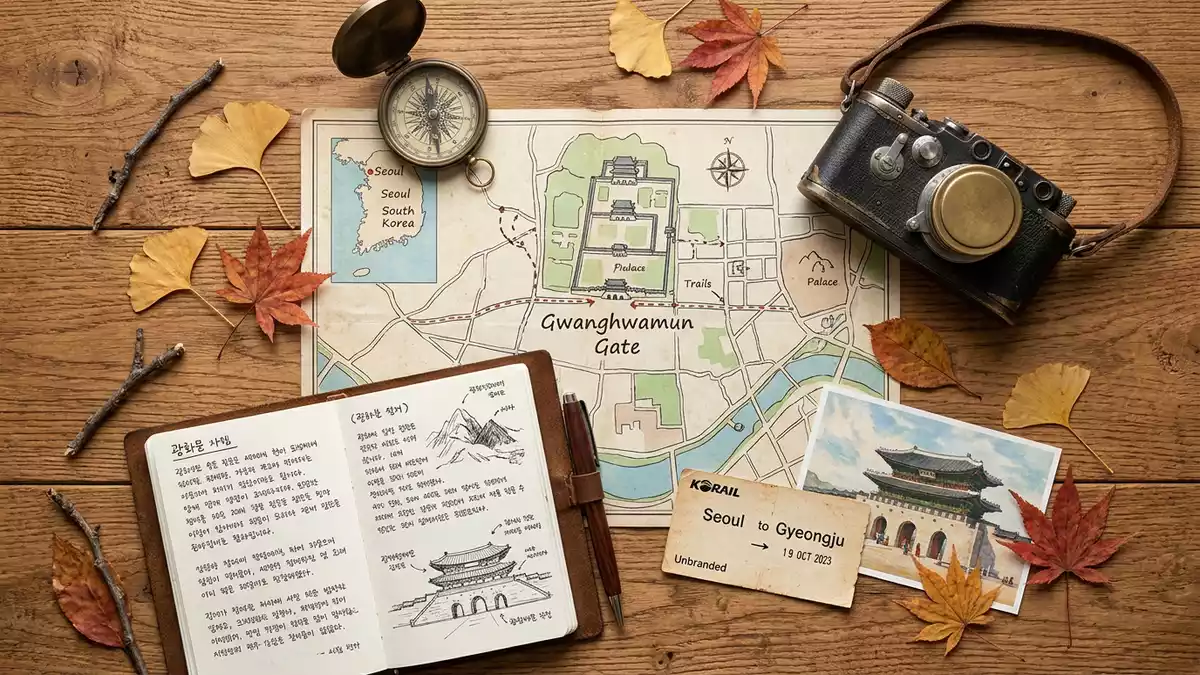
The place known as Gwanghwamun in Seoul is the main southern gate of Gyeongbokgung, the royal palace complex of the Joseon dynasty, and a carefully reconstructed stone and timber threshold on the city’s central axis.Gwanghwamun Gate was built in 1395 under King Taejo, giving the gate a clear origin in the late fourteenth century and binding it to the earliest years of Joseon rule.
A royal gate on Seoul’s north–south spine
Gwanghwamun stands where the broad boulevard running north from the city centre meets the outer walls of Gyeongbokgung, marking the transition from civic streets into the ceremonial core of the old capital.The gate forms the south entrance to Gyeongbokgung, aligned with the palace’s main throne hall and the mountains beyond. The alignment follows long-standing practice in East Asian court planning, with the king seated in the palace facing south, so the south gate served as the principal approach for formal processions.Heritage records identify Gwanghwamun as both the south gate and the main gate, a dual role that underlines its importance in the original plan.
The gateway itself combines a massive granite base with an elevated timber pavilion, expressing the hierarchy between structural solidity and ornamental roofline at a glance.Tall stone walls carry the wooden gate tower, allowing it to look out over the city outside and the courtyards within. Three arched passages pierce the stone platform: the central opening historically reserved for the monarch, flanked by two side openings used by heirs and officials on formal occasions. This tripartite arrangement makes the social order of the Joseon court visible in the stone of the gate.
From early Joseon to modern reconstruction
Gwanghwamun belongs to the early phase of Gyeongbokgung’s construction, dating to 1395 alongside the palace buildings that embodied the authority of the new dynasty.The gate’s name, given by King Sejong in 1426, is often translated as a phrase about light and virtue spreading widely, reflecting the court’s ambitions for rule based on learning. For centuries, the gate anchored administrative life around it, with government offices lining the space immediately to its south in what is now a large open plaza.Historical notes on Gwanghwamun Plaza describe the six ministries once housed in front of the gate, showing how closely the space around the gateway was tied to state power.
The structure has not survived those centuries unchanged. It was destroyed in the late sixteenth century during the Imjin War, when Japanese forces invaded the peninsula, and stood in ruins while Gyeongbokgung lay largely abandoned.The gate was rebuilt during the reign of King Gojong in the 1860s, as part of a wider reconstruction of the palace.Records for Gyeongbokgung note Gwanghwamun’s rebuilding in 1865, marking a nineteenth-century phase in its fabric. Later upheavals under Japanese colonial rule saw the gate dismantled and reassembled away from its original line, and concrete was introduced in twentieth-century reconstructions, leaving the gate materially altered and slightly displaced from its designed position.
Stone, timber and the restored Woldae podium
The appearance visitors encounter now reflects a major reconstruction campaign that replaced concrete elements with granite and wood and returned the gateway to its historic location on the palace’s axis.A project launched in 2006 completely disassembled Gwanghwamun, allowing craftspeople to rebuild the stone base and timber pavilion in line with surviving records.Contemporary reports emphasise how closely the reconstructed gate matches its late Joseon form, reconnecting the palace frontage with its historical profile.
In front of the stone platform lies the Woldae, a broad podium that extends the base of the gate into the plaza and articulates the threshold between palace and city.Studies of the Woldae describe it as the principal podium structure of the gateway, a platform that was removed in the twentieth century and has been restored in recent years. With its granite surfaces stepping out towards the boulevard, the podium now reasserts the ceremonial depth once present at the palace entrance and gives Gwanghwamun a layered forecourt between the modern road and the historic walls.
Visiting Gwanghwamun: what travellers from Western Europe should know
- Gwanghwamun stands at the northern end of a major boulevard in central Seoul, directly in front of Gyeongbokgung Palace in the Jongno district, with metro stations nearby.
- The gateway sits on a raised granite base with several flights of stone steps, and the surrounding plaza is a broad paved area exposed to sun and weather.
- The official language is Korean and the currency is the South Korean won.
- Entry requirements depend on your nationality; UK travellers can check the FCDO travel advice at gov.uk/foreign-travel-advice, Irish travellers the Department of Foreign Affairs at ireland.ie.
Searching for Gwanghwamun on social platforms
These links open searches for Gwanghwamun on each platform.Frequently asked questions about Gwanghwamun
Where is Gwanghwamun located in Seoul?
Gwanghwamun stands on the southern edge of Gyeongbokgung Palace in the Jongno district, aligned with a major boulevard that runs through central Seoul.
What can visitors expect when they visit Gwanghwamun?
Visitors encounter a granite and timber gate with three arched passages, a restored stone podium extending into a wide plaza, and views through to the courtyards of Gyeongbokgung.
What makes Gwanghwamun distinctive among Seoul’s historic structures?
Its role as the principal entrance to the Joseon royal palace, combined with its reconstructed early Joseon form and the restored Woldae podium, make Gwanghwamun a clear marker of Korea’s dynastic capital.


