

Gwanghwamun and the stone face of Joseon Seoul
Published on 09/15/2026 at 13:01 | Editorial responsibility: Rafael Müller, Editor-in-Chief AD HOC NEWS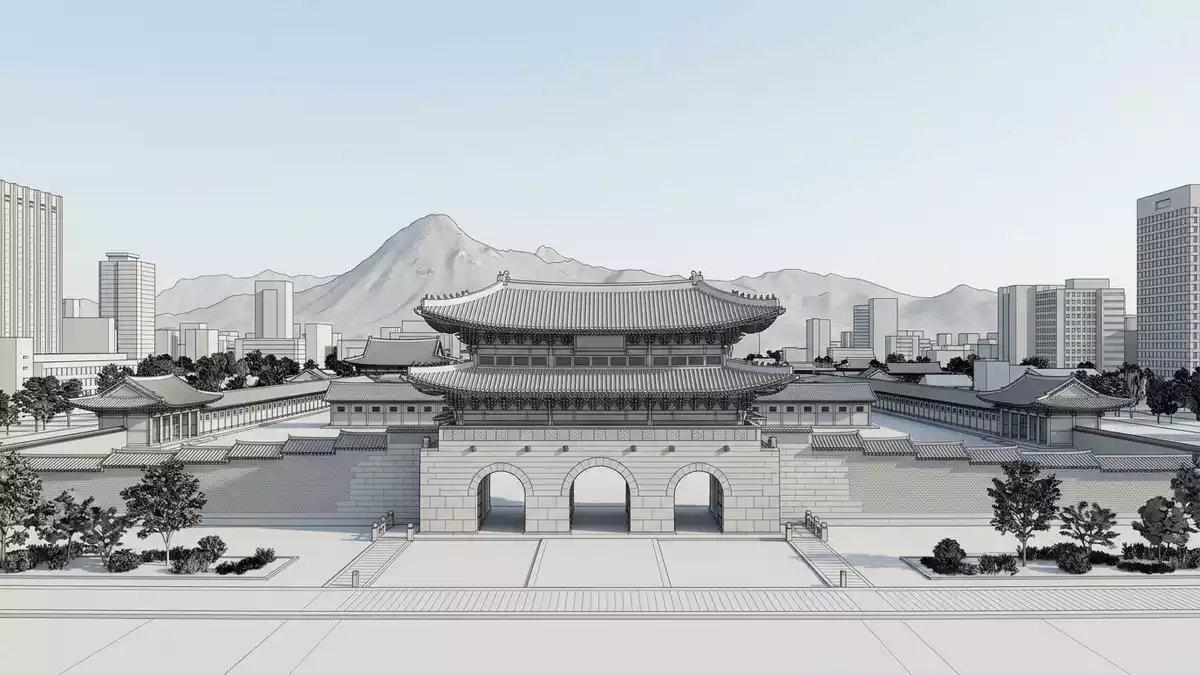
Gwanghwamun in Seoul is the south gate of Gyeongbokgung Palace, first built in 1395 under King Taejo of the Joseon dynasty. Its present form combines granite and wood, and the gate remains one of the clearest surviving royal markers in the city.
The southern gate of Gyeongbokgung
The gate stands at the front of Gyeongbokgung, the main palace of Joseon. Three arched openings define the facade, with a central passage flanked by two side passages, and the structure rises above a broad ceremonial approach.
The name is tied to King Sejong the Great, who gave it its current name in 1426. The gate has also been associated with repeated damage and rebuilding, including destruction during the Japanese invasions of the late sixteenth century and later restoration work.
Gyeongbokgung Palace and the gate form a royal pair that still defines the north-western centre of Seoul.
Stone, timber and restored royal form
The visible structure reflects a careful rebuild completed in 2010 after a reconstruction campaign that began in 2006. The gate uses granite and timber, replacing earlier concrete work from the twentieth century.
That restored form makes the gate read less like a lone monument and more like a carefully framed threshold. The broad roofline, heavy piers and deep shadow under the gate emphasise its role as a passage between palace precinct and city.
The current name dates from 1426, while the palace road in front of it links the gate to the wider royal landscape of Hanyang.
Royal threshold in the city centre
Seoul’s central civic district now gathers around the gate, but the royal geometry remains easy to read. The palace frontage, the square and the nearby administrative buildings make the gate a hinge between court history and modern capital planning.
That setting helps explain why the gate matters as architecture as much as as memory. It is not an isolated pavilion; it is the surviving face of a palace entrance that once organised movement, ceremony and state display.
The square in front and the south gate together preserve the outline of the old palace frontage.
Visiting Gwanghwamun: what travellers from Western Europe should know
- The gate stands in central Seoul, at the front of Gyeongbokgung Palace and beside Gwanghwamun Square. The area is reached through the city’s metro network.
- The approach is flat and fully urban, with the gate set into a broad paved public space. The palace frontage gives a strong sense of scale from street level.
- The gate is a royal structure from the Joseon dynasty, so the main interest lies in architecture, location and historical layering. Granite, timber and the arched openings are its defining features.
- The surrounding district contains major government buildings and museum-scale civic spaces. The gate works best as part of a wider walk through the palace quarter.
Searching for Gwanghwamun on social platforms
These links open searches for Gwanghwamun on each platform.
Frequently asked questions about Gwanghwamun
Where is Gwanghwamun?
Gwanghwamun stands in Seoul, at the southern edge of Gyeongbokgung Palace. It faces the broad civic space of Gwanghwamun Square.
What does a visit involve?
The experience centres on the gate’s scale, material and setting. The surrounding plaza and palace frontage make the structure easy to read from several angles.
What makes Gwanghwamun distinctive?
Its importance lies in the combination of Joseon royal history, the named gate from 1426 and the restored granite-and-wood form. It is a palace threshold that still anchors the centre of the city.


