
Guoli Gugong Bowuyuan and its palace-style roofline
Published on 09/24/2026 at 06:34 | Editorial responsibility: Rafael Müller, Editor-in-Chief AD HOC NEWS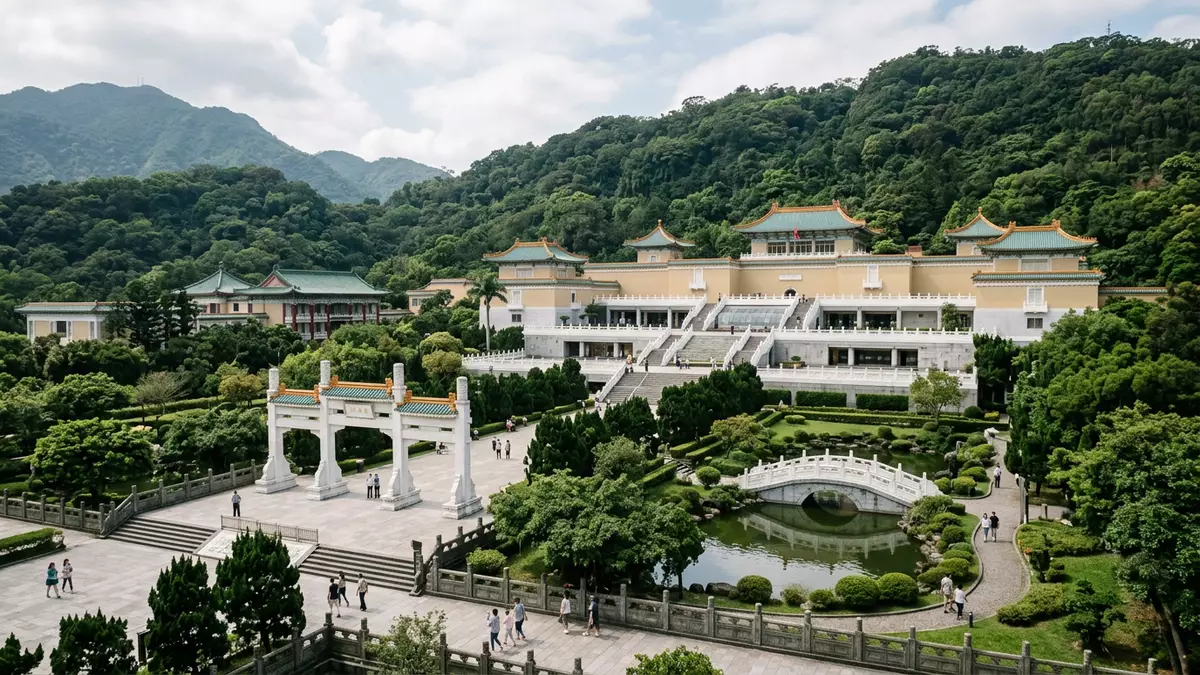
Guoli Gugong Bowuyuan rises in Taipeh with a roofline drawn from Chinese palace architecture. Green glazed tiles, yellow walls, white stone details and deep eaves frame a museum whose collections span more than 4,000 years of Chinese art.
The building and its contents form a single visual encounter: a twentieth-century museum in Waishuangxi, filled with objects connected to imperial courts, calligraphers, painters and craftsmen.
Guoli Gugong Bowuyuan: a palace form in twentieth-century Taipeh
The museum’s Taipei building was designed by Huang Baoyu, who led its architectural development from 1961. Construction was completed in 1965, and the museum opened to the public on 13 November that year.
Its exterior uses a classical Chinese vocabulary, including a broad roof, deep eaves and a formal central hall. The main building follows the traditional Hall of Distinction concept, with a domed roof and symmetrical extensions on both sides. classical architectural details connect the structure with public buildings created in Taiwan during the 1950s and 1960s.
The museum stands in Shilin District beside the wooded slopes of northern Taipeh. Its palace-like appearance is visible before the collection begins, with the roof and façade establishing a strong architectural frame for the galleries.
From imperial holdings to a museum in Taiwan
Guoli Gugong Bowuyuan preserves a large body of art associated with the Chinese imperial collection. The core holdings were connected with the Palace Museum in Beijing and with collecting under Qing emperor Qianlong, who reigned from 1735 to 1796.
The collection includes works from the Shang, Zhou, Han, Tang, Song, Yuan, Ming and Qing periods. Chinese painting, calligraphy, ritual bronzes, ceramics, jade, lacquerware, enamelware, decorative carvings, embroidery, tapestry, books and archival documents all have a place within its scope.
The museum came into being in 1965 after collections from Taiwan’s National Palace Museum, the Central Museum and other public cultural institutions were brought together in Taipei. the museum’s 1965 foundation marked the creation of a new institution around these dispersed holdings.
The objects carry histories that extend beyond the Taipei building. During the twentieth century, parts of the Palace Museum holdings moved through several locations before reaching Taiwan, where they were installed in the museum completed in 1965.
Jade, brushwork and the detail of imperial art
Small objects provide some of the clearest encounters with the collection’s range. The Jadeite Cabbage uses natural colour within the stone to distinguish pale stalks from green leaves, while insects appear among the carved foliage.
The Meat-shaped Stone is carved from jasper. Its natural layers form the visual basis of the object, with drilled pores and colour applied to the upper surface. The result belongs to the Qing dynasty, dated from 1644 to 1911.
These objects sit beside works in very different media. Bronze vessels carry the weight of early ritual culture, porcelain records refined ceramic traditions, and lacquerware turns layered surfaces into decoration. Calligraphy and painting place the movement of the brush at the centre of the image.
Chinese painting and calligraphy share materials such as brush, ink, paper and silk. Their presence in Guoli Gugong Bowuyuan gives the collection a strong relationship between written language and visual art. the jasper Meat-shaped Stone also shows how mineral colour and surface pattern became part of a carved image.
The museum therefore presents more than a sequence of display cases. Its architecture supplies a palace setting, while the galleries contain objects whose materials range from ink and silk to jade, porcelain, bronze and jasper.
Visiting Guoli Gugong Bowuyuan: what travellers from Western Europe should know
- Guoli Gugong Bowuyuan is at No. 221, Section 2, Zhishan Road, Shilin District, Taipeh. The Tamsui-Xinyi MRT Line reaches Shilin Station, where buses R30, 255, 304 and 815 continue towards the museum.
- The museum is in Waishuangxi, beside the northern Taipeh hills. The approach includes urban roads and a hillside setting rather than a flat central-city square.
- The official language is Mandarin Chinese and the currency is the New Taiwan dollar.
- Entry requirements depend on your nationality; UK travellers can check the FCDO travel advice at gov.uk/foreign-travel-advice, Irish travellers the Department of Foreign Affairs at ireland.ie.
Searching for Guoli Gugong Bowuyuan on social platforms
These links open searches for Guoli Gugong Bowuyuan on each platform.
Frequently asked questions about Guoli Gugong Bowuyuan
Where is Guoli Gugong Bowuyuan?
Guoli Gugong Bowuyuan is in Shilin District, in northern Taipeh, at Waishuangxi beside the city’s wooded hills.
What can visitors expect inside?
The galleries contain Chinese painting, calligraphy, bronzes, ceramics, jade, lacquerware, textiles, books and historical documents from several dynasties.
What makes the museum distinctive?
Its palace-style building by Huang Baoyu houses objects connected with more than 4,000 years of Chinese art, including Qing-dynasty jade and jasper carvings.


