
Guoli Gugong Bowuyuan and its palace-style roofline
Published on 09/16/2026 at 10:42 | Editorial responsibility: Rafael Müller, Editor-in-Chief AD HOC NEWS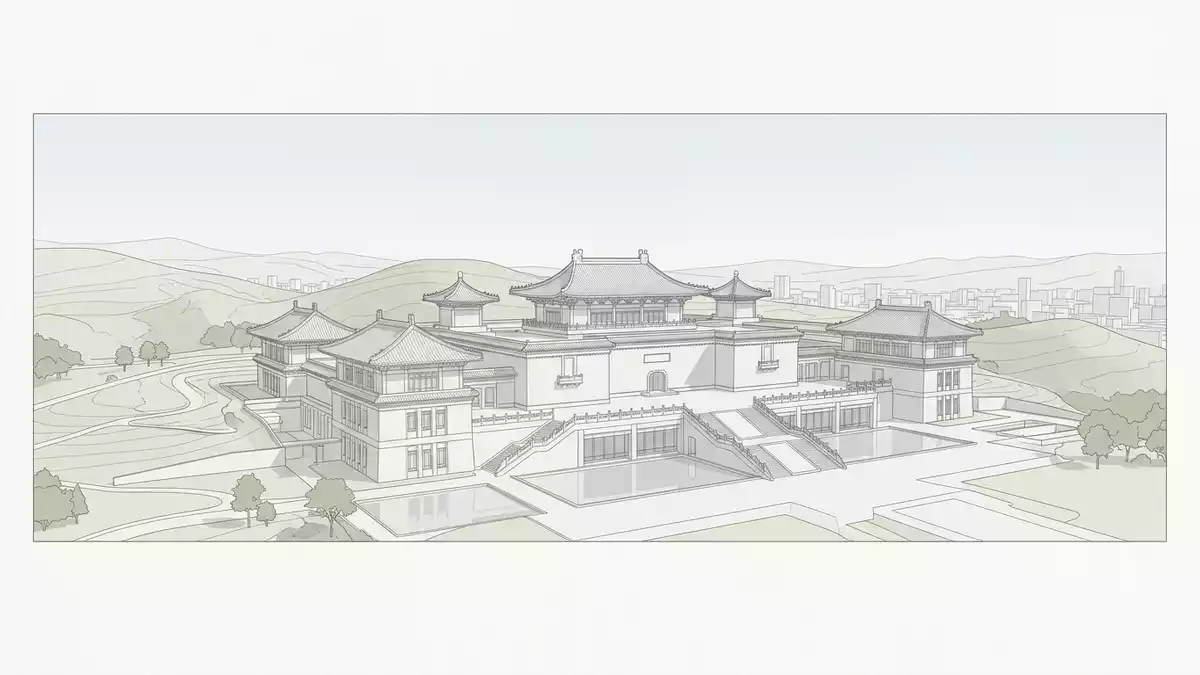
Guoli Gugong Bowuyuan in Taipeh is the National Palace Museum, a museum whose palace-style exterior makes its collection feel anchored in architecture as much as in objects. The building in Waishuangxi was completed in August 1965 and opened in Taipei that November.
A museum shaped like a palace
The main building presents a Chinese palace vocabulary rather than a neutral box. Huang Baoyu designed the museum in its Taipei form, and the project was completed in the mid-1960s.
That choice gives Guoli Gugong Bowuyuan a strong visual identity in the city. The rooflines, layered eaves and formal symmetry echo imperial architecture, while the institution inside is a modern museum of art, calligraphy and historical objects.
From Beijing collections to Taipeh galleries
The museum’s roots reach back to the National Palace Museum established in Beijing in 1925, and its Taipei branch later carried that name forward. The collection in Taiwan came from the earlier museum tradition and from the Preparatory Department of the National Central Museum.
The Taipei museum therefore holds more than an architectural replica of a palace setting. It brings together a collection associated with the Song, Yuan, Ming and Qing courts, displayed in a building completed in 1965.
Waishuangxi, gardens and the museum site
The Taipei museum stands in Waishuangxi, a district setting in the north of the city. Its site includes the main hall and a central garden, both part of the museum composition.
That combination of building and garden gives Guoli Gugong Bowuyuan a clear spatial order. The museum reads as a formal complex rather than a single container, with the architecture and the grounds presented as one ensemble.
Visiting Guoli Gugong Bowuyuan: what travellers from Western Europe should know
- The museum is in Waishuangxi in Taipeh. The official language is Mandarin Chinese and the currency is the New Taiwan dollar.
- The site is urban rather than remote. It sits within the city and is reached through Taipei’s public transport network and local roads.
- The architecture uses broad roofs, deep eaves and a formal main hall. The grounds include a central garden alongside the museum building.
- The museum’s collection is associated with imperial Chinese art, including calligraphy, paintings, bronzes, porcelains and jades.
- Entry requirements depend on your nationality; UK travellers can check the FCDO travel advice at gov.uk/foreign-travel-advice, Irish travellers the Department of Foreign Affairs at ireland.ie.
Searching for Guoli Gugong Bowuyuan on social platforms
These links open searches for Guoli Gugong Bowuyuan on each platform.
Frequently asked questions about Guoli Gugong Bowuyuan
Where is Guoli Gugong Bowuyuan?
It is in Taipeh, in the Waishuangxi area of the city. The museum sits in Taiwan, and its primary English name is National Palace Museum.
What does a visit involve?
The building, garden and galleries form a single museum complex. The architecture is formal and palace-like, and the collection centres on Chinese imperial art.
What makes Guoli Gugong Bowuyuan distinctive?
Its identity comes from the combination of a 1965 museum building, a palace-inspired exterior and a collection tied to earlier imperial courts. That mix gives it a clear place in Taipeh’s cultural landscape.


