
Gugong, the former imperial palace at the heart of Peking
Published on 08/30/2026 at 11:39 | Editorial responsibility: Rafael Müller, Editor-in-Chief AD HOC NEWS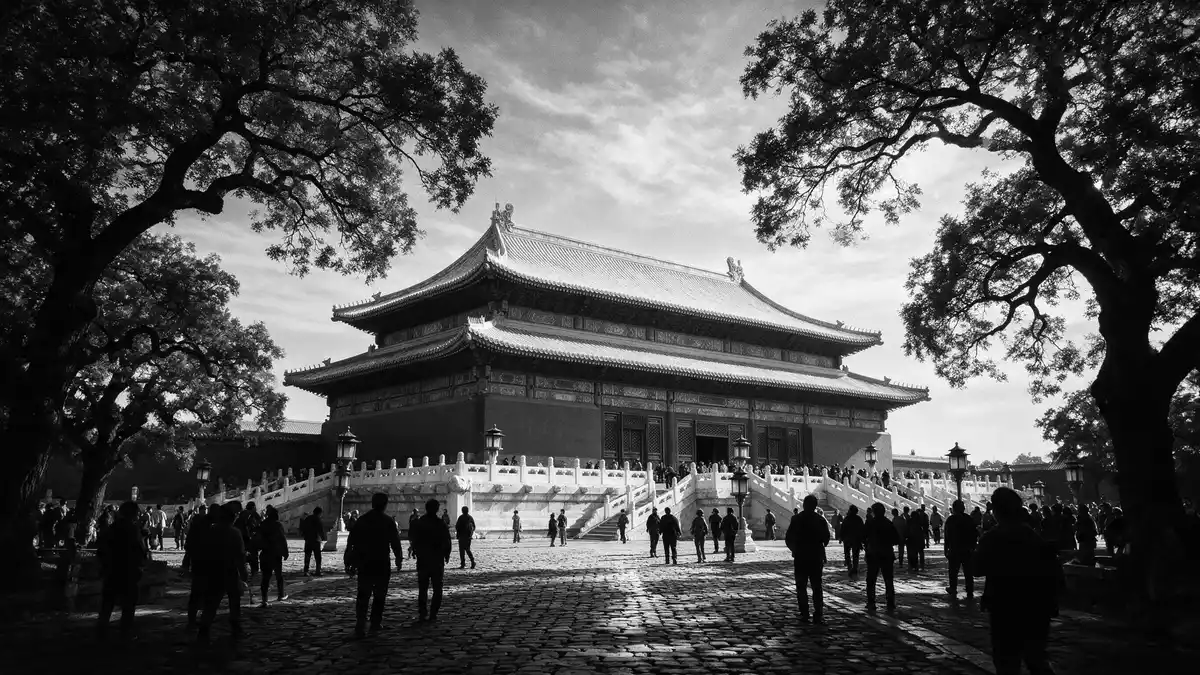
Gugong in Peking, widely known in English as the Forbidden City, is the former imperial palace complex that once housed the Ming and Qing emperors at the centre of China’s old capital. Completed in 1420 under the Yongle Emperor of the Ming dynasty, it occupies a walled rectangle of courtyards, halls and gates aligned on a strict north–south axis that still organises the historic core of Beijing.
An imperial city within the city
Gugong stands just north of Tian’anmen Square, enclosed by high defensive walls and a surrounding moat that mark it out as an imperial enclave within central Peking.imperial palace complex The plan forms a long rectangle, with its main ceremonial buildings arranged one behind another along the central axis and flanked by subsidiary courtyards and residential quarters. At the southern end, the Meridian Gate opens towards the outer city; at the northern end, gates lead towards Jingshan Park and the old inner city beyond.imperial palace complex at the centre of Beijing
Construction of the palace complex began in the early fifteenth century when the Ming court moved the capital to Peking, and the main halls were completed in 1420.built 1406-1420 and home to 24 Ming and Qing emperors until 1912 From that year until the abdication of the last Qing emperor in 1912, Gugong served as the ceremonial and residential centre of imperial power. The complex is now formally known as the Palace Museum, reflecting its conversion into a public museum in the twentieth century while retaining the historic palace architecture.officially known as the Palace Museum
Wooden halls, stone courts and ceremonial space
Architecturally, Gugong is a vast ensemble of timber halls, stone-paved courtyards and ornamental gates that together form one of the largest surviving wooden building complexes in the world.Forbidden City, called Gu Gong in Chinese The main ceremonial spaces lie in the Outer Court, where monumental audience halls rise on tiered stone platforms above broad open squares. Their timber frames are painted in red and gold, with bracketed roofs and glazed tiles that follow classical Chinese palace design.
Behind these formal halls, the Inner Court contains residential compounds, gardens and smaller pavilions that once housed the emperor and his household. The site extends over dozens of hectares, its courtyards separated by walls, ornamental gateways and covered corridors that create sequences of enclosed spaces. As the political centre of the Ming and Qing dynasties, Gugong concentrated imperial ritual, governance and daily life within this dense architectural fabric, which has been recognised as a UNESCO World Heritage Site since 1987.Verbotene Stadt, UNESCO-Weltkulturerbe seit 1987
From palace to Palace Museum
After the end of the Qing dynasty in 1912, the buildings of Gugong gradually ceased to be an imperial residence and were reorganised as a museum. In 1925 the Palace Museum was formally established within the former palace compound, turning the complex into an institution dedicated to preserving and displaying imperial collections.converted into the Palace Museum in 1925 The name “Gugong”, meaning “Former Palace”, reflects this shift from a working seat of power to a historic site.
Today the Palace Museum occupies the entire walled precinct, using halls and side buildings as galleries while keeping much of the traditional layout intact.The Palace Museum — known in Chinese as Gùg?ng Collections of painting, calligraphy, ceramics, bronzes, lacquerware and imperial furnishings are housed in former throne halls and residential suites, with displays that draw on the long history of court culture. The transformation from palace to museum has allowed the architecture itself to be experienced as an exhibit, with the sequence of courtyards and gates giving visitors a sense of how imperial space was organised.
Visiting Gugong: what travellers from Western Europe should know
- Gugong lies in central Peking immediately north of Tian’anmen Square, on the historic north–south axis of Beijing’s old city. It is reached by urban transport including metro lines that serve stations near the southern side of the complex.
- The palace precinct is enclosed by walls, towers and a surrounding moat, and movement inside follows long paved courtyards and stairways leading up to raised platforms and halls.
- The official language is Chinese and the currency is the Chinese yuan (CNY).
- Entry requirements depend on your nationality; UK travellers can check the FCDO travel advice at gov.uk/foreign-travel-advice, Irish travellers the Department of Foreign Affairs at ireland.ie.
Searching for Gugong on social platforms
These links open searches for Gugong on each platform.
Frequently asked questions about Gugong
Where is Gugong located in Peking?
Gugong is in central Peking, just north of Tian’anmen Square, within a walled rectangle that forms the historic core of Beijing’s old city.
What can visitors expect on a visit to Gugong?
Visitors walk through a sequence of monumental timber halls, stone-paved courtyards and ornamental gates, experiencing the former imperial palace as a museum within its original architecture.
What makes Gugong distinctive among historic sites in China?
Gugong combines a fifteenth-century palace layout, extensive wooden architecture and its role as the former seat of Ming and Qing imperial power, all preserved within a single walled complex recognised as a UNESCO World Heritage Site.


