
Grotte di Frasassi, an immense underground landscape beneath Genga
Published on 09/16/2026 at 09:59 | Editorial responsibility: Rafael Müller, Editor-in-Chief AD HOC NEWS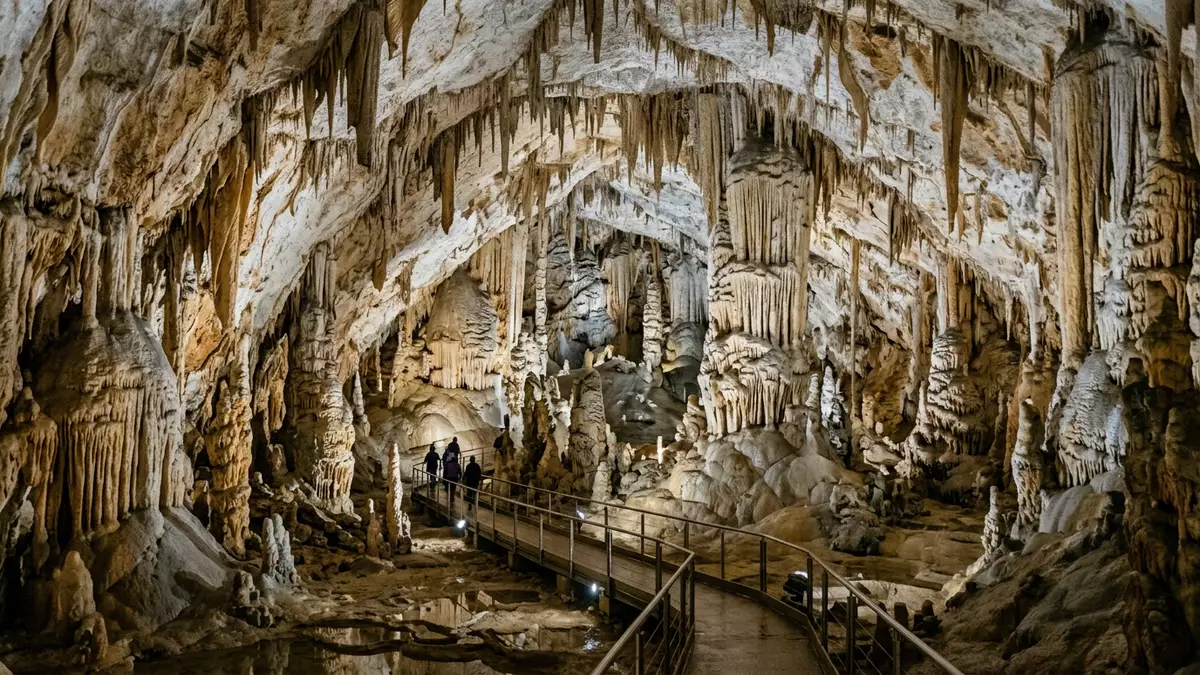
Grotte di Frasassi in Genga, in the Marche region of Italy, is a karst cave system where limestone has been dissolved and sculpted into vast underground chambers over millions of years.karst cave system The caves lie within the protected landscape of the Gola della Rossa e di Frasassi, where a rocky gorge above and a branching network of caverns below form a single geological setting.Gola della Rossa e di Frasassi
An underground cathedral of limestone chambers
The most striking impression on entering Grotte di Frasassi is the sheer scale of its first major chamber, known as the Abisso Ancona, a cavern so large that a cathedral could fit comfortably inside.Abisso Ancona This hollow forms part of a cave complex that extends for many kilometres beneath the Apennine limestone, where galleries, side rooms and corridors connect in a multi-level system.stretches beneath the Appennine Mountains
Within these chambers the cave floor and roof are crowded with speleothems, the mineral formations that grow as water drips, flows and evaporates through the rock. Stalactites hang from ceilings in clusters, sometimes aligned like organ pipes, while stalagmites rise from the ground in columns and irregular spires that resemble melted wax or sculpted pillars.stalactites resembling pipe organs In places, flowstone sheets coat walls and slopes, creating smooth terraces and rippled cascades of calcite that reflect light in muted tones.
A cave system shaped and discovered in the twentieth century
Geologically, Grotte di Frasassi belongs to a limestone massif in the central Apennines, where water and dissolved gases have worked through the rock over a considerable span of time, opening voids and enlarging fractures into walkable passages.subterranean world of calcareous rock formations The caves are described as hypogenic in origin, formed largely from below as hydrogen sulphide and other components in deep water reacted with oxygenated water nearer the surface, producing acids that etched their way through the limestone.hypogenic speleogenesis
In human terms, the turning point came in the late twentieth century when local speleologists explored and documented the system. On 25 September 1971 members of the Speleological Marchigiano Group associated with the Italian Alpine Club of Ancona identified and entered major chambers, opening the way for systematic mapping and later public access.discovery dates back to 25 September 1971 Portions of the caves were then prepared for guided visits, with paths, lighting and viewing points installed so that visitors could move safely through a sequence of representative spaces while most of the underground network remained reserved for research and specialised exploration.percorso turistico
Grotte di Frasassi within the Gola della Rossa e di Frasassi park
The caves sit inside a regional natural park that links the underground karst to an above-ground landscape of cliffs, river valleys and woodland. The protected area, known as the Parco naturale regionale della Gola della Rossa e di Frasassi, encompasses the Sentino river gorge and the limestone slopes surrounding Genga, providing a setting where geology, vegetation and built heritage meet.Parco naturale regionale della Gola della Rossa e di Frasassi Within this framework the caves are one part of a wider itinerary that can include Romanesque architecture, hill villages and viewpoints over the gorge.
Inside the show cave route, artificial lighting picks out specific formations and distances, making clear the layers of calcite, the overhangs and the branching nature of the passages without removing the sense of being in a largely natural environment. Walkways and steps are built above the cave floor, sometimes crossing chambers at different levels, which gives changing perspectives on the same groups of stalactites and stalagmites and reveals how the mineral deposits occupy three-dimensional space within the rock.
Visiting Grotte di Frasassi: what travellers from Western Europe should know
- Grotte di Frasassi lies near Genga in the province of Ancona in central Italy, reached by road connections signposted from the SS76 route between Ancona and the interior and by regional rail services to Genga-San Vittore Terme.
- The prepared tourist route follows constructed paths and stairways through large underground chambers, and visitors spend extended time on foot on firm but sometimes inclined surfaces.
- The caves form part of a regional natural park landscape that also includes the Sentino river gorge and the village of San Vittore, so an exploration underground can be combined with time among limestone cliffs and historic architecture nearby.
- The official language is Italian and the currency is the euro.
Searching for Grotte di Frasassi on social platforms
These links open searches for Grotte di Frasassi on each platform.
Frequently asked questions about Grotte di Frasassi
Where is Grotte di Frasassi located?
Grotte di Frasassi is situated in the municipality of Genga in the province of Ancona in the Marche region of central Italy, within the Gola della Rossa e di Frasassi regional natural park.
What can visitors expect inside the caves?
Visitors walk through large limestone chambers along prepared paths, seeing stalactites, stalagmites and flowstone formations under artificial lighting that highlights the scale and structure of the underground landscape.
What makes Grotte di Frasassi distinctive among European cave systems?
The caves combine exceptionally spacious chambers such as the Abisso Ancona with a hypogenic origin linked to ascending acidic waters, all set within a protected gorge landscape near Genga in the Apennine foothills.


