
Grotte di Frasassi, a vast underground world beneath Genga
Published on 08/31/2026 at 06:15 | Editorial responsibility: Rafael Müller, Editor-in-Chief AD HOC NEWS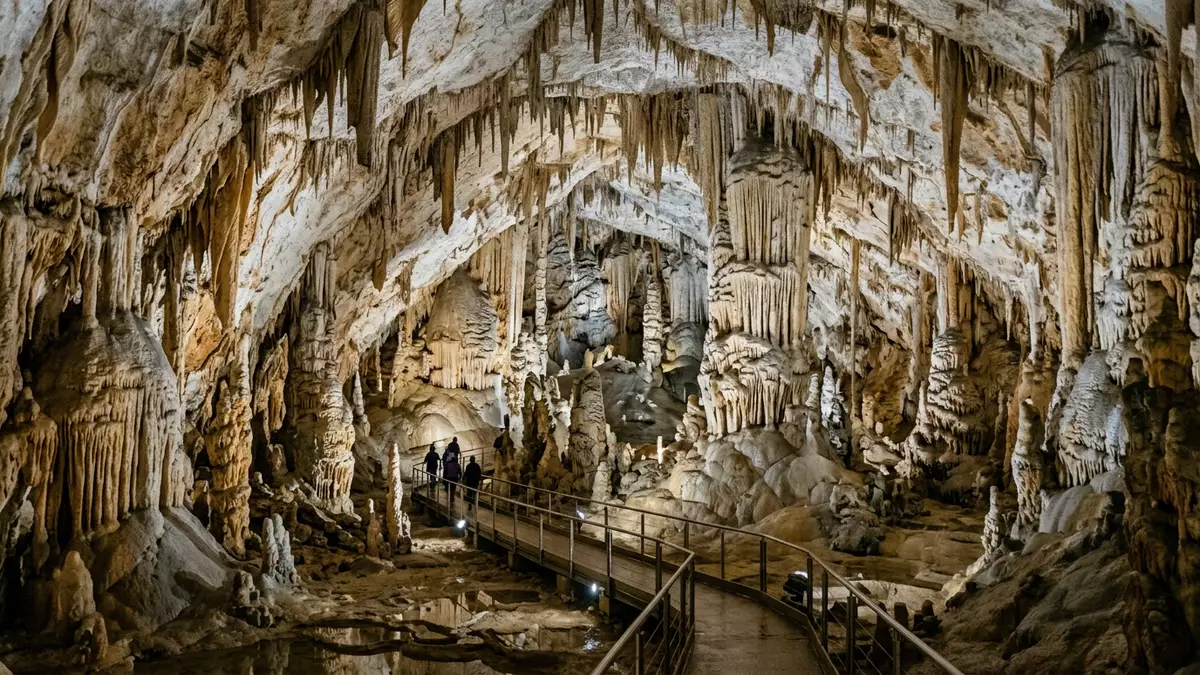
Grotte di Frasassi is a vast karst cave system beneath the hills of Genga in central Italy, where underground chambers open inside the limestone of the Apennines. Formed over geological time by water cutting through rock in the Frasassi gorge, the caves present an underground landscape of scale and detail that contrasts with the wooded valley above.
An underground landscape in the Marche Apennines
Grotte di Frasassi lies in the municipality of Genga in the province of Ancona, part of the Marche region on the Adriatic side of the Apennine chain.karst cave system in Genga The cave complex sits inside limestone slopes along the gorge known as Gola della Rossa e di Frasassi, which forms a protected regional natural park above and around the underground passages.Parco naturale regionale della Gola della Rossa e di Frasassi Here the Sentino river has carved a deep incision through the massif, and below the surface the caves run for many kilometres through the rock.karst tunnels within the gorge
The entrance used by visitors opens partway up the gorge, where a paved route leads into a sequence of lit chambers. Outside, the landscape is characterised by wooded slopes and rocky walls; inside, the same limestone appears in entirely different forms. The caves lie within Mount Valmontagnana and nearby formations, with their tunnels arranged on several levels that follow past stages in the river network above.Mount Valmontagnana and multi-level tunnels
From the Ancona Abyss to delicate concretions
The part of Grotte di Frasassi open to the public begins with one of its most striking spaces: the Abisso Ancona, or Ancona Abyss, a chamber so large that major cathedrals would fit inside it.Abisso Ancona dimensions This cavern has a height of about 200 m and spans roughly 180 m in length and 120 m in width, giving it a volume measured in millions of cubic metres.over two million cubic metres Beyond this first space, the tourist route continues through a series of chambers and corridors, where the emphasis shifts from sheer size to the forms of the cave deposits.
The concretions in Grotte di Frasassi include stalactites hanging from the vaults, stalagmites rising from the floors, columns where the two meet, and delicate formations shaped by slowly dripping water.stalactites and stalagmites In some chambers, thin parallel stalactites resemble organ pipes, while nearby stalagmites form shapes compared to melted candles or layered towers.organ-like stalactites and melted-candle stalagmites Pools and basins hold still water, where crystals have grown along their edges; elsewhere, curtains of calcite drape from walls where mineral-rich water has streamed over the rock.calcite formations and crystallised pools
Discovery, protection and speleological exploration
Although cavities in the Frasassi area had long been known locally, the modern exploration of the cave system dates to 25 September 1971, when members of the Speleological Marchigiano Group of the Italian Alpine Club in Ancona identified and entered the deeper network now known as Grotte di Frasassi.discovery on 25 September 1971 Subsequent surveying revealed an extensive hypogean complex branching under the municipality of Genga, with kilometres of passages distributed on more than one level.hypogeum complex beneath Genga The caves were opened to guided public visits a few years after their exploration, while large sections remain reserved for research and specialist speleological activity.opened to the public in the 1970s
The inclusion of the caves within the Parco naturale regionale della Gola della Rossa e di Frasassi has given them a formal protective framework, linking the underground features with the river gorge, the surrounding forests and the cultural sites nearby.caves within the regional park The same limestone geology that shapes the caves also supports the cliffs and slopes of the gorge, where paths, viewpoints and small settlements mark the surface, creating a landscape in which the subterranean and the external parts mirror each other in material while differing completely in form.
Visiting Grotte di Frasassi: what travellers from Western Europe should know
- Grotte di Frasassi lies near Genga in the Marche region of Italy and is reached by road links signposted from the SS76 route between Ancona and the interior, with the Genga-San Vittore Terme railway station close to the visitor facilities.
- The standard tourist route follows a constructed path through large chambers and passages, with steps and short ramps underfoot and a stable underground environment that remains enclosed from outside weather.
- The caves form part of a regional natural park that also includes the Frasassi gorge and surrounding hills, so they sit within a landscape where rocky walls, woodland and small settlements are in close proximity.
- Italian is the official language and the currency is the euro.
Searching for Grotte di Frasassi on social platforms
These links open searches for Grotte di Frasassi on each platform.
Frequently asked questions about Grotte di Frasassi
Where is Grotte di Frasassi located?
Grotte di Frasassi is in the municipality of Genga in the province of Ancona, in the Marche region of central Italy, within the Gola della Rossa e di Frasassi regional natural park.
What can visitors expect inside the caves?
Visitors walk along a constructed route through large chambers such as the Ancona Abyss and through passages lined with stalactites, stalagmites, calcite curtains and pools formed by mineral-rich water.
What makes Grotte di Frasassi distinctive among Italian cave systems?
The combination of enormous chambers like the Ancona Abyss, extensive multi-level tunnels beneath Mount Valmontagnana and richly developed concretions within a protected river gorge makes Grotte di Frasassi a notable karst complex in Italy.


