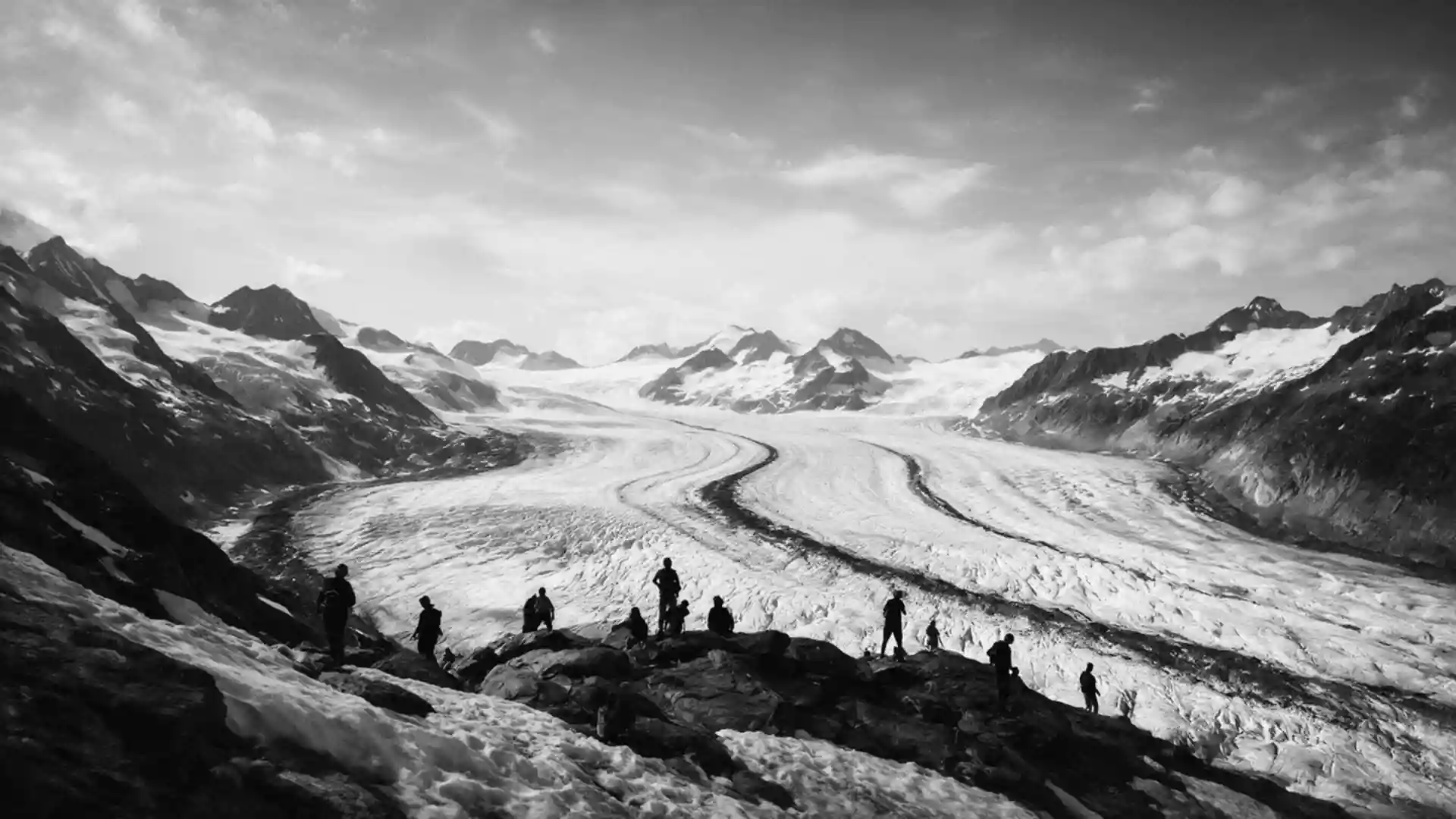
Grosser Aletschgletscher: the great ice river above Fiesch
Published on 08/29/2026 at 22:19 | Editorial responsibility: Rafael Müller, Editor-in-Chief AD HOC NEWS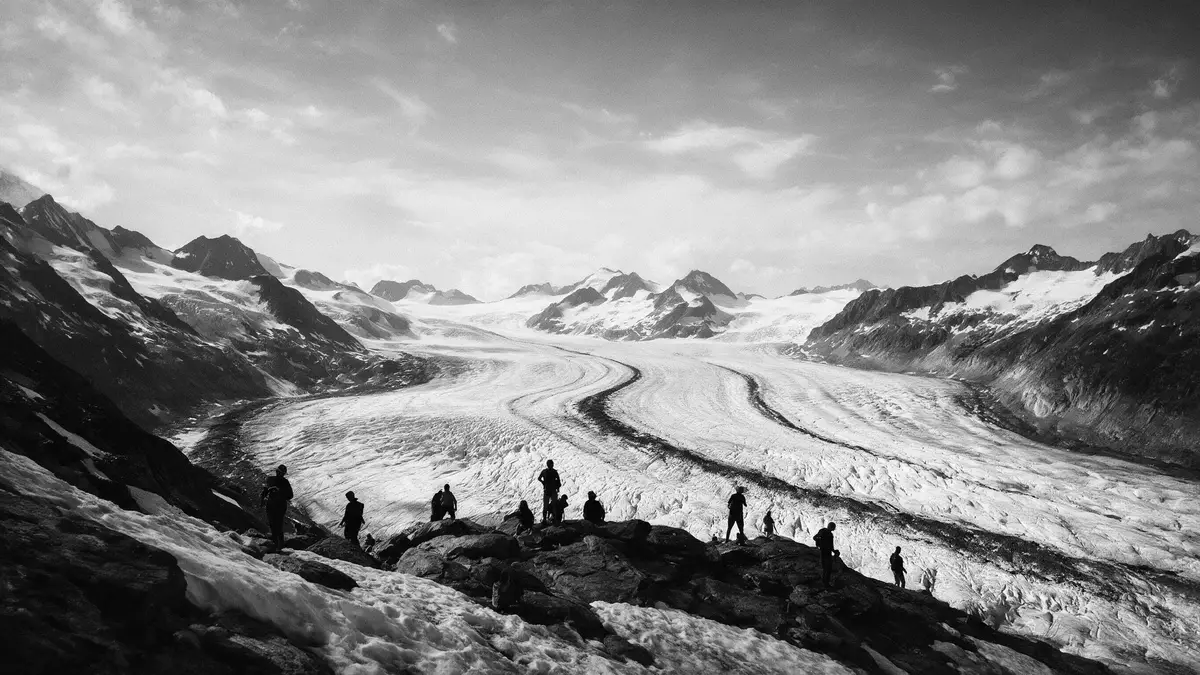
High above the Valais village of Fiesch, Grosser Aletschgletscher sweeps through a high mountain basin as a vast river of ice, framed by the peaks of the Bernese Alps. It is the largest glacier in the Alps, part of the Swiss Alps Jungfrau-Aletsch World Heritage landscape, and its curving white surface has become one of the defining panoramas of Switzerland.
The great glacier at the heart of Jungfrau-Aletsch
Grosser Aletschgletscher lies in the eastern Bernese Alps, within the Swiss canton of Valais, where the high rock walls around Jungfrau, Mönch and Eiger gather several névés into a single broad stream of ice.Aletsch Glacier The glacier is an immense body, extending for more than 20 km (12.4 mi) from its upper basin at Konkordiaplatz down towards the Rhône valley and covering tens of square kilometres in ice and debris.largest and longest glacier in the Alps At its thickest measured point near Konkordiaplatz, the ice column reaches hundreds of metres, forming a deep cross-section that glaciologists have studied as a record of Alpine climate.
The glacier forms the centrepiece of the Swiss Alps Jungfrau-Aletsch World Heritage Site, a protected area recognised by UNESCO since 2001 for its outstanding glaciated landscape and geological value.Swiss Alps Jungfrau-Aletsch The inscribed property, sometimes referred to as Jungfrau-Aletsch-Bietschhorn, spans tens of thousands of hectares and includes high summits, deeply incised valleys and a wide spectrum of Alpine habitats shaped by ice and rock.Jungfrau-Aletsch-Bietschhorn decision Within this expanse, Grosser Aletschgletscher stands out as the main ice stream, collecting snow from several firn fields that merge at Konkordiaplatz into a single, slowly moving mass.
Shape, movement and the high-peak setting
Seen from above, Grosser Aletschgletscher curves gently as it descends, its surface marked by pale bands and darker stripes where rock material has been dragged into moraines along the flow. The overall form follows the bend of the valley, giving visitors from Fiesch and neighbouring resorts a clear view of the glacier’s sinuous path from the high basin down towards the lower tongue.Grosser Aletsch Glacier length and volume Over decades, glaciologists have measured changes in length, area and thickness, using Grosser Aletschgletscher as a key indicator of long-term climate trends in the European Alps.modelling the retreat of Grosser Aletschgletscher
Around the glacier, the rock architecture of the Jungfrau region shapes the visual frame: high summits, sharp ridges and hanging valleys form a natural amphitheatre of grey and brown stone above the white ice. Peaks such as Jungfrau and neighbouring mountains rise well above 4,000 m (13,123 ft), with snowfields feeding the firn basins that supply the glacier.Eiger, Mönch and Jungfrau massif Around the lower margins of Grosser Aletschgletscher, rocky lateral moraines and patches of Alpine vegetation mark the transition between moving ice and stable ground, giving the landscape clear horizontal layers from valley forest to glaciated heights.
Viewpoints above Fiesch and the Aletsch Arena
For travellers based in Fiesch and the surrounding Aletsch Arena, Grosser Aletschgletscher is primarily experienced from high viewpoints on nearby ridges and summits. The mountain station and ridge of Eggishorn above Fiescheralp offer a particularly wide panorama, taking in much of the upper glacier and a broad sweep of surrounding peaks.Eggishorn viewpoint description Further west, Bettmerhorn and Riederalp provide other vantage points, each giving a different angle on the curving ice and the distant basin of Konkordiaplatz where several firn fields converge.Aletsch Arena viewpoints
On clear days, these viewpoints reveal the length of Grosser Aletschgletscher as it runs away into the distance, with the high peaks of the Jungfrau group rising above the upper basin. The contrast between the smooth, pale surface of the glacier and the jagged rock towers behind it is one of the reasons the Aletsch Arena has developed a network of marked viewpoints, terraces and paths along the ridge. From these vantage points, visitors can see the layering of the landscape: glacier in the centre, forested slopes on the flanks, and distant valley settlements far below.
Visiting Grosser Aletschgletscher: what travellers from Western Europe should know
- Grosser Aletschgletscher lies above the Valais village of Fiesch, reached by rail services through the Rhône valley to regional stations such as Brig and Fiesch, followed by mountain lifts into the Aletsch Arena.
- The terrain around the main viewpoints is high Alpine ground with substantial elevation, where paths and terraces can involve steep gradients, rocky sections and exposed ridges that require secure footing.
- From the ridge stations above Fiesch, Grosser Aletschgletscher is seen across a deep drop, with safety barriers and marked paths separating visitor areas from the unstable ground near the glacier’s edge.
- English, French and German are widely encountered in Valais; the official language of the canton around Fiesch is German and the currency is the Swiss franc.
- Entry requirements depend on your nationality; UK travellers can check the FCDO travel advice at gov.uk/foreign-travel-advice, Irish travellers the Department of Foreign Affairs at ireland.ie.
Searching for Grosser Aletschgletscher on social platforms
These links open searches for Grosser Aletschgletscher on each platform.
Frequently asked questions about Grosser Aletschgletscher
Where is Grosser Aletschgletscher in Switzerland?
Grosser Aletschgletscher lies in the eastern Bernese Alps within the Swiss canton of Valais, above the Rhône valley and close to the village of Fiesch.
What can visitors expect when viewing the glacier?
Visitors see a long, curving river of ice surrounded by high Alpine peaks and deep valleys, usually from viewpoints on ridges and summits linked to the Aletsch Arena resorts.
What makes Grosser Aletschgletscher distinctive among Alpine glaciers?
It is the largest and longest glacier in the Alps and forms the central feature of the Swiss Alps Jungfrau-Aletsch UNESCO World Heritage landscape.