
Grosser Aletschgletscher and the great river of ice above Fiesch
Published on 09/03/2026 at 19:15 | Editorial responsibility: Rafael Müller, Editor-in-Chief AD HOC NEWS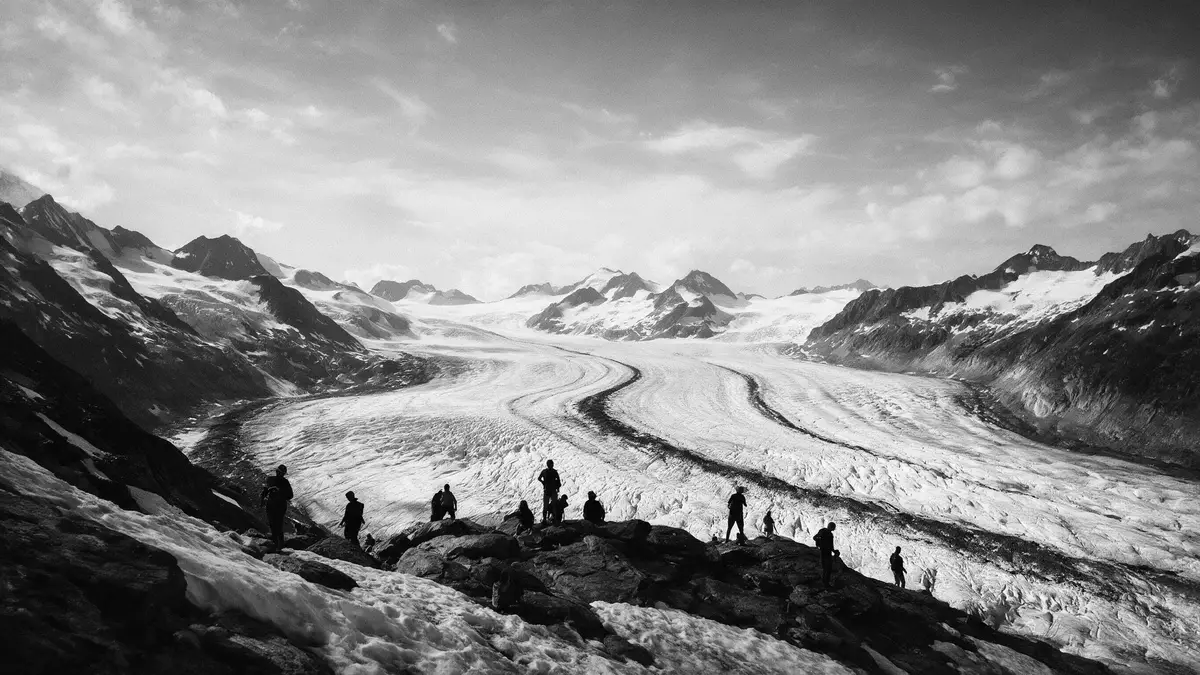
High above the Valais village of Fiesch, Grosser Aletschgletscher forms a broad river of ice sweeping through the Bernese Alps in southern Switzerland. As the largest glacier in the Alps, it anchors the Swiss Alps Jungfrau-Aletsch World Heritage landscape and draws together high summits, snowfields and rock into a single, continuous body of ice.
The long curve of the Great Aletsch Glacier
Grosser Aletschgletscher is a valley glacier on the southern flank of the Bernese Alps in the canton of Valais, extending for over 20 km (12.4 mi) from its accumulation basins down towards the Massa valley.valley glacier in Valais Its ice gathers in a broad, high plateau of firn known as Konkordiaplatz, where several tributary glaciers meet before the main tongue flows away in a single, gently curving arc. The glacier descends from elevations above 4,000 m (13,123 ft) to a lower tongue lying below 2,000 m (6,562 ft), crossing a considerable vertical range along its course.high-altitude glacier profile
The scale of Grosser Aletschgletscher is reflected in its surface area, which has been measured in recent decades at tens of square kilometres of continuous ice.largest and longest glacier in the Alps Flow stripes, crevasses and medial moraines mark the glacier surface, tracing the movement of the ice from the surrounding catchment into the main trunk. From viewpoints along the ridge, the glacier appears as a broad band of pale ice curving between dark rocky walls, with the Jungfrau and neighbouring peaks rising above its upper basins.
A core of the Swiss Alps Jungfrau-Aletsch World Heritage site
Grosser Aletschgletscher lies at the centre of the Swiss Alps Jungfrau-Aletsch area, which was inscribed on the UNESCO World Heritage List in 2001 as a high-alpine landscape dominated by glacial forms.Swiss Alps Jungfrau-Aletsch inscription The wider property, sometimes referred to as Jungfrau-Aletsch-Bietschhorn, covers a large swathe of the Bernese and Valais Alps, including major peaks, smaller glaciers and associated forests and pastures. Within this protected framework, the Great Aletsch Glacier is recognised as Europe’s largest continuous Alpine glacier and a central reference point in understanding glacial processes in the High Alps.Great Aletsch glacier within the World Heritage
The Jungfrau-Aletsch region is described in UNESCO documentation as the most glaciated part of the European Alps, containing a rich variety of classic glacial landforms such as cirques, horns, ridges and U-shaped valleys.glacial landscape context Grosser Aletschgletscher sits among these features as a single, dominant glacier body, with lateral moraines, icefalls and a surrounding belt of subalpine woodland known as the Aletsch forest. The protected status limits major infrastructure on the glacier itself, keeping the central ice and its immediate surroundings relatively undisturbed within the broader tourism region of Valais and the Bernese Oberland.
Ice, rock and routes above Fiesch
For travellers using Fiesch as a base, Grosser Aletschgletscher is reached by mountain transport systems that climb from the Rhône valley up to vantage points on the surrounding ridges. From these elevated stations and paths, the glacier appears below as a vast, gently curving body of ice flanked by rocky slopes and scattered patches of high-alpine vegetation. The broader setting includes multiple summits of the Bernese Alps, with the Jungfrau massif contributing accumulation basins that feed the glacier’s upper reaches.accumulation basins feeding the glacier
On the eastern side, Grosser Aletschgletscher is connected over the Grünhornlücke glacier pass to Fieschergletscher, linking different ice bodies within the same high-mountain system.link to Fieschergletscher over Grünhornlücke The Massa river drains meltwater from the glacier towards the Rhône, carving its own valley and marking the downstream continuation of the glacier’s influence on the landscape. Around the glacier, marked routes and viewing platforms give structured access to the ridge, while leaving the main ice surface and its immediate margins as a largely natural high-alpine environment dominated by rock, snow and slowly moving ice.
Visiting Grosser Aletschgletscher: what travellers from Western Europe should know
- Grosser Aletschgletscher lies above the village of Fiesch in the Swiss canton of Valais, on the southern side of the Bernese Alps, reached by mountain transport from the Rhône valley.
- The terrain around the glacier viewpoints is high-alpine, combining substantial elevation, rocky paths and sections of stepped routes that require firm footwear and steady footing.
- Fiesch sits in Switzerland, where the official language of the wider region is German and the currency is the Swiss franc.
- The glacier area lies within the Swiss Alps Jungfrau-Aletsch World Heritage site, so paths and platforms follow structured routes above steep drops and glaciated terrain.
Searching for Grosser Aletschgletscher on social platforms
These links open searches for Grosser Aletschgletscher on each platform.
Frequently asked questions about Grosser Aletschgletscher
Where is Grosser Aletschgletscher located?
Grosser Aletschgletscher lies above Fiesch in the Swiss canton of Valais, on the southern slope of the Bernese Alps within the Swiss Alps Jungfrau-Aletsch region.
What should visitors expect when viewing the glacier?
Visitors encounter a long valley glacier framed by high-alpine terrain, with ridge viewpoints reached by mountain transport and paths crossing rocky, stepped ground at substantial elevation.
What makes Grosser Aletschgletscher distinctive among Alpine glaciers?
It is recognised as the largest glacier in the Alps and forms the central ice body of the Swiss Alps Jungfrau-Aletsch World Heritage site, linking major summits, firn basins and glacial landforms.


