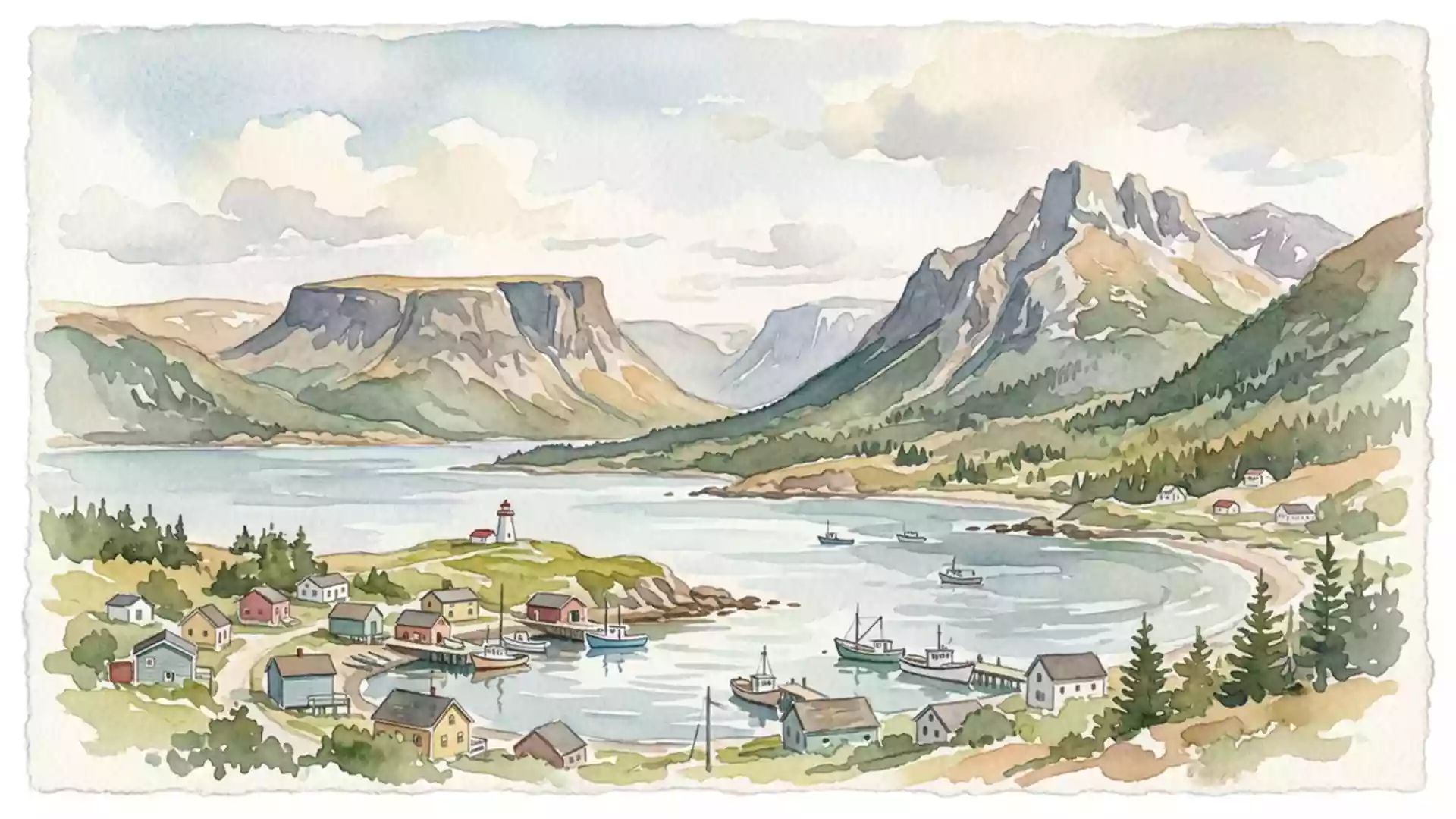
Gros Morne National Park where Earth’s history lies open
Published on 08/28/2026 at 17:36 | Editorial responsibility: Rafael Müller, Editor-in-Chief AD HOC NEWS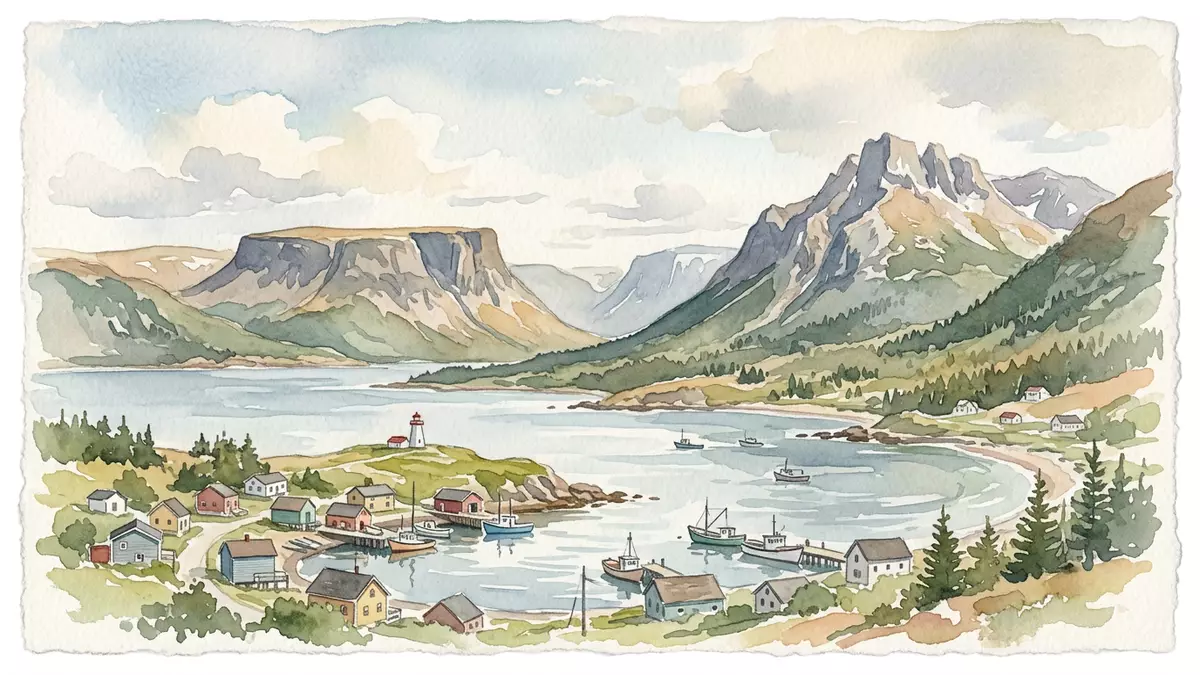
Gros Morne National Park on the west coast of Newfoundland is a Canadian national park where deep ocean crust and even mantle rock lie exposed beside glacially carved fjords. The park was inscribed as a UNESCO World Heritage Site in 1987 for both its dramatic scenery and its outstanding geological record of plate tectonics in the Long Range Mountains. Gros Morne National Park takes its name from Gros Morne, a mountain whose French-derived name refers to a large, sombre hill, and it is closely associated with the community of Rocky Harbour on Newfoundland’s west coast.
An exposed cross-section of ocean crust and mantle
The defining feature of Gros Morne National Park is the way it exposes rocks that normally lie far below the Earth’s surface, giving geologists and visitors access to ocean crust and mantle material in a single landscape. UNESCO recognised the park under natural criteria vii and viii because its rocks collectively present an internationally significant illustration of continental drift and plate tectonics along the eastern margin of North America. UNESCO’s inscription for Gros Morne emphasises both the geological story and the exceptional natural beauty of landlocked freshwater fjords in an ocean setting.
Much of this geology is concentrated in the Tablelands, at the southern end of the park, where rust-coloured peridotite from the upper mantle forms a stark plateau above the surrounding green mountains. In the Tablelands, mantle-derived ultramafic rocks such as peridotite and serpentinite sit alongside mafic rocks like gabbro that represent oceanic crust, creating a visible junction between two parts of an ancient ocean floor. Descriptions of the Table Mountain Massif explain that this assemblage of mantle and crust was emplaced by plate movements in the Cambrian and Ordovician periods, offering one of the clearest on-land ophiolite complexes in eastern North America.
Glacial fjords and the Long Range Mountains
Gros Morne National Park also protects part of the Long Range Mountains, a subrange of the Canadian Appalachians whose ancient rocks record collisions between continents more than a billion years ago. The high ground drops into deep, landlocked freshwater fjords, carved by glaciers and now separated from the open Atlantic by narrow channels and sill-like ridges. In its World Heritage listing, UNESCO highlights these glacier-scoured headlands and fjords in an ocean setting as an outstanding wilderness environment of exceptional natural beauty. Parks Canada’s overview of Gros Morne describes how colliding continents and grinding ice shaped the park’s variety of cliffs, coastal lowlands and mountain plateaus.
Within this landscape, Gros Morne mountain rises as one of the park’s most recognisable peaks, its slopes forming part of a skyline of rounded summits and steep valleys. The contrast between the grey-green metamorphic and sedimentary rocks of the Long Range Mountains and the orange-brown peridotite of the Tablelands is easily visible, turning a walk or drive through the park into a journey across different layers of Earth’s crust. Satellite and aerial imagery from agencies such as NASA show the Long Range Mountains trending along Newfoundland’s west coast, with Gros Morne’s fjords incised into their western flank. NASA’s Earth Observatory feature underlines how the Tablelands and surrounding mountains together illustrate the construction of ancient mountain belts.
Rocky Harbour, geology trails and coastal villages
The modern gateway for many visits to Gros Morne National Park is Rocky Harbour, a community on the west coast of Newfoundland that serves as one of the main bases for exploring the protected area. Official park information places Gros Morne on Newfoundland’s west coast, reachable overland from Deer Lake and the ferry terminal at Port aux Basques, with Rocky Harbour acting as a service centre on the shoreline of Bonne Bay. Parks Canada’s visit planning page gives contact details based in Rocky Harbour, reflecting the town’s close relationship with the national park.
Around Rocky Harbour and other coastal communities such as Norris Point and Trout River, marked trails and roads lead into the different geological zones of Gros Morne. Near Trout River, the Tablelands road gives access to the mantle rocks, where vegetation is sparse because the peridotite’s chemistry lacks the nutrients most plants require. The Newfoundland and Labrador tourism guide highlights the park’s mix of coastal villages, inland valleys and accessible geological viewpoints, making it possible to combine shorelines, mountain scenery and science-focused walks within one visit.
Visiting Gros Morne National Park: what travellers from Western Europe should know
- Gros Morne National Park lies on the west coast of Newfoundland in the Canadian province of Newfoundland and Labrador, with Rocky Harbour acting as one of the principal service communities for the park.
- The terrain within the park ranges from coastal lowlands to high plateaus and steep valleys; some routes climb on stony paths and mountain trails, and access to the Tablelands crosses exposed rocky ground with limited vegetation.
- The official language of the area is English and the national currency is the Canadian dollar.
- Entry requirements depend on your nationality; UK travellers can check the FCDO travel advice at gov.uk/foreign-travel-advice, Irish travellers the Department of Foreign Affairs at ireland.ie.
Searching for Gros Morne National Park on social platforms
These links open searches for Gros Morne National Park on each platform.
Frequently asked questions about Gros Morne National Park
Where is Gros Morne National Park located?
Gros Morne National Park is on the west coast of Newfoundland in the Canadian province of Newfoundland and Labrador, with Rocky Harbour among the nearby communities.
What should visitors expect on a trip to Gros Morne?
Visitors encounter a combination of coastal villages, mountain plateaus, deep fjords and the rust-coloured mantle rocks of the Tablelands, all linked by roads and walking trails.
What makes Gros Morne National Park distinctive?
The park is distinctive because it exposes ocean crust and mantle rocks alongside glacial fjords in one protected landscape, a combination recognised in its 1987 UNESCO World Heritage inscription.