
Gros Morne National Park’s otherworldly geology in Rocky Harbour
Published on 09/01/2026 at 06:05 | Editorial responsibility: Rafael Müller, Editor-in-Chief AD HOC NEWS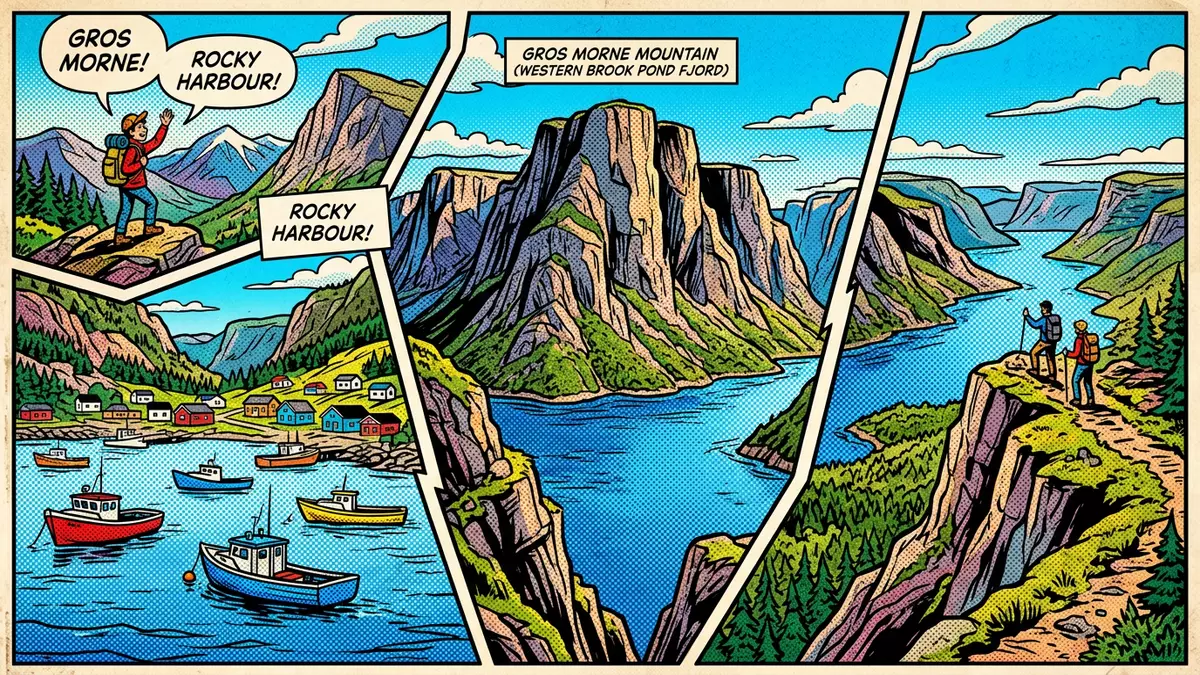
Gros Morne National Park on the west coast of Newfoundland is a landscape where geology is unusually visible in everyday scenery. Designated a UNESCO World Heritage Site in 1987, it brings ancient ocean crust, mantle rocks and glacial fjords into one walkable region around Rocky Harbour.
Where plate tectonics meet coastal Newfoundland
Gros Morne National Park lies on the Great Northern Peninsula in Newfoundland and Labrador, with Rocky Harbour as the largest community inside the protected area.Rocky Harbour is located on the west coast of Newfoundland The park occupies part of the Long Range Mountains, a subrange of the Canadian Appalachians that form barren highlands above a low coastal fringe.The park contains a portion of the Long Range Mountains
Elevated plateaux in the western part of the park rise from Precambrian gneiss and granite known as the Long Range Inlier, part of the Grenville Province of the Canadian Shield.Precambrian gneisses and granites underlie most of the high barren land These older rocks create grey continental-style mountains, while younger sedimentary sequences and ophiolite complexes shape the varied lower terrain.
The Tablelands: walking on Earth’s mantle
The most striking single feature in Gros Morne National Park is the Tablelands, a rust-coloured plateau of peridotite rock in the southern part of the park.The Tablelands are flat-topped land rich with peridotite rock Peridotite is mantle material, normally buried deep below the crust, brought to the surface here by ancient tectonic collisions that closed the Iapetus Ocean and contributed to the rise of the Appalachian mountain belt.Ophiolite rocks were obducted as plate tectonics closed the Iapetus Ocean
The chemistry of the ultramafic rocks makes the Tablelands largely inhospitable to plant life, leaving a bare surface where orange and brown tones dominate the slopes.Ultramafic rocks are geochemically inhospitable to most plant life This creates a stark visual contrast with the surrounding green-grey Long Range Mountains, where more typical continental rocks support forest and tundra vegetation.
Glacial fjords, ponds and exposed ocean crust
Gros Morne National Park combines tectonic structures with glacial landforms, making its valleys and inlets part of the same geological story as its highlands.The park illustrates some of the world’s best examples of plate tectonics Deep, glacially carved fjords cut into the coastal mountains, with sheer cliffs rising above lakes and inlets that once connected to the sea.Glacial action has resulted in coastal lowland, alpine plateau and fjords
Western Brook Pond, a freshwater fjord, lies within this network of glacial valleys. Its long, narrow basin was carved by ice, later cut off from the ocean as land rebounded and sea connections closed.Western Brook Pond was carved by advancing glaciers and later isolated from the sea Around the pond, cliffs rise hundreds of metres above the water, and waterfalls descend from high plateaux into the fjord basin.
Visiting Gros Morne National Park: what travellers from Western Europe should know
- Gros Morne National Park is on Newfoundland’s west coast in the province of Newfoundland and Labrador, with Rocky Harbour as a central base inside the park.
- Terrain within the park ranges from low coastal plains to high plateaux, including steep mountain slopes and glacially carved valleys that require sustained walking on uneven ground.
- Western Brook Pond and similar fjord landscapes are reached by trails that lead across boggy areas and boardwalk sections, so footwear suited to wet ground is important.
- The official language is English and the currency is the Canadian dollar.
- Entry requirements depend on your nationality; UK travellers can check the FCDO travel advice at gov.uk/foreign-travel-advice, Irish travellers the Department of Foreign Affairs at ireland.ie.
Searching for Gros Morne National Park on social platforms
These links open searches for Gros Morne National Park on each platform.
Frequently asked questions about Gros Morne National Park
Where is Gros Morne National Park?
Gros Morne National Park is on the west coast of Newfoundland in the Canadian province of Newfoundland and Labrador, with Rocky Harbour inside its boundaries.
What should visitors expect on a trip to Gros Morne?
Visitors encounter fjords, high plateaux, coastal lowlands and the rust-coloured Tablelands, with trails and viewpoints that pass directly across exposed ocean crust and mantle rocks.
What makes Gros Morne National Park distinctive?
The park is distinctive because deep ocean crust, mantle rocks and glacial fjord landscapes are exposed together in one area, a combination recognised through its UNESCO World Heritage status since 1987.


